
Kuhli loach
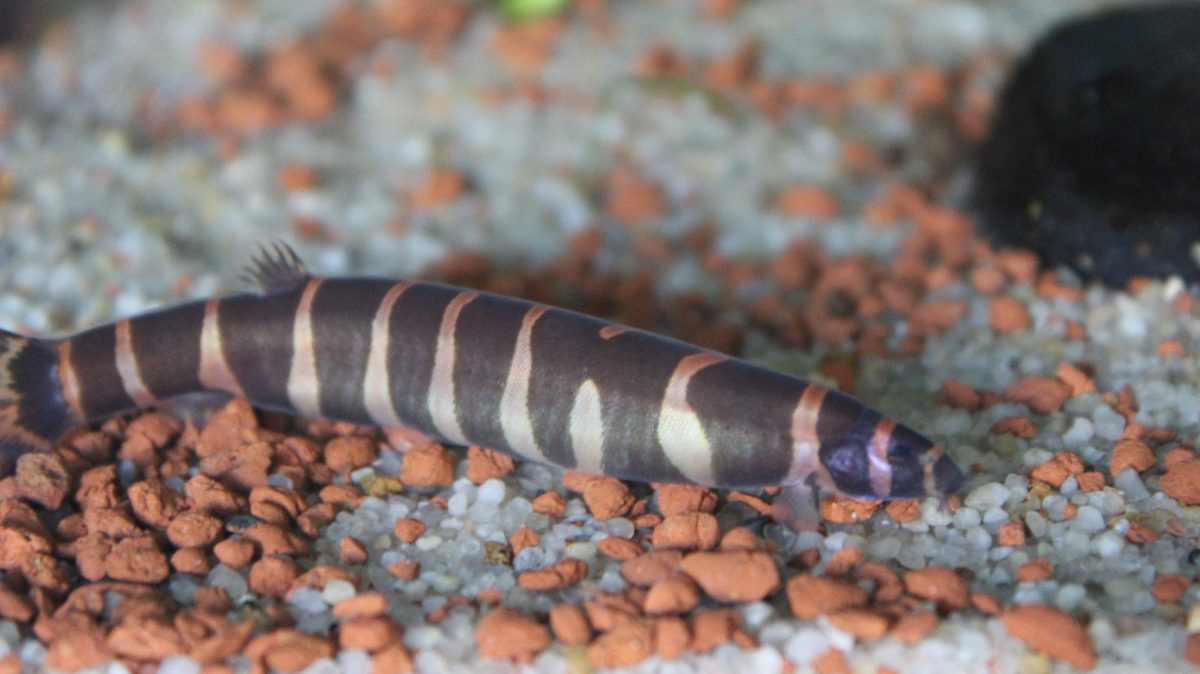
A loach sold as a snake-like fish and then not seen for weeks. It needs sand, soft water, a tight lid and food after lights out.
| Temperature | 22–26 °C (72–79 °F) |
|---|---|
| pH | 5.5–7.0 |
| Hardness | 1–8 °dGH |
| Volume | from 50 l (13 gal) |
| Size | up to 12 cm (4.7 in) |
| Lifespan | 8–10 years |
What it is and where it comes from
The kuhli loach (Pangio kuhlii) is a loach from South-East Asia, named after the German zoologist Heinrich Kuhl (1797–1821). It lives in shallow forest streams, oxbows and peat swamps with a thick layer of fallen leaves on the bottom.
One confusion is worth knowing. On current evidence the true P. kuhlii lives only on Java and almost never reaches the trade. Most of what is sold as a kuhli loach is Pangio semicincta from Malaysia, Sumatra and Borneo. For care the difference is small, but it matters in arguments about species.
Housing and conditions
Temperature 22–26 °C. Some sources say 24–28, others 21–26, the spread coming from aquarium lines living in warmth for generations. Above 28 °C is too much.
pH 5.5–7.0, hardness 1–8 °dGH. Soft, slightly acidic water, ideally with leaf litter or alder cones that tint it. In hard water the fish survives but does less well.
Volume 50–60 l for a group of 5–6. A lone loach hides and barely shows itself; in a group it gets bolder and comes out by day. To see how many fit your tank, use the calculator.
Substrate: fine sand only, 4–5 cm deep. The fish will not bury in gravel, and sharp edges tear its skin. Weak current, dim light, plenty of cover from driftwood and moss. Cover the tank: the loach jumps and squeezes through gaps. A sponge on the filter is essential, or it ends up in the impeller.
Feeding
A nocturnal bottom predator: small sinking tablets, bloodworm, brine shrimp, daphnia, microworms. Feed after lights out, or the fast tank mates eat everything first.
Overfeeding looks like a loach gorging at a tablet and then lying still. Uneaten food rots in the sand while the fish roots through it around the clock. A portion should go in 10–15 minutes; net out leftovers.
Lifespan
8–10 years, a lot for a fish this size. It depends on temperature and on how clean the sand is, since the loach spends half its life in it. In cool water it lives longer but grows slower.
Temperament and tank mates
Utterly peaceful and indifferent to tank mates. The problem is not aggression but size: any predator over 10 cm sees a worm.
Good tank mates: small tetras, rasboras, cardinal tetras, corydoras, otocinclus, shrimp. Not: cichlids, large catfish, loaches, goldfish, crayfish and crabs. A bristlenose pleco is not ideal either: they compete for cover.
Diseases
- Skin injuries. Torn patches and redness. Sharp gravel is usually the cause, and a body without scales gets infected fast.
- Ich. Grains on the body. It is sensitive to medication, so the dose goes down, and salt is out in a community tank.
- Getting stuck in the filter. A missing fish turns up in the sponge or the pipe, often already dead.
- Emaciation. Sunken body, thin neck: competition for food, as by day the loach stays hidden and at night a tablet is gone before it arrives.
A vet makes the diagnosis; blind antibiotic treatment does harm.
Breeding
Almost never managed at home. Tetra states that without hormone injections you will not get many fry, and Seriously Fish notes no confirmed reports of spawning in an aquarium. The routine described: a spawning tank 15–20 cm deep, soft acidic water, a grid on the bottom, up to 700 eggs, larvae in 3–4 days. Few people take that on.
Who it suits
A beginner, with caveats: the water is simple, but sand, evening feeding and a protected filter are needed from day one. 50–60 l for a group of 5–6. The main drawback: you barely see it by day, and beginners spend months thinking it died. On the other hand it never quarrels with anyone and lives up to 10 years.
Calculator
The calculator takes your dimensions and works out glass, weight, stand and doses.
Open the calculator