
Pufferfish
A puffer with a beak instead of teeth, which needs snails and a tank of its own. Why it is dangerous, and why it is no fish for a beginner.
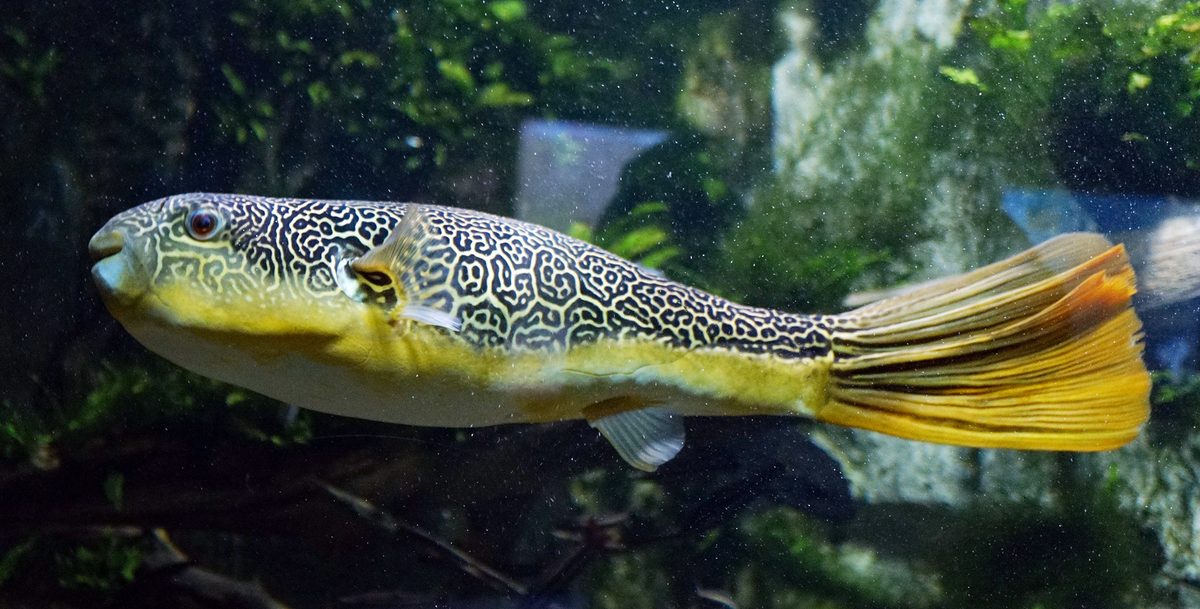
| Temperature | 24–28 °C (75–82 °F) |
|---|---|
| pH | 7.5–8.5 |
| Hardness | 10–20 °dGH |
| Volume | from 100 l (26 gal) |
| Size | 3.6–67 cm (1.4–26 in), by species |
| Lifespan | up to 10 years |
What it is and where it comes from
Tetraodons, or puffers, are a genus of ray-finned fish in the family Tetraodontidae. They live in the fresh waters of Africa; the Asian species went in a 2013 revision to Dichotomyctere, Leiodon and Pao. In the trade "tetraodon" usually means the green puffer (Dichotomyctere nigroviridis, formerly Tetraodon nigroviridis) and the figure-8 puffer, while the true Tetraodon are the fahaka, the mbu, the redeye (or Congo) and the leopard. The name combines Greek "tetra" (four) and "odon" (tooth).
The mouth is a beak of two bony plates, hence "four-toothed". Sizes in the genus run from 3.6 cm in T. waandersii to 67 cm in the mbu. The tissues of many puffers accumulate tetrodotoxin, which blocks nerve signals and paralyses muscle: the fish must not be eaten, and hands are washed after cleaning the tank.
Housing and conditions
Conditions depend on the species, and that is the point. For the green puffer: 100–150 l per fish, 24–28 °C, pH 7.5–8.5, hardness 10–20 °dGH, salinity about 1.005. Juveniles tolerate fresh water; adults need it salted.
Fahaka and mbu grow large, wanting hundreds of litres and strong filtration. Moderate flow, driftwood and stone cover, sand substrate, floating plants for shade. A lid is essential, since puffers jump. Water must be clean, 20% changed weekly. Raise the salt gradually, at the next water change, never all at once. The volume for a given species is estimated in the calculator.
Feeding
Predators on live and frozen food: snails, bloodworm, brine shrimp, shrimp, mussels; many ignore dry food. Snails are obligatory: the beak grows constantly, and without shells it overgrows until the fish stops eating.
Feed once a day, a portion eaten in a couple of minutes. Overfeeding is dangerous in puffers: they have no sense of measure, the belly swells, the fish lies on the bottom, the water fouls fast. Underfeeding is the safer error.
Lifespan
Up to 10 years is quoted for the green puffer. Reliable figures for the large species are scarce and the data disagree; in a tank the span is often shorter through mistakes with food and water. The beak and the water quality matter as much as volume.
Temperament and tank mates
Solitary and territorial. In a community tank they nip fins, hunt small fish and eat snails and shrimp, so keep them alone or with sturdy fish of similar size that take brackish water.
Not with veil-finned or slow fish. With their own kind only in a large tank with cover, and even then without guarantees. Shrimp and snails do not live in a puffer tank.
Diseases
Ich. White spots, rapid breathing, scuffs. Treat in quarantine with antiparasitics, following the instructions.
Overgrown beak. The fish cannot close its mouth and takes only soft food. Snails prevent it; an advanced case needs a vet.
Overfeeding and obesity. A swollen belly, lethargy, no appetite. A fasting day and smaller portions, though a badly overfed fish dies.
Bacterial ulcers. Red spots and ragged fin edges. Clean water and antibacterials on a vet's instruction.
A vet makes the diagnosis; guessing with antibiotics does harm.
Breeding
Rarely bred. Sex is not obvious in many species, so the pair is chosen from a group of young fish. A spawning tank with brackish water and flat stones, incubation about a week, the male on guard. The fry take nauplii and are hard to raise, so breeding stays with experienced keepers.
Who it suits
Not for a beginner: a species tank from 100 l, live food, snails and a willingness to remove large waste. Minus points: aggression, jumping, poison in the tissues, beak trouble. Plus: it learns its owner, hunts in a way worth watching and lives long. Keep one only if you are ready for a dedicated tank and a steady supply of snails. If you want a fish for a community tank, a puffer is not it.
Calculator
The calculator takes your dimensions and works out glass, weight, stand and doses.
Open the calculator