
Angelfish
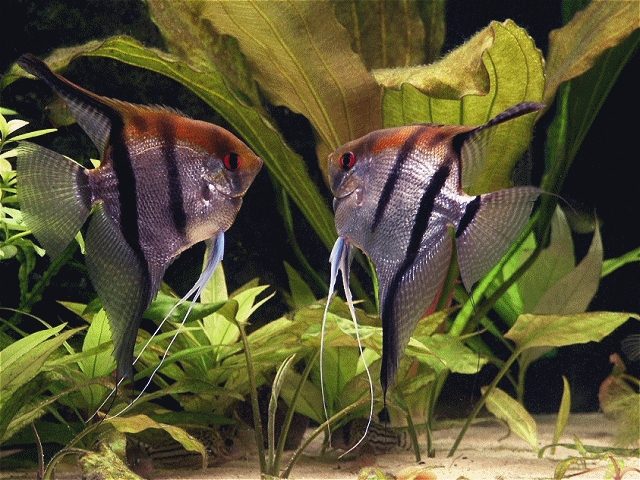
An angelfish grows larger than it looks in the shop and needs a tall tank. A pair in 100 litres will live a dozen years if you keep it away from small fish.
| Temperature | 24–28 °C (75–82 °F) |
|---|---|
| pH | 6.0–7.5 |
| Hardness | 5–15 °dGH |
| Volume | from 100 l (26 gal) |
| Size | up to 15 cm (6 in) |
| Lifespan | 8–10 years |
What it is and where it comes from
The common angelfish (Pterophyllum scalare) comes from the Amazon basin, the Rio Negro and neighbouring blackwater rivers. It keeps to slow backwaters among driftwood and flooded roots, where its flat body slips between branches. The dorsal and anal fins are long and almost symmetrical, the ventral fins are thin feelers. It reaches 15 cm (6 in), and with the fins stands almost 30 cm (12 in) tall, so a narrow tank does not suit it.
Lichtenstein described the species in 1823. It reached Europe in 1909, and breeding since has produced gold, black, marble and veil forms.
Housing and conditions
Temperature 24–28 °C, pH 6.0–7.5, hardness 5–15 °dGH. Volume from 100 l (26 gal) per pair, with a water column of at least 50 cm (20 in), because the fish grows upward. A group of 4–6 needs 300–400 l (80–105 gal).
A high-capacity filter with a moderate current. Diffused light, 8–10 hours. Broad-leaved plants, driftwood, dark substrate. Angelfish nibble tender leaves and small tank mates can become dinner, so choose tough-leaved plants. Work out your volume in the calculator.
Feeding
Flakes and cichlid pellets, plus bloodworms, brine shrimp, shrimp and pieces of fish. Plant matter is essential: spirulina, blanched spinach, zucchini. Feed once or twice a day, a portion eaten in five minutes.
Overfeeding leads to obesity and hexamita. There should be no convex belly after a meal, and if the fish lies on the bottom and refuses food, check nitrates and temperature. Do not overdo tubifex: fish get fat and stop breeding.
Lifespan
8–10 years, and some individuals reach 12–15. Time depends on volume: in a cramped tank the fish grows slowly and lives less. Above 30 °C and with high nitrates, life shortens.
Temperament and tank mates
A peaceful cichlid that turns territorial when spawning. Tank mates: corydoras, large tetras, rasboras, gouramis, small catfish. Not with neons and guppies, which it eats, nor shrimp, aggressive cichlids or goldfish.
Angelfish are kept as a pair or a group in which pairs form later. During spawning the pair drives everyone off the eggs and may bite its neighbours.
Diseases
The angelfish is hardy, but five diseases turn up regularly.
- Ich. White spots, the fish scratches itself and breathes fast. Raise the temperature to 28–30 °C and follow the remedy dose.
- Hexamita. White thread-like droppings, a sunken belly, refusal to feed. Metronidazole on a schedule set by a vet.
- Fin rot. Fins become ragged and a white edge forms. Clean water and antibacterial remedies help.
- Hole in the head. Pits and erosions on the head, and the fish loses appetite. Linked to poor water and vitamin shortage; a vet chooses the treatment.
- Dropsy. Scales stand out, the belly swells, the eyes bulge. The outlook is usually poor, and without a vet the fish dies.
A vet makes the exact diagnosis; blind antibiotic treatment does harm.
Breeding
A pair forms out of a group of young fish. Spawning tank 60–100 l at 28–30 °C, pH 6.0–6.5, with an upright leaf or a piece of slate. The female lays 150–200 eggs and the parents tend the clutch. Larvae hatch in 3–5 days, and the fry swim a few days later. The young mature at 8–12 months.
The difficulty is choosing a pair, and young parents often eat the first clutch. Sometimes the eggs are incubated separately, taken off the substrate.
Who it suits
The angelfish is not for a first aquarium. It needs 100 l or more, a tall tank, stable temperature and a varied menu. It is large, eats small livestock and tolerates high nitrates badly. On the other hand, it lives long, recognises its owner and becomes the centre of the composition.
Calculator
The calculator takes your dimensions and works out glass, weight, stand and doses.
Open the calculator