
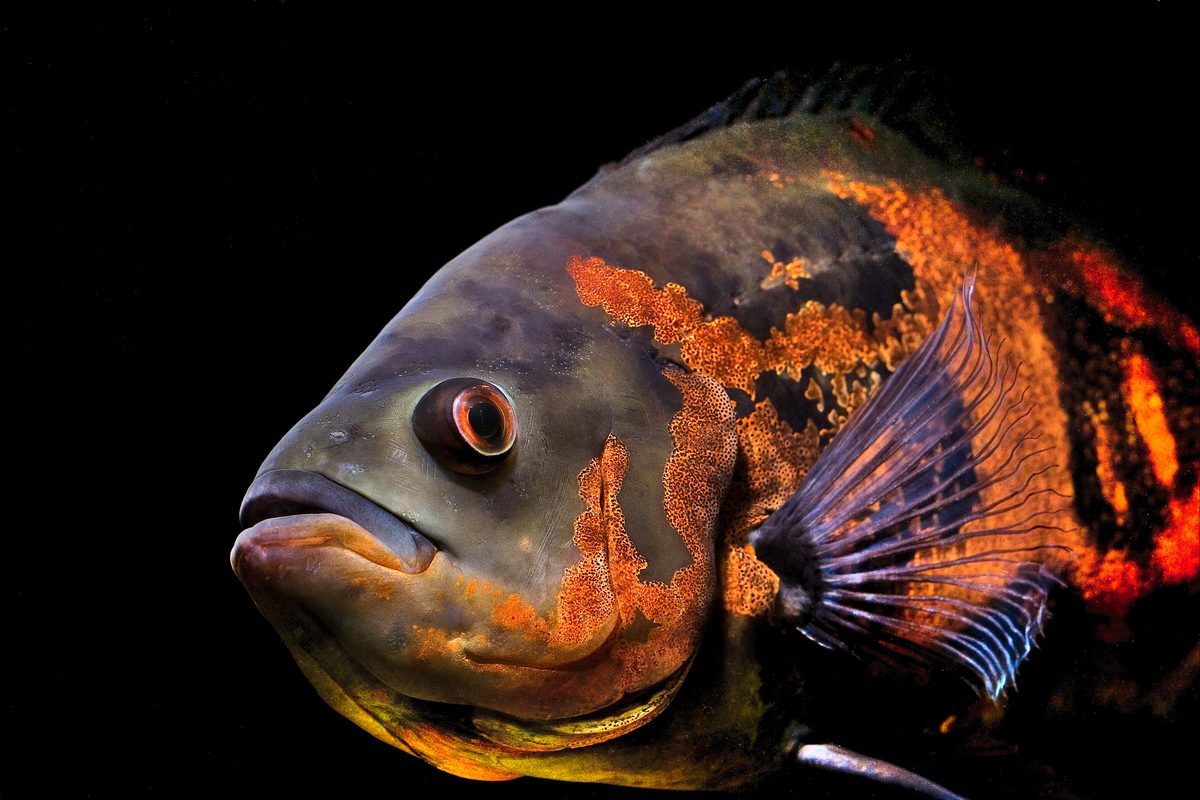
Oscar
An oscar grows to 35 cm and lives up to 20 years, so it is worth buying only for a big tank. What it actually needs.
| Temperature | 22–28 °C (72–82 °F) |
|---|---|
| pH | 6.0–7.5 |
| Hardness | 5–19 °dGH |
| Volume | from 400 l (106 gal) |
| Size | up to 35 cm (14 in) |
| Lifespan | 10–20 years |
What it is and where it comes from
The oscar, Astronotus ocellatus, comes from the Amazon basin, from Colombia and Venezuela down to Argentina, in the Ucayali, Madeira, Rio Negro, Orinoco and a dozen other rivers. It stays in the shallows near the bank among flooded roots, away from current.
Louis Agassiz described it in 1831 as Lobotes ocellatus, named for the eye spot on the caudal peduncle. Breeders have since produced tiger, red, albino and longfin forms. Almost all fish on sale are farmed in Eastern Europe and South-East Asia, and wild ones are rarely caught. Farmed oscars take a wider range of hardness than imported ones.
Housing and conditions
An adult pair needs 400 l, at least 150 cm long. In a 120 cm tank it can barely turn and hits the glass.
| Parameter | Value |
|---|---|
| Temperature | 22–28 °C |
| pH | 6.0–7.5 |
| Hardness | 5–19 °dGH |
| Volume | from 400 l per pair |
| Size | up to 35 cm |
| Lifespan | 10–20 years |
Pick a filter turning over 4–5 tank volumes an hour: two large cichlids make a lot of waste. Change 30–50% a week and vacuum the substrate. Weak current, dim light. Coarse gravel or sand: the oscar digs constantly. It tears out plants; anubias on driftwood can survive. Hide the heater behind decor: the fish breaks glass tubes. Volume and weight are easy to check in the calculator.
Feeding
A predator. In the wild it eats fish, insects, prawns and fruit falling in the water. In the tank, high-protein cichlid pellets plus bloodworm, prawn, earthworm and pieces of white fish. Feed once a day, at most twice; the portion should go in 3–4 minutes.
Overfeeding is obvious at once: a swollen belly, a fish standing near the bottom, no appetite next morning, pieces rotting in the water. Then come obesity, fatty liver and a short life. Beef heart and chicken are out, as oscars cannot digest the fat. Live guppies are a poor idea too, since parasites come with them.
Lifespan
10–20 years. In a cramped tank with rare water changes it rarely reaches 10; in 400–500 l with proper filtration it lives far longer. Longfin forms are weaker.
Temperament and tank mates
Calm for its size, but the mouth is big: a tank mate must be larger or faster. It gets on with sailfin plecos, synodontis, silver dollars, severums and large Cichlasoma, and eats neons, guppies, small barbs and shrimp.
Malawi mbuna is a bad match, with different water and temperament. Territory fights start before spawning, so the pair is better moved out.
Diseases
Ich. White spots on body and fins, the fish rubs against stones. Raise the temperature a couple of degrees, increase aeration, use an antiparasitic per the label.
Hexamitiasis. White stringy faeces, refusal to feed, sunken belly, later pits in the head. Do not treat without a water test and a vet's prescription.
Bacterial infection. Torn fins with white edges, red ulcers, cloudy eyes. Test for ammonia and nitrite first, change water, then treat.
Injuries. A fright, a dash, a hit against the glass, a jump out of the tank. A lid and decor without sharp edges prevent it.
A vet makes the diagnosis; blind antibiotic treatment does harm.
Breeding
A pair forms out of a group of young fish and often stays for life. The male is larger, the female shows an ovipositor before spawning. They lay up to 2000 eggs on a flat stone, clean it together, then guard clutch and fry. Raising that many young at home is unrealistic: it takes volume, food and time.
Who it suits
Not a beginner. It needs 400 l, a strong filter and a weekly water change. The fish lives 12–15 years; a move is stressful. Drawbacks: the size and the debris after every meal. Then again, an oscar recognises its owner and takes food from your fingers. More on fish and equipment is in the reference.
Calculator
The calculator takes your dimensions and works out glass, weight, stand and doses.
Open the calculator