
Marbled crayfish
The marbled crayfish breeds without a partner and leaves tanks easily. Here are volume, cover, feeding and the legal limits on keeping it.
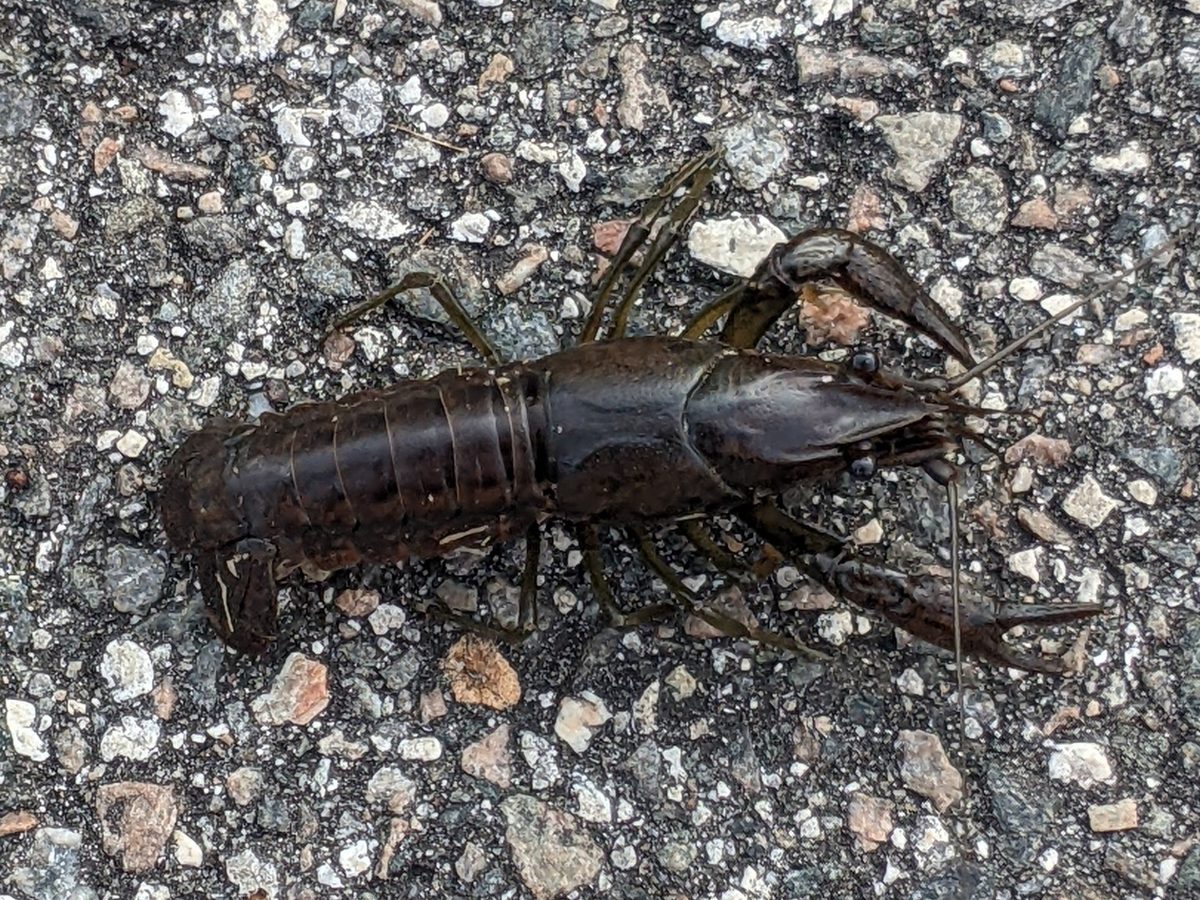
| Temperature | 20–26 °C (68–79 °F) |
|---|---|
| pH | 6.5–7.5 |
| Hardness | 6–15 °dGH |
| Volume | from 60 l (16 gal) |
| Size | up to 12 cm (4.7 in) |
| Lifespan | 3–5 years |
What it is and where it comes from
The marbled crayfish was long listed as a form of the Florida Procambarus fallax, then described in 2017 as a separate species, Procambarus virginalis. It appeared in the hobby in Germany in 1995, which gave it the German name Marmorkrebs.
Breeding is the odd part: every individual is female and the offspring a genetic copy of the mother. The crayfish is triploid, parthenogenesis is its only way to continue the line, and the whole world population descends from one individual that appeared around 1988. From aquariums it spread into wild waters of Europe, Asia and Africa, and in the EU it has been on the invasive list since 2016, with keeping, transport and sale banned.
Housing and conditions
Temperature 20–26 °C, pH 6.5–7.5, hardness 6–15 °dGH. In soft water moulting goes harder, so GH is not allowed below 6.
Volume from 60 l per crayfish, 80–100 l for a pair with offspring. Floor area matters, not height, since a crayfish crawls and does not swim. Any substrate except sharp, and two or three pieces of cover per individual: ceramic tubes, pots, coconuts, driftwood.
A filter with a sponge on the intake, and aeration around the clock. A lid and no gaps: the crayfish climbs hoses and cables, escapes through a pipe cutout and dries out on the floor within hours. One that dried but still moves goes back into water in a separate container.
Feeding
Omnivorous. The base is sinking crustacean granules, vegetables (courgette, carrot, potato) and lettuce leaves. It really eats the plant part rather than spoiling it: elodea, hornwort and duckweed disappear completely. Protein once a week, as a piece of fish or shrimp.
At night the crayfish hunts fish, catching slow and small ones, especially those sleeping near the bottom. Overfeeding shows as cloudy water and scattered leftovers, because it tears food apart and drops what it does not finish.
Lifespan
3–5 years. Females carrying eggs live less, spending energy on offspring that appears every few months.
Temperament and tank mates
Aggressive and territorial. The big claws are for fighting, not for eating: in a cramped tank crayfish tear limbs off each other, though those grow back after a moult.
It cannot be kept with cherry shrimp, Amano shrimp or slow fish, since anything smaller that cannot swim away becomes food. Snails get eaten too. Of the fish, only mobile medium species living in open water suit.
Problems
- Crayfish plague. It looks healthy but carries Aphanomyces astaci, the agent of crayfish plague, lethal to river crayfish. Water from the tank must not be poured into waterways.
- Failed moult. The crayfish gets stuck in the old shell or comes out with deformed claws, from low GH and too little calcium.
- Copper poisoning. Convulsions, loss of coordination, death. Copper comes from medicines and from tap water.
- Drying out. The crayfish climbed out and dried. Its gills sit in a moist chamber, and in dry air it does not last long.
A specialist makes the exact diagnosis, but with invertebrates moving the animal into clean water and fixing the parameters is usually easier than treating blindly.
Breeding
No partner needed. The female lays 50–100 eggs and carries them under the abdomen for 3–5 weeks, and the young that emerge are 2–3 mm and look like adults. In six months they produce offspring themselves and the tank fills within a year. There is usually nowhere to give the young away, so breeding should be deliberate, and releasing the crayfish into the wild is not allowed.
Who it suits
An aquarist who knows what to do with a hundred juveniles and is ready to keep a single species without tank mates. It needs 60 l or more, a lid with no gaps and constant cleaning. Drawbacks: aggression, escapes and its legal status in Europe. The plus: offspring are guaranteed even from one individual.
Calculator
The calculator takes your dimensions and works out glass, weight, stand and doses.
Open the calculator