
Blood parrot cichlid
The blood parrot was created by people and does not exist in the wild. It is hardy and peaceful, but its small mouth and its appetite need watching.
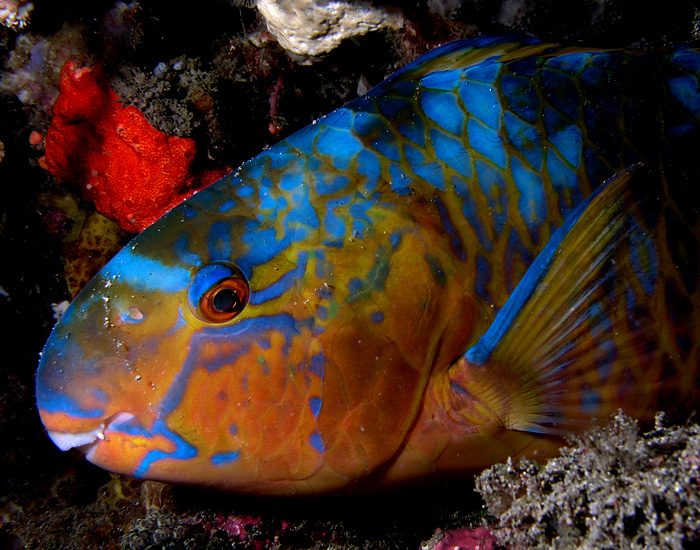
| Temperature | 24–28 °C (75–82 °F) |
|---|---|
| pH | 6.5–7.5 |
| Hardness | 5–20 °dGH |
| Volume | from 200 l (53 gal) |
| Size | up to 25 cm (10 in) |
| Lifespan | 8–12 years |
What it is and where it comes from
The blood parrot cichlid does not exist in the wild. It is a hybrid of South American cichlids bred in Taiwan: English Wikipedia gives 1986, Russian sources the early 1990s. The exact parentage is kept secret; the names mentioned most often are Amphilophus labiatus, A. citrinellus and various Cichlasoma species.
Hybridisation changed the fish's build: the body is rounded, the mouth is small and does not close fully, the spine is curved and the swim bladder is altered. So the parrot swims awkwardly and could not survive in the wild.
Housing and conditions
Temperature 24–28 °C (75–82 °F). Tetra gives 25–28, handbooks 24–28; the difference is small, but in cool water the fish gets sick more often.
pH 6.5–7.5, hardness 5–20 °dGH. Change 20–30% a week and filter hard, since the fish is big and produces a lot of waste.
Volume from 200 l (53 gal) for a pair or a small group. A lid is essential, as parrots jump out. Substrate sand or large rounded gravel, decor of driftwood and cover: in a bare tank the fish gets nervous. Moderate light with plenty of red, because under blue light the parrot looks washed out. Plants only tough-leaved and anchored, or they get dug up. Moderate current: the parrot swims poorly and tires in a strong flow.
Feeding
The mouth is built so the fish cannot take a large piece. Slow-sinking cichlid pellets, softened flakes, finely chopped prawn and bloodworm suit it. Feed 2–3 times a day in small portions and watch that the fish actually gets enough.
Overfeeding is common with parrots: they beg and have a poor sense of when to stop. Signs: a heavy belly, the fish lying on the bottom or swimming on its side. The risks are obesity and swim bladder trouble, and the hybrid's bladder is already altered.
Lifespan
8–12 years. Tetra says 10–12, aquarium handbooks 8–10. The spread is honest: it depends on feeding and volume, and obesity is more common in this hybrid than in wild cichlids.
Temperament and tank mates
Peaceable and even timid for its size. It hides in cover, recognises its owner and comes to the front glass. Aggression turns up in individual fish and in a pair when spawning.
Tank mates: calm cichlids of a matching size, large catfish, bala sharks, rainbowfish, angelfish. Small fish and shrimp become food. Aggressive territorial cichlids will chase the parrot, and it will not fight back.
Diseases
- Obesity. The most frequent problem. A heavy belly, little movement, fast breathing.
- Swimming trouble. The fish hangs at the surface or lies on the bottom. It is linked to the altered swim bladder and to overfeeding.
- Fight injuries. Grazes on the sides and lips, usually from more aggressive tank mates.
- Ich. Grains on the body after moving or after cold water.
A vet makes the exact diagnosis, and blind self-treatment with antibiotics does harm.
Breeding
You will not get offspring at home, as males of the hybrid are sterile. A pair still spawns, digs a pit or cleans a stone and guards the clutch, but the eggs turn white within days and get eaten. There are isolated cases where a male of a closely related Cichlasoma fertilised the eggs and the fry survived. All parrots on sale come from farms in South-East Asia.
Who it suits
For a beginner with a big tank: the fish is hardy, needs no special water chemistry and is barely aggressive. It needs 200 l or more, a lid and an external filter. Drawbacks: a tendency to obesity, no breeding and the ethical question. Many fish are sold artificially dyed, and those are better left in the shop. Other species profiles are collected in the reference.
Calculator
The calculator takes your dimensions and works out glass, weight, stand and doses.
Open the calculator