
Ramshorn snail
A ramshorn arrives with plants and breeds without a partner. Here is when it is useful, why it fills the tank and how to keep it in check.
| Temperature | 18–26 °C (64–79 °F) |
|---|---|
| pH | 7.0–8.0 |
| Hardness | 8–20 °dGH |
| Volume | from 10 l (2.6 gal) |
| Size | up to 3.5 cm (1.4 in) |
| Lifespan | 1–2 years |
What it is and where it comes from
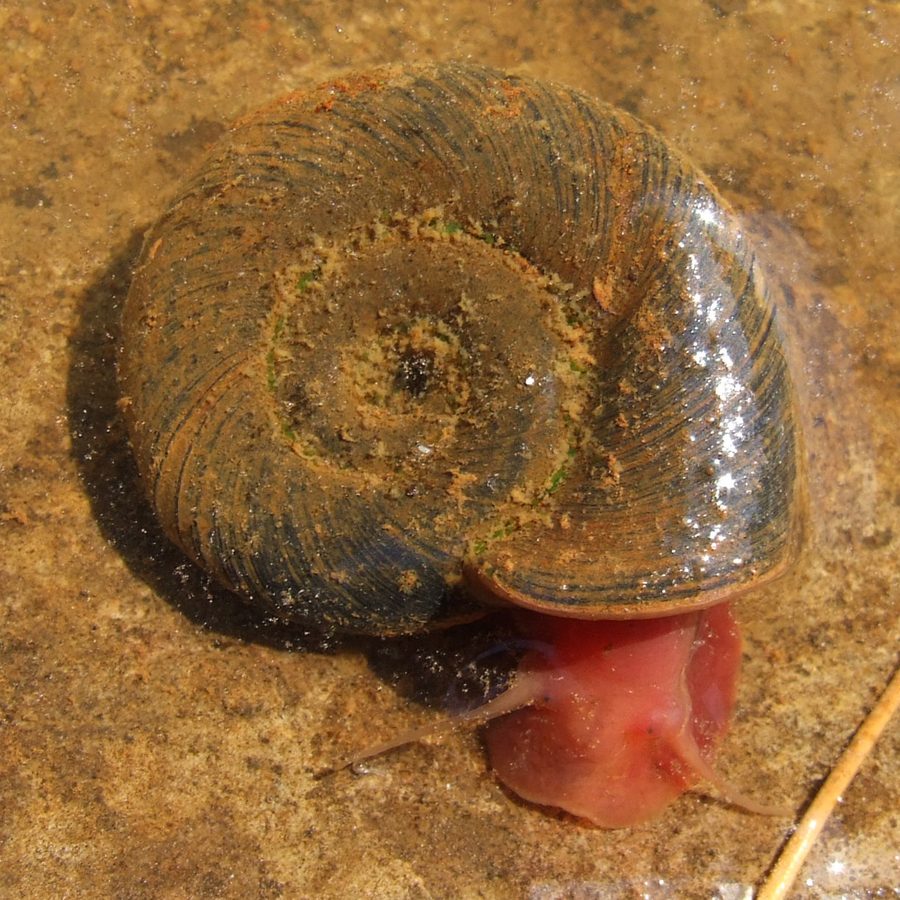
Planorbarius corneus, the great ramshorn, lives across most of Europe, in western Asia and Siberia: ponds, oxbows, ditches, slow rivers. Its shell is coiled in a flat spiral up to 35 mm across, with 5–5.5 whorls in adults.
It has been in the hobby a very long time and is usually treated as a weed rather than a pet. It arrives with plants: a clutch or juveniles come in on a leaf and fill the tank within a month. Buying one is hard, since people give them away.
Housing and conditions
Temperature 18–26 °C (64–79 °F), though the snail takes cold water and short overheating too. pH 7.0–8.0, hardness 8–20 °dGH. In soft acidic water the shell loses calcium fast and breaks down.
Volume from 10 l (2.6 gal), and nothing special is required. It breathes atmospheric air through a siphon and lives with weak aeration, and its blood carries haemoglobin, so low oxygen is tolerated. Light and substrate do not matter; plants are desirable as pasture and a place to lay.
A filter is better with a sponge: juveniles get sucked into the impeller, the main reason ramshorns barely grow in a filtered tank. A lid is not needed, but it keeps snails from drying on the glass.
Feeding
Algae, detritus, leftover fish food, rotting leaves. No special feeding is needed, but when food runs short the snails switch to living plants and punch holes in tender leaves.
Overfeeding looks like a population spike: a dozen snails on the glass after every fish feeding. Excess organic matter is the reason there are too many, so what you remove is the cause, not the snails.
Lifespan
Usually a year or two, while in an aquarium some individuals reach four and even six. The spread between sources is wide because in the wild the cycle is annual, and in warmth with food the snail lives longer.
Temperament and tank mates
Harmless and slow. It is compatible with any fish except loaches, puffers and large cichlids that crunch the shell. Shrimp and other snails coexist calmly, and the only competition is for food.
A ramshorn does not get along with Helena: the predator eats one snail in a few days, but one Helena is not enough for a hundred ramshorns. Helena is still the standard answer to overpopulation, except that afterwards the tank holds a hungry predator that also needs feeding.
Problems
- Shell erosion. The tip whitens and thins, from soft water and acidic pH. Raising hardness and calcium in the food helps.
- Fungus on the shell. White fluff on chips. The snail moves to clean water; organic matter comes out of the main tank.
- Copper poisoning. Snails retract and die, often after fish treatment. For molluscs copper is lethal in small doses.
- Overpopulation. Not a disease but a result of overfeeding: hundreds of snails, cloudy water and rising nitrates. The answer is less food, hand collection and a predatory snail.
A specialist makes the exact diagnosis, but with invertebrates it is usually easier to move the animal into clean water and fix the parameters than to treat blindly.
Breeding
The ramshorn is a hermaphrodite, no partner is needed and one individual is enough. A transparent pad 12 by 8 mm is glued to the glass, a stone or a leaf, and after two to three weeks snails the size of a poppy seed come out. Numbers can only be controlled with food and by collecting clutches, since an adult lays eggs every few weeks.
Who it suits
A beginner who understands the snail cannot be removed again. In a big tank with moderate feeding it is useful, grazing algae and carrion. In a small shrimp tank it quickly becomes a problem. The one-year lifespan and a shell that dissolves in soft water do not flatter it either.
Calculator
The calculator takes your dimensions and works out glass, weight, stand and doses.
Open the calculator