
Cuban crayfish
A Cuban crayfish turns blue by its second year, but it climbs out of the tank and eats plants. Here are volume, cover, feeding and the moult.
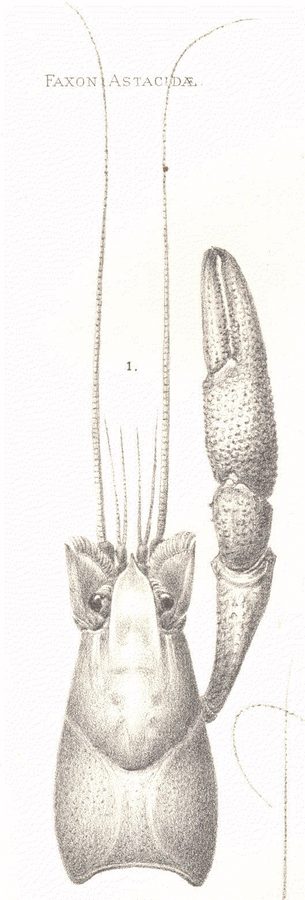
| Temperature | 24–26 °C (75–79 °F) |
|---|---|
| pH | 7.0–7.6 |
| Hardness | 8–12 °dGH |
| Volume | from 60 l (16 gal) |
| Size | up to 12 cm (4.7 in) |
| Lifespan | about 3 years |
What it is and where it comes from
Procambarus cubensis lives in Cuba, in small lakes, ponds and streams with clean warm water, hiding in flooded roots and under driftwood. It reached Europe and the USSR in 1980 and became one of the first aquarium crayfish.
Adults are blue, hence the second name, the blue Cuban crayfish. Juveniles are grey and plain, and the full colour comes by eighteen months to two years, depending on feeding and water parameters. It is not a large crayfish, rarely growing past 12 cm in an aquarium.
Housing and conditions
Temperature 24–26 °C, pH 7.0–7.6, hardness 8–12 °dGH. Water that is too soft makes the shell hard to build, so GH is not allowed below 6.
Volume at 20–30 l per individual, 100 l for a small group. Floor area counts, water depth is secondary. Substrate coarse sand or fine gravel, and the more cover the better: pots, tubes, coconuts, caves. Hiding places are needed for rest and during the moult, when the crayfish is soft and defenceless.
Filtration and aeration must be good, with 20 % water changes weekly. Driftwood is placed so it sticks slightly out of the water but gives no way out. A lid is mandatory, since the crayfish climbs hoses, and without water it dies within hours as the gills dry out.
Feeding
Omnivorous. Sinking granules for crustaceans and catfish, bloodworm, tubifex, pieces of fish, vegetables. The plant part is essential, because without it the crayfish starts nibbling the plants. Fine-leaved species it eats quickly, so echinodorus, cryptocorynes and anubias with tough leaves are planted, roots covered with stones.
At night the crayfish hunts fish, and that is no myth: a sleepy fish near the bottom is caught with the claws. Overfeeding shows as cloudy water and leftover food scattered around the tank.
Lifespan
About three years, with some individuals reaching four or five. In cool water the crayfish grows slower and lives longer.
Temperament and tank mates
Males fight over territory and females, raise their claws, and in a cramped tank it comes to torn limbs. A limb regrows after a moult, but not at once.
A species tank with a group of crayfish works best. With fish, only mobile medium species are possible: barbs, rainbowfish, mollies. Cherry shrimp and slow fish are out, because the crayfish eats them. Large aggressive fish are dangerous to the crayfish itself, especially at a moult.
Problems
- Failed moult. The crayfish cannot shed the old shell, gets stuck and dies, from low GH, too little calcium and dirty water.
- Fungus on the shell. A white or brown coating on chipped areas. The crayfish is moved out, the water cleaned, and the damage treated as the product instructions say.
- Bacterial infection. Listlessness, refusal to feed, dark spots on the shell. Quarantine and cleaning help, and antibiotics are not poured in without a diagnosis.
- Copper poisoning. Convulsions, loss of balance, death. Copper comes from medicines and from tap water.
A specialist makes the exact diagnosis, but with invertebrates moving the animal into clean water and fixing the parameters is usually easier than treating blindly.
Breeding
Dioecious, and the male shows a narrower abdomen and longer claws. Sexual maturity comes at around six months. The female carries black eggs about 2 mm under the abdomen, and after three to five weeks young 2–3 mm come out. For the first week they stay near the mother, then scatter. At six to eight weeks they are sorted by size, or the larger eat the smaller.
Who it suits
A beginner who wants a crayfish in a tank of its own: it is hardy, breeds on its own and needs no sea. 60 l is enough for one, and a group needs more. Drawbacks: escapes, night hunting for fish and mandatory cover. If the tank is a community with shrimp, this crayfish is not the one.
Calculator
The calculator takes your dimensions and works out glass, weight, stand and doses.
Open the calculator