
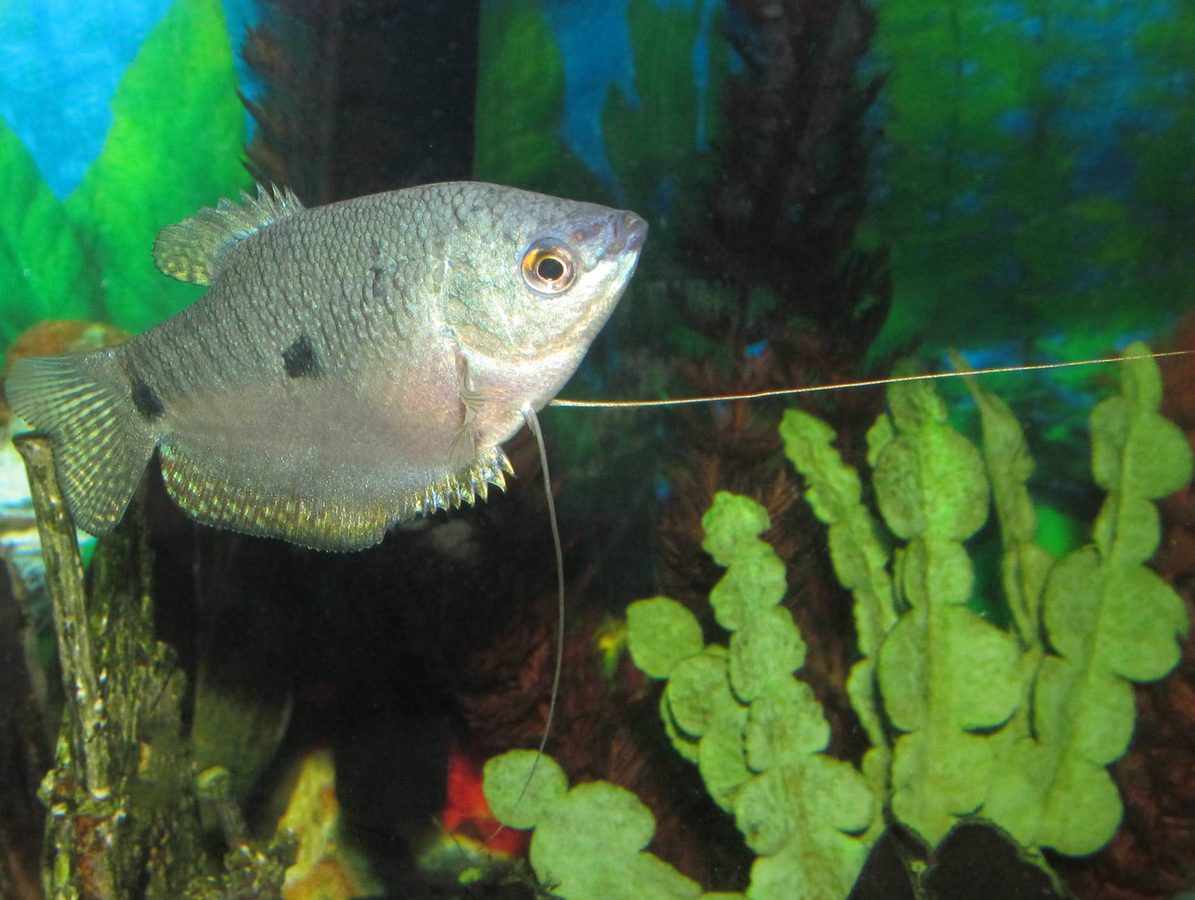
Three spot gourami
A large labyrinth fish that forgives mistakes with water but turns into a bully with age. It lives for years and stays in view.
| Temperature | 24–30 °C (75–86 °F) |
|---|---|
| pH | 5.5–8.5 |
| Hardness | 3–35 °dGH |
| Volume | from 80 l (21 gal) |
| Size | up to 15 cm (6 in) |
| Lifespan | 4–6 years |
What it is and where it comes from
The three spot, or blue, gourami (Trichopodus trichopterus) comes from Southeast Asia: the Mekong basin and the slow waters of Cambodia, Laos, Thailand, Vietnam, Malaysia, Sumatra, Java and Borneo. It keeps to swamps, canals, oxbows and flooded fields, moving into the floodplain in the rainy season and back to permanent water in the dry one. Wild fish are silver grey with two dark spots, which with the eye make three, hence the name.
In aquariums bred forms are commoner: marble, blue, gold, platinum, lavender. All descend from one species and cross with each other. Wild fish are almost never sold, and the trade stock is farmed in Southeast Asia and Eastern Europe.
Housing and conditions
Temperature 24–30 °C, pH 5.5–8.5, hardness 3–35 °dGH. It is among the most adaptable species, but steady values matter more than correct ones: a three-degree jump is harder than life at an unusual yet stable 26 °C.
Volume from 80 l (21 gal) per pair, as an adult reaches 15 cm (6 in) and 40 l is cramped. Weak current, ordinary filtration, aeration desirable, though the labyrinth organ allows air breathing. Diffused light, dense plants with open space to swim. Dark fine substrate, since on light ground the fish pales. A lid is needed: the gourami jumps out.
Feeding
Omnivorous: flakes with plant matter, frozen bloodworms, tubifex, brine shrimp, daphnia. Feed once or twice a day, a portion eaten in a couple of minutes, with one fasting day a week, since labyrinth fish tend to obesity and a full stomach presses on the swim bladder.
Overfeeding shows in a swollen belly; the fish hangs at the surface or lies on the bottom. Then the water spoils, food rots, ammonia rises, and the gourami is poisoned faster than it can get hungry.
Lifespan
Usually four to six years, and large fish that survive year one reach eight. Time depends on temperature, volume and whether the fish was fed to death. Cool water slows metabolism and ageing, but constant below 22 °C is not worth it.
Temperament and tank mates
Young gouramis are peaceful; adult males turn territorial. Fights go on over a female and a place at the surface, and long-finned fish suffer: guppies, bettas, goldfish. Choose tank mates by size and temperament.
- barbs, large tetras, corydoras, bristlenose plecs and loaches fit;
- bettas, guppies, small neons and shrimp do not;
- two males only in a large volume with cover.
Diseases
Typical problems:
- Ich. White spots on the body and fins, and the fish rubs against the decor. Malachite green products, with the temperature raised.
- Lymphocystis. Grey-white growths on the fins, like ich but larger. The virus cannot be treated and passes on its own in good water.
- Fin rot. Fin edges whiten and tear after fights or in dirty water. Water changes and an antiseptic are needed.
- Obesity and constipation. The belly swells and the fish hangs at the surface. A fasting day and plant food help.
A vet makes the exact diagnosis; blind antibiotic treatment does harm.
Breeding
The male builds a bubble nest at the surface among floating plants and the female releases 500–1200 eggs. Tank from 30 l, water 15–20 cm deep, 26–28 °C. Afterwards the female is moved out, or the male may beat her. He guards the nest, larvae hatch in a day, and the fry swim on day four or five, when he is removed too. First food: infusoria, then brine shrimp nauplii.
Who it suits
It suits a beginner with a reservation: the fish forgives water mistakes, but an adult male can be a bully. A tank of 80 l or more, a lid and open water are needed. Minuses: obesity, aggression towards long-finned neighbours, sensitivity to temperature swings. A plus: it stays in view and lives for years. Use the calculator to see how many fit.
Calculator
The calculator takes your dimensions and works out glass, weight, stand and doses.
Open the calculator