
Labeo
A large bottom fish that grows into the owner of the tank. It lives for more than fifteen years, so the decision is a long one.
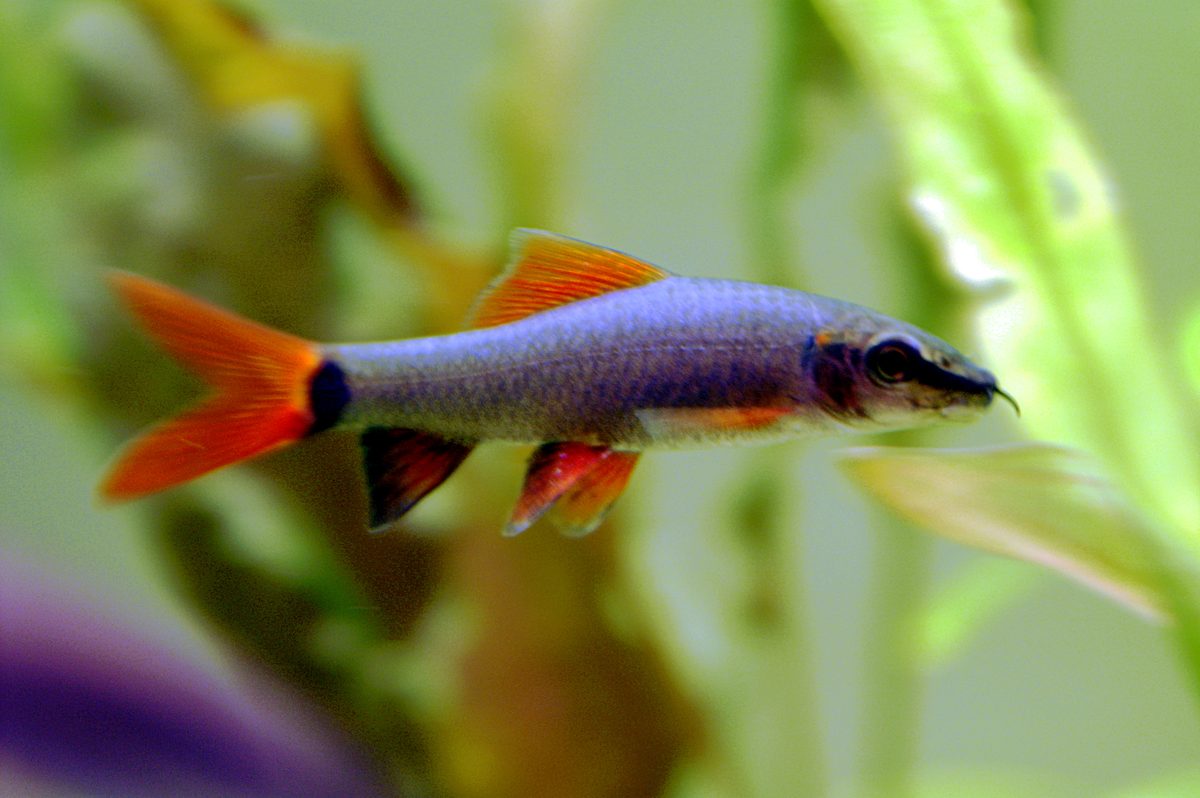
| Temperature | 20–26 °C (68–79 °F) |
|---|---|
| pH | 6.5–8.0 |
| Hardness | 2–15 °dGH |
| Volume | from 240 l (63 gal) |
| Size | up to 15 cm (5.9 in) |
| Lifespan | 15+ years |
What it is and where it comes from
The labeo, Epalzeorhynchos frenatum, comes from Thailand, Laos and Cambodia: the Mekong, Chao Phraya and Mae Klong basins, where it held station on riffles over sand and stone and moved into flooded forest in the rainy season. Many wild populations have vanished in recent decades, and a wild-caught fish is almost unfindable for sale, so everything in the trade comes from farms. It reaches 15 cm but is sold as a 5 cm juvenile, and that gap is where disappointment starts.
The species has been in the hobby for a long time, mostly as the albino form with bright red fins. Shops sell it as an algae eater, though it grazes worse than Siamese algae eaters and mainly wants a patch of bottom of its own.
Housing and conditions
Temperature 20–26 °C, pH 6.5–8.0, hardness 2–15 °dGH. It needs current and plenty of oxygen; in still water a labeo sits in a corner and goes downhill. Use a filter with headroom and change 30% of the water weekly.
Western references ask for a footprint of at least 120 by 45 cm, roughly 240 l. People buy the 5 cm juvenile, drop it into 100 l, and a year later it is 15 cm and treats the tank as its property. Keep the substrate fine and the stones and driftwood free of sharp edges, with plenty of cover. Hard-leaved plants are safe; soft ones get nibbled.
A young labeo barely shows itself, sitting in cover, feeding after dark and bolting from bright light. That is behaviour, not illness. The adult reverses it, patrolling open water and checking the borders for intruders.
Feeding
It scrapes film off stones and glass, which is not enough on its own. Offer bloodworm, daphnia, brine shrimp and blanched cucumber, courgette, spinach or peas. Feed after lights out. For the first month a new labeo often eats only at night.
Overfeeding shows as a swollen belly and a sluggish fish. It will not stop at bloodworm, so measure the portion and lift leftovers after half an hour. Fouled water is more dangerous to it than hunger.
Lifespan
More than fifteen years, one of the longest spans among small cyprinids. In practice most never reach five, kept in cramped tanks on dry food alone.
Temperament and tank mates
With age the labeo becomes the owner of the tank, attacking fish of similar shape and stripe: other Epalzeorhynchos, Siamese algae eaters, gars, Gyrinocheilus. Other neighbours are left alone, though a big male will chase even barbs.
- good: barbs, danios, large tetras, loaches, corydoras;
- avoid: Siamese algae eaters, labeo bicolor, gars, Gyrinocheilus;
- keep it singly, and add it last.
Diseases
The usual problems of an imported fish:
- Ich. White spots and scratching. Treat with malachite green in a separate tank.
- Emaciation. The fish loses weight while apparently eating, often through internal parasites. No treatment without tests.
- Fin rot. Ragged fins after fights or in dirty water.
- Injuries. Labeos hit the glass and tear the snout on stones. Cover and soft substrate cut the risk.
A vet makes the diagnosis; guessing with antibiotics does harm.
Breeding
Nobody breeds labeos in hobby tanks: there are no documented cases. All stock comes from farms in South-East Asia, where spawning is induced, so every fish on sale is imported, often worn out by the journey. Quarantine is not optional.
Who it suits
An experienced keeper who wants a big bottom fish in 240 l or more. Not a beginner's fish: it is expensive, lives for decades and demands current plus a territory. Weak points are size, territoriality and sensitivity to organic waste; the strong point is a striking look and readable behaviour. The calculator will size a tank for it.
Calculator
The calculator takes your dimensions and works out glass, weight, stand and doses.
Open the calculator