
Paradise fish
The first aquarium fish of Europe and one of the most quarrelsome. It takes cool water but needs a tank of its own and a tight lid.
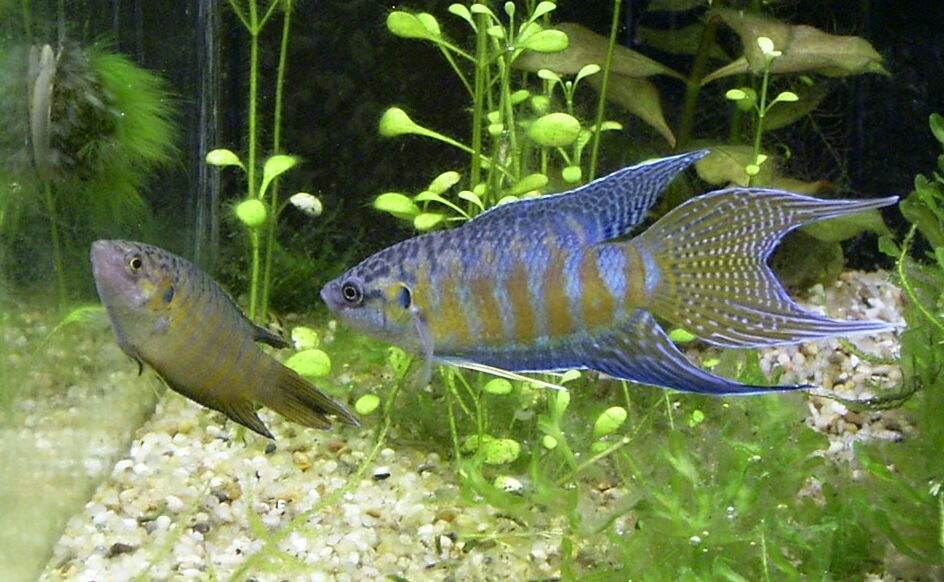
| Temperature | 20–26 °C (68–79 °F) |
|---|---|
| pH | 6.0–8.0 |
| Hardness | 5–20 °dGH |
| Volume | from 70 l (18 gal) |
| Size | up to 10 cm (4 in) |
| Lifespan | 5–8 years |
What it is and where it comes from
The paradise fish lives in slow fresh waters of the Far East, from the Yangtze to central Vietnam and northern Laos, including Taiwan and Hainan. It has been introduced to Korea, Japan, Malaysia and the USA, where it has settled in places. It keeps to ponds, canals, rice paddies and oxbows, and in the wild it tolerates cold and heat alike.
In 1869 a French soldier, Gerault, brought about a hundred fish to Paris, twenty-two arrived, and Pierre Carbonnier bred them the same year. The paradise fish became one of Europe's first aquarium fish, earlier than the betta. Wild fish are almost never sold, the stock is farmed, and there are albino, red and blue lines and forms without stripes.
Housing and conditions
Here the sources differ. Western references keep the fish at 10–22 °C and treat it as subtropical, benefiting from a cool winter. Russian sites give 20–24 °C. Both work, as it survives cold and summer heat, but constant 28 °C shortens its life.
pH 6.0–8.0, hardness 5–20 °dGH. Volume from 70 l (18 gal) per pair, with a footprint of at least 80 by 30 cm. An adult male is 6–8 cm (2.4–3 in) without the tail, about 10 cm (4 in) with a veil tail; the female is smaller and fuller. Dense plants, floating ones essential, as the male nests in them. Weak current, diffused light. A tight lid, because the fish jumps and slips through gaps.
Feeding
A predator by build: daphnia, brine shrimp, bloodworms, tubifex, small midge larvae. Live food is desirable, but farm lines eat good flakes too. Feed once a day, a portion eaten in a minute or two.
Overfeeding looks like a swollen belly and listlessness, then obesity, shortness of breath and refusal to feed. One fasting day a week helps, but no more often, since the fish is large and loses weight fast.
Lifespan
Usually five to eight years, and the spread in the sources is wide, depending on the temperature kept. A fish that winters cool lives noticeably longer than one at 27 °C all year.
Temperament and tank mates
Males are territorial, and during spawning they hit everything that moves, not only rivals. Two males need a very long tank with thickets and cover. One male needs two or three females, or all the attention goes to one and she suffers.
- large danios, barbs, corydoras and labeo fit;
- guppies, bettas, small tetras, shrimp and veil forms do not;
- small tank mates are seen as food.
Diseases
Most often the fins and skin take the damage:
- Ich. White specks, scratching, rapid breathing. Malachite green.
- Fin rot. After fights the ragged fin edges whiten. Water changes and an antiseptic help.
- Lymphocystis. Grey growths on the fins, a virus that passes on its own in clean water.
- Obesity. The belly swells and the fish lies on the bottom. Fasting and plant food.
A vet makes the exact diagnosis; blind antibiotic treatment does harm.
Breeding
The male builds a bubble nest in floating plants, courts the female and embraces her under the nest. The eggs number several hundred and float up. Incubation takes two to four days depending on temperature. Larvae hang in the nest until the yolk is absorbed, and the fry eat infusoria, then brine shrimp nauplii. The adults are removed once the young swim.
Who it suits
Not for a beginner who wants a community tank with small fish. It is good for a species tank of 70 l or more, with one male, thickets and a tight lid. What is inconvenient: pugnacity, jumping, obesity. On the other hand, it takes cool water and needs no heating in summer. How many fish your tank carries is shown by the calculator.
Calculator
The calculator takes your dimensions and works out glass, weight, stand and doses.
Open the calculator