
Sailfin pleco
A sailfin pleco is sold as a 5 cm juvenile and grows to half a metre, living twenty years. What an adult needs besides a big tank.
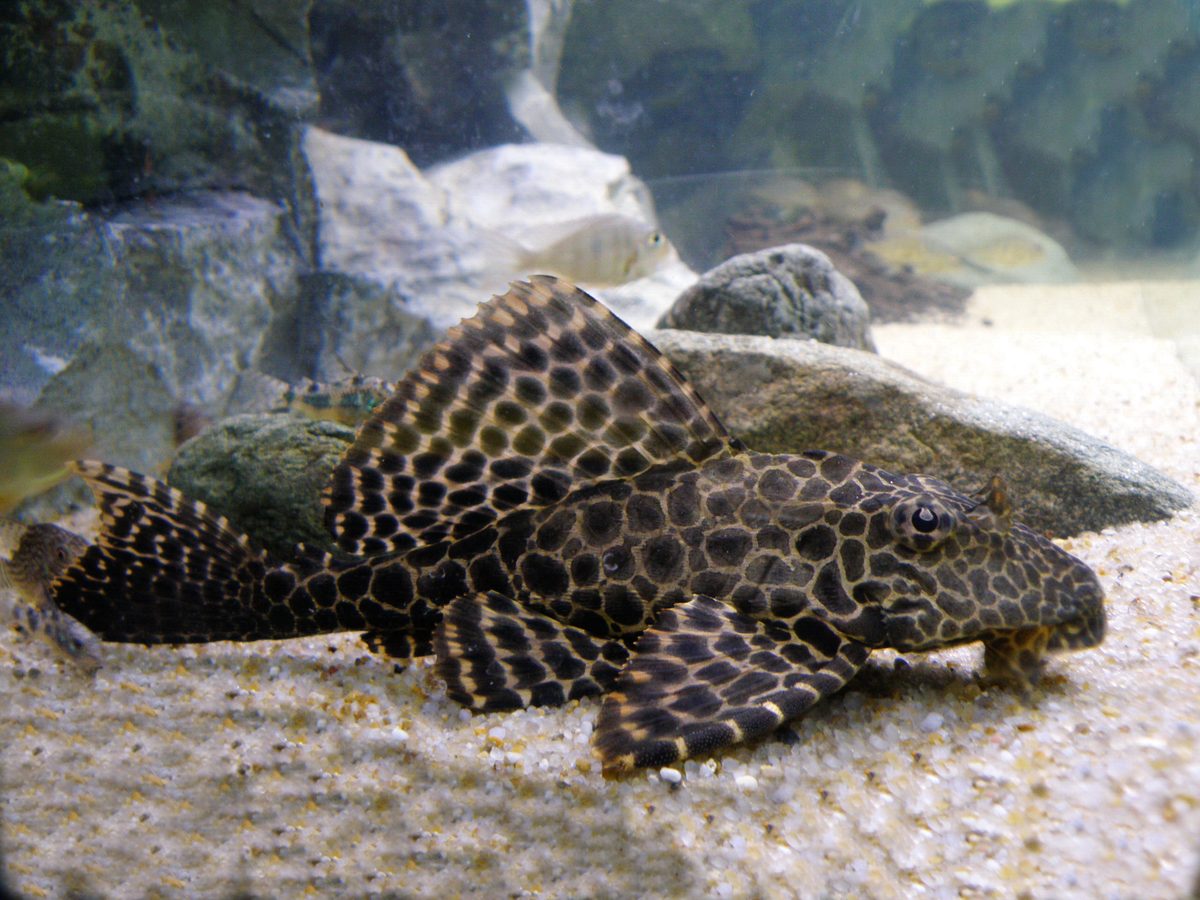
| Temperature | 23–27 °C (73–81 °F) |
|---|---|
| pH | 6.5–7.8 |
| Hardness | 4–20 °dGH |
| Volume | from 300 l (80 gal) |
| Size | up to 50 cm (20 in) |
| Lifespan | 15–20 years |
What it is and where it comes from
The sailfin pleco (Pterygoplichthys gibbiceps) is an armoured catfish from the Amazon and Orinoco basins. It lives in shallow water with slow current and moves onto flooded land in the rainy season. Kner described the species in 1854. It reached the hobby through farms in South-East Asia, where it is bred in ponds and shipped around the world.
In the shop it is a spotted juvenile of 5–8 cm, and the seller rarely explains what it will turn into.
Housing and conditions
Tank from 300 l for an adult. Sources disagree: Wikipedia says 200 l and a length of 30–35 cm, Tetra a minimum of 250 l, aquarium handbooks 300 l. For a half-metre catfish, 300 l and a long tank rather than a cube is the honest figure.
Temperature 23–27 °C. Some sources give 22–26, others 23–28; the main thing is no swings. pH 6.5–7.8, hardness 4–20 °dGH, so almost any water will do. Change up to 30% a week and run an external filter: the waste is like a small dog's. Volume and weight of the tank are easy to check in the calculator.
Current moderate to strong. Coarse substrate, since the fish stirs up sand. Dim light. Driftwood is needed for the cellulose. Plants only tough-leaved ones, anubias and ferns, or they get dug up and eaten. Cover the tank: a fish this strong can shift a glass lid.
Feeding
Eighty percent of the diet is vegetable: spirulina tablets and wafers, courgette, cucumber, pumpkin, spinach. A portion at night, leftovers removed in the morning. Animal protein no more than once a week, or the liver suffers.
Overfeeding shows in a swollen belly, cloudy water and a film on the surface. In a big volume this is harder to fix than to prevent.
Lifespan
15–20 years, and some individuals pass 20. That is a cat-sized commitment. In a small volume the fish rarely reaches ten.
Temperament and tank mates
Peaceful and does not eat small fish. Conflicts happen with its own kind: two adult sailfins in one tank will fight over hiding places, and bristlenose plecos clash with it over driftwood.
Good neighbours: large cichlids, bichirs, large gouramis, bala sharks, silver dollars. Bad ones: discus and angelfish, which the pleco attaches to and grazes on when hungry. It does not chase small fish, but it can pin one down in a cramped tank.
Diseases
- Emaciation. Sunken belly, sunken eyes: too little vegetable food and no driftwood. Fixed by diet, not medicine.
- Nitrogen poisoning. The fish lies on the bottom, breathes fast, the water yellows. Water changes, a clean filter and a lighter load on the tank.
- Fatty liver. From too much protein and bloodworm: firm belly, apathetic fish, indifferent to food.
- Injuries when moving. Fin spines catch in the net and come off with mesh stuck to them. Move the fish in a container of water.
A vet makes the diagnosis; blind antibiotic treatment does harm.
Breeding
It does not breed in a home tank. In the wild the catfish digs a burrow up to a metre long in a clay bank, the female lays eggs and the male guards the clutch. That cannot be repeated indoors, and all fish on sale come from farms. In adults the sex is read from the genital papilla; external cues are almost absent.
Who it suits
Not a beginner, if we mean the adult fish. You need 300 l, a strong external filter and room for 15 years ahead. Plus side: peaceful, hardy and useful against algae while young. The drawback: by about two years old it stops being a cleaner, and the waste only grows. Buy it for the fish itself, not for the housework. More catfish and cichlid articles are in the reference.
Calculator
The calculator takes your dimensions and works out glass, weight, stand and doses.
Open the calculator