
Bamboo shrimp
A filter shrimp catches food with its fans and starves without current. Here is the flow, the suspension, the volume and the moult of this large shrimp.
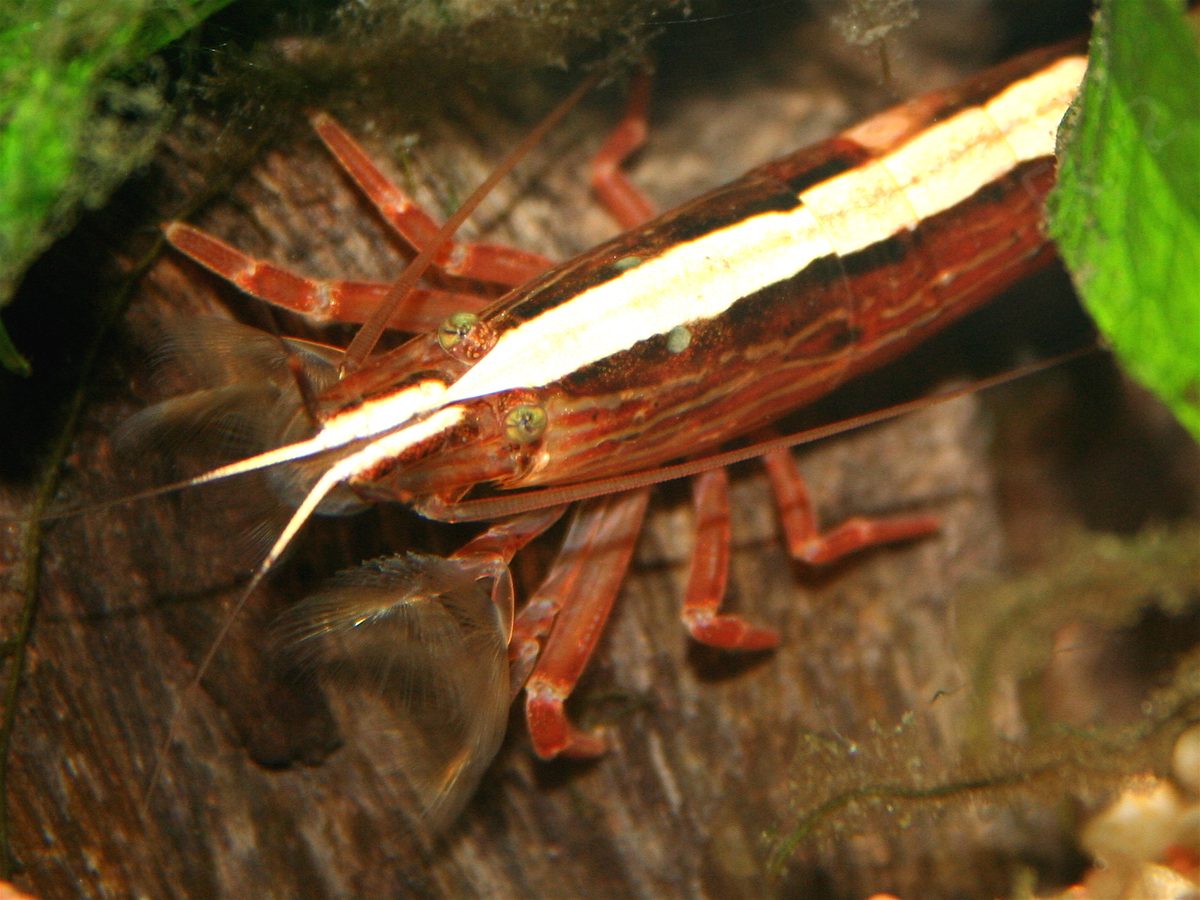
| Temperature | 24–27 °C (75–81 °F) |
|---|---|
| pH | 6.5–7.5 |
| Hardness | 4–10 °dGH |
| Volume | from 60 l (16 gal) |
| Size | up to 10 cm (4 in) |
| Lifespan | 2–4 years |
What it is and where it comes from
Atyopsis moluccensis lives in Southeast Asia: Thailand, Malaysia, Singapore, Indonesia, the Philippines. It holds position in streams with a noticeable current, settles on a rock or driftwood and opens the fans of bristles on its first two pairs of walking legs. With them it filters plankton and organic particles out of the water.
Aquarists have known it since the 1990s, but it became popular later, once it turned out to live long and leave its neighbours alone. It is easily confused with other fan shrimp sold under the same name.
Housing and conditions
Temperature 24–27 °C (75–81 °F), with short spells up to 29 °C. pH 6.5–7.5, hardness 4–10 °dGH. Water too soft and acidic shows up badly at moulting.
Volume from 60 l (16 gal), and 100 l (26 gal) for a group of four or five. Current is essential and has to be directed: the shrimp picks a spot in the flow and sits there for hours. In still water it starves, because it gets no particles.
An internal filter is placed so the stream runs along a rock or driftwood, ideally against the pump. Fine substrate, cover from stones, and a lid, since the shrimp walks up the glass and can get out. Copper and copper-based remedies are lethal, so only settled water goes in.
Feeding
The food has to be a suspension: flakes ground to dust, powders for filter feeders, spirulina mixed into water, liquid foods for invertebrates. A portion goes in with a syringe straight into the flow in front of the shrimp, or it settles and is lost.
Overfeeding clouds the water, leaves organic matter on the bottom and stops the shrimp working its fans. A shrimp that spends whole days picking through the substrate is underfed and has switched to grazing, the first sign the current is too weak.
Lifespan
Accounts differ: 2–4 years is the usual figure, and a few sources say five or more. A shrimp that never gets its suspension lives a year and dies of exhaustion.
Temperament and tank mates
Peaceful and very cautious. It gets on with fish that do not try to eat a large shrimp: tetras, danios, rainbowfish, livebearers, corydoras. Large cichlids and loaches are dangerous, especially at a moult.
It is not kept with crayfish or Helena snails. Helena does not hunt adults, but a moulting, soft shrimp is easy prey. Small cherry shrimp risk being pulled into a filter that has no sponge.
Problems
- Wasting. A hollow behind the carapace, the shrimp thin and listless, from no current and no suspension food. The fix is another filter and feeding into the flow.
- Copper poisoning. Convulsions, falling on one side, quick death. There is no treatment, only a move to clean water.
- Failed moult. The shrimp cannot shed its shell and dies. It follows low GH, so hardness is raised in advance, not after the fact.
- Bacterial infection. A cloudy body, refusal to feed, the shrimp sitting on the bottom. Quarantine, cleaning and a water change help.
A specialist makes the exact diagnosis, but with invertebrates it is usually easier to move the animal into clean water and fix the parameters than to treat blindly.
Breeding
It does not breed in fresh water: the larvae develop in brackish and marine water, a handful of people repeat that at home, and there is no stable result. Every shrimp on sale is imported, which is why the price is high and losses after shipping are noticeable.
Who it suits
Not a beginner. It needs a mature tank of 60 l or more with directed current and stable water, and in a fresh setup the shrimp dies. Drawbacks: dust feeding, sensitivity to copper and no breeding. Pluses: large size, calm temperament and a long life. The filter load of such a tank fits the calculator.
Calculator
The calculator takes your dimensions and works out glass, weight, stand and doses.
Open the calculator