
Assassin snail
Helena eats ramshorns but will not end a population spike. Here are feeding, hardness and tank mates for this predatory snail.
| Temperature | 22–26 °C (72–79 °F) |
|---|---|
| pH | 7.0–8.0 |
| Hardness | 6–15 °dGH |
| Volume | from 20 l (5 gal) |
| Size | up to 3 cm (1.2 in) |
| Lifespan | 2–4 years |
What it is and where it comes from
Clea helena, also sold as Anentome helena, lives in Southeast Asia: Thailand, Malaysia, Sumatra. In the wild it keeps to streams with clean current and a sandy bottom, burrows into the substrate and hunts mostly at night.
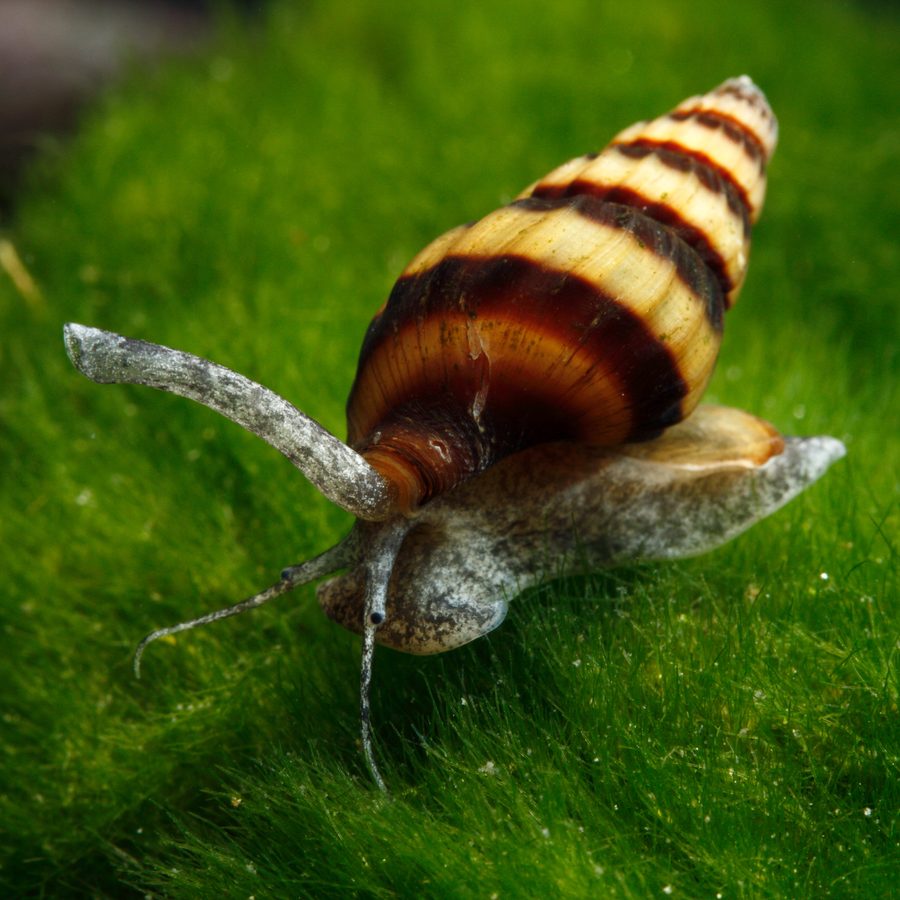
It entered the hobby as a tool against ramshorns and trumpet snails and quickly became a pet in its own right. The shell is conical, yellow-brown with bands, the body pale, with a long proboscis. Sex cannot be told from the outside, and there is no dimorphism.
Housing and conditions
Temperature 22–26 °C (72–79 °F). pH 7.0–8.0, hardness 6–15 °dGH, carbonate 4–10 °dKH. Below pH 7 the shell suffers, so acidic water and CO2 injection are better avoided in a tank with Helena.
Volume from 20 l, at 8–10 l per individual. Fine substrate, sand or soft gravel: the snail buries itself completely and leaves only the siphon out. Cover in driftwood and stones, a filter with moderate flow, and a lid is desirable.
Copper is lethal. Ordinary ich medicines based on it wipe out Helena within a day, so treating fish in a shared tank means checking the ingredients.
Feeding
A predator whose base diet is other snails. Helena does not chase prey, it waits for a snail to come to it. It finds a ramshorn, a bladder snail or a trumpet snail by smell, inserts the proboscis and eats the soft tissue without damaging the shell. It rarely attacks an adult mystery snail but does take juveniles and weakened ones.
When no snails are left, Helena gets protein: bloodworm, pieces of fish, sinking catfish granules, two or three times a week. Without extra food it weakens and dies, and the aquarist later wonders why the snail just disappeared. Algae and plants it does not eat at all.
Lifespan
2–4 years with stable parameters. In cooler water at 22 °C the snail lives longer than at 26 °C, and on short rations the term is noticeably shorter.
Temperament and tank mates
A calm loner, usually buried during the day. It gets along with any fish except loaches and puffers, which eat molluscs themselves. Adult shrimp are safe, small and moulting ones may not be. It is not kept with a mystery snail or a nerite, since for Helena those are food.
With ramshorns Helena does its job, but slowly: one snail eats about one small mollusc every few days. A big population spike needs not a pair of Helenas but a dozen, and then they start starving themselves.
Problems
- Shell damage. The tip turns white and the cone crumbles, from soft water. Raising GH and KH helps.
- Copper poisoning. The snail falls out of its shell and dies. The source is medicines and tap water.
- Starvation. Helena sits still, does not react to snails and loses weight. After a tank is cleared it must be given meat.
- No offspring. Not a disease but a missing partner: the snail is dioecious, so at least two individuals are needed.
A specialist makes the exact diagnosis, but with invertebrates it is usually easier to move the animal into clean water and fix the parameters than to treat blindly.
Breeding
Dioecious. The female glues single transparent capsules 1–1.5 mm across to the glass or a stone, one egg in each. Young emerge after 4–6 weeks, the pace is slow, and there is no population growth like with ramshorns. Breeding needs two or three individuals and stable water; sex cannot be determined, so you buy a group and wait.
Who it suits
An aquarist who already has a ramshorn problem, and anyone who wants an unusual snail in a small tank. 20 l is enough and care is simple. Drawbacks: a narrow diet, sensitivity to copper and no way to clear a tank of molluscs quickly. The plus: plants stay intact.
Calculator
The calculator takes your dimensions and works out glass, weight, stand and doses.
Open the calculator