
Ram cichlid
A small cichlid from the llanos of the Orinoco that wants warm, acidic water and a mature tank. What it eats, and why it lives only a few years.
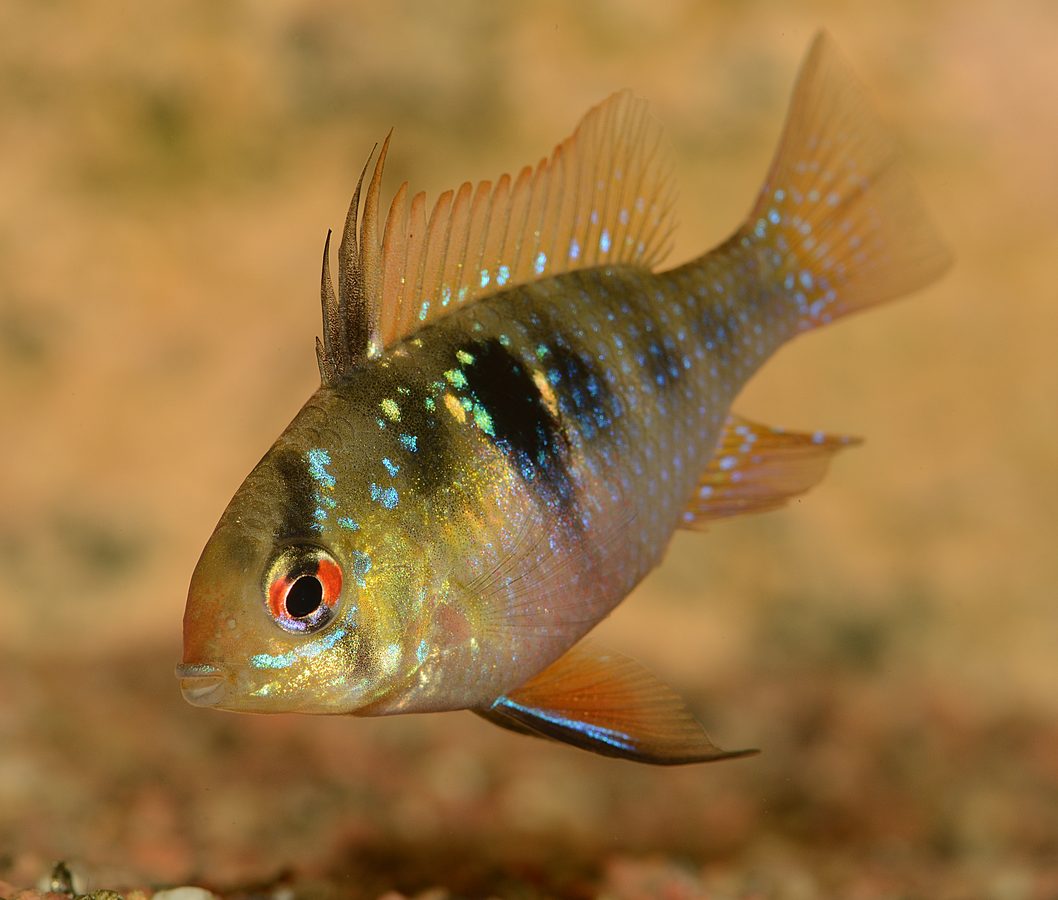
| Temperature | 25–30 °C (77–86 °F) |
|---|---|
| pH | 5.0–7.5 |
| Hardness | 1–15 °dGH |
| Volume | from 60 l (16 gal) |
| Size | up to 7 cm (2.8 in) |
| Lifespan | 3–5 years |
What it is and where it comes from
The ram cichlid, also sold as the Ramirez dwarf cichlid, is a small cichlid from the llanos of the Orinoco basin in Venezuela and Colombia. The old name stuck although the genus changed: described in 1948 as Apistogramma ramirezi, the fish was moved between genera and in 1998 placed in Mikrogeophagus.
The name honours Manuel Ramirez, who caught fish for the trade. Wild waters are warm, acidic and leaf-stained, with sand and plants. The fish has been kept for decades, and the modern colour forms (electric blue, gold, balloon, veiltail) were bred in Asia.
Housing and conditions
Temperature 25–30 °C (77–86 °F); English sources give 27–30, field measurements 25.5–29.5. pH 5.0–7.5: some sources say 4.0–7.0, others 6.0–7.5. Hardness 1–15 °dGH: 1–10 in one source, 5–15 in another, and spawning needs the softer end. Size is disputed: 4 cm (1.6 in) in English data, up to 7 cm (2.8 in) in Russian.
From 40 l (10 gal) per pair, with 60 l (16 gal) more practical. Fine sand, driftwood, flat stones, plants and shade. Weak current, dim light, a biologically mature filter. Water changes stay small, 10–15% a week, because this fish takes big ones badly. A pair manages on a 60×30 cm footprint, and the volume for a pair can be worked out in the calculator.
Feeding
It feeds off the substrate, taking a mouthful of sand and sifting it. The mouth is small, so food must be small: bloodworm, brine shrimp, daphnia, sinking granules. Twice a day in small portions, and live food is rinsed first so that no parasites come with it.
Overfeeding is routine: the belly swells, the fish goes listless, the water clouds. Obesity and swim bladder trouble are treated with fasting and clean water, though it is better not to get there.
Lifespan
3–5 years in an aquarium. Bred colour forms live less, the balloon especially, because its internal organs are displaced. Warm water and high nitrate speed up ageing.
Temperament and tank mates
Peaceful, but a pair guards a territory while spawning. It gets on with small tetras, rasboras, corydoras, other apistogrammas and even discus, which like the same warm water. It competes poorly for food, so neighbours must not be faster.
Not with large cichlids, coldwater goldfish or aggressive species. It eats shrimp, especially the young.
Diseases
Ich. White spots, rubbing, refusal to feed. Treated in quarantine with carefully chosen temperature and medication.
Lateral line erosion. Pits on the head and along the line, from poor water. Better conditions help, but the marks often stay for good.
Fungus on the eggs. A clutch turning white in the spawning tank. Rinse the eggs, keep the water clean, remove the affected ones.
Bacterial infections. Ragged fins, ulcers, bloating. Treated in quarantine on a vet's advice; quarantine for new fish is mandatory, as ich arrives with a purchase.
A vet makes the diagnosis; antibiotics at random do harm.
Breeding
A pair forms out of a group of young fish, and artificial pairs do not always spawn. Spawning tank from 15 l (4 gal), a flat stone or a pit in the sand, water near 29 °C (84 °F) and soft. 150–300 eggs, up to 500. At 29 °C the larvae hatch in 40 hours and do not swim for five days. Both parents care for the brood, but young or commercial fish often eat the clutch. Fry take microfood and nauplii.
Who it suits
Not a beginner's fish: it needs a mature tank, steady warmth and soft water. Minimum 60 l per pair, no bullies. Minus: a short life, nitrate sensitivity, unreliable spawning. Plus: small size, bright colour, interesting behaviour. With stable water it lives out its years without trouble.
Calculator
The calculator takes your dimensions and works out glass, weight, stand and doses.
Open the calculator