
Molly
A livebearer that needs hard, alkaline water. In soft water it falls ill, and no amount of medicine makes up for the wrong chemistry.
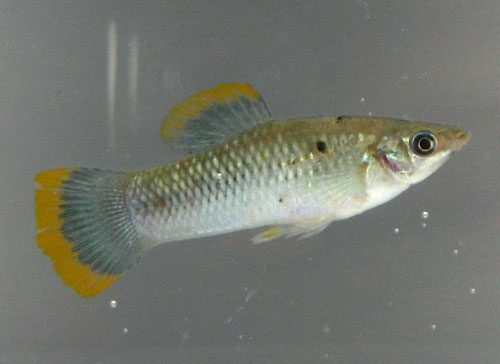
| Temperature | 24–28 °C (75–82 °F) |
|---|---|
| pH | 7.0–8.5 |
| Hardness | 12–25 °dGH |
| Volume | from 60 l (16 gal) |
| Size | up to 10 cm (4 in) |
| Lifespan | 3–5 years |
What it is and where it comes from
Valenciennes described the molly in 1846. It lives in Mexico, Guatemala and Honduras, in rivers, lagoons, roadside ditches and brackish estuaries, tolerating water from still to a moderate current, often murky and warm.
In the wild the fish takes anything from 11 to 39 °C as long as the change is gradual, which explains its toughness. In an aquarium such swings still do damage.
The black molly appeared in 1925 in Florida farms: first a speckled form, then Bill Sternke spent over ten years on a velvet black one. Almost all shop mollies are hybrids with the sailfin and broad-fin species, and no pure wild fish are sold, so many lines are in poor health.
Housing and conditions
The main thing is hard, alkaline water. pH 7.0–8.5, hardness 12–25 °dGH; in soft, acidic water the fish weakens fast, clamps its fins and stops eating. Salt is not essential, since calcium and magnesium are what matter. The literature suggests salt, but in a community tank it harms plants and catfish, so testing hardness beats tipping salt in by eye.
Temperature 24–28 °C (75–82 °F), though Seriously Fish allows 21–28 °C. A tank from 60–80 l (16–21 gal); adults do better with a 90×30 cm footprint. Moderate current, good aeration, bright light up to 12 hours, live or artificial plants, dark substrate, and a lid, as mollies jump.
Feeding
In the wild it scrapes algae and picks up detritus, so the vegetable part of the diet is obligatory. Flakes with spirulina, granules for livebearers, blanched spinach, cucumber. Live food is a supplement, not the base of the menu. Feed once or twice a day, a portion eaten in a couple of minutes.
Overfeeding looks like a heavy belly and a fish standing on the bottom. Their gut is long and constipation comes more often than in barbs; spare food rots, nitrate rises, and obesity does not come off quickly.
Lifespan
Usually 3–5 years. Males live less than females and barely grow after maturity. Balloon forms with a bent body rarely reach two years, because the organs are compressed. Cooler water also stretches the years.
Temperament and tank mates
Peaceful and active, but not for every community tank: the molly needs hard water, while tetras, angelfish and discus live in soft water, so pick tank mates that tolerate hardness.
Tank mates: swordtails, platies, Endler's guppies, rainbowfish, some barbs. Not: soft-water tetras, discus, large cichlids. Males court relentlessly, so one male needs two or three females; a single female with two males wears out fast.
Diseases
What turns up most often:
- Ich: white spots, rapid breathing. Treated with antiparasitic medication as directed.
- Fin rot: fins go cloudy and tear, usually in dirty water.
- Fungus on injuries and after stress: cottony growths, especially in soft water.
- Obesity and constipation: a heavy belly, the fish does not swim. Fasting and plant food help.
A vet makes the diagnosis; antibiotics at random do harm.
Breeding
A livebearer. Pregnancy lasts about 8 weeks, and the female drops up to 120 fry, usually fewer. The fry are large and take brine shrimp nauplii and crushed flakes from day one. In a community tank the brood gets eaten, so a female close to giving birth is moved to a separate tank with plants. Mesh boxes are no good, since the fry are cramped. Males barely grow after maturity, so in a breeding colony they are swapped for young ones now and then.
Who it suits
A beginner whose tap water is hard: in soft water the fish sickens no matter how much you treat it. It needs a tank from 60 l, a lid and steady hardness. Minus: weak genetics in shop fish, a habit of jumping and pestering males. To check how many mollies your tank can carry, use the calculator.
Calculator
The calculator takes your dimensions and works out glass, weight, stand and doses.
Open the calculator