
Green terror
The green terror lives in cool water and needs a tank from 250 litres. Why it does not go into a community tank and how to pair it without fights.
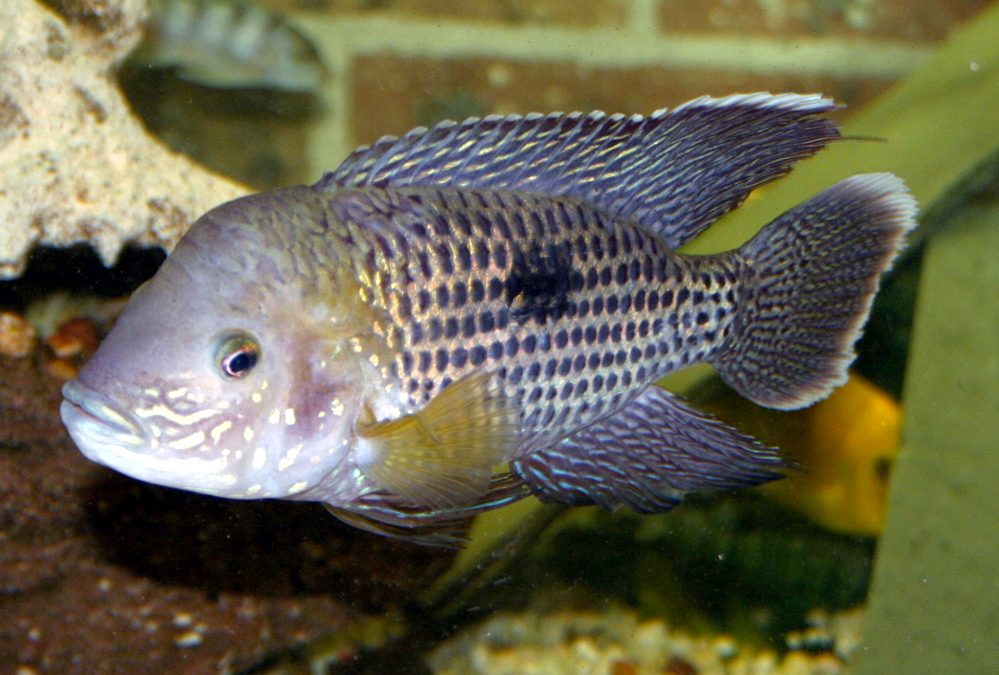
| Temperature | 20–25 °C (68–77 °F) |
|---|---|
| pH | 6.5–8.0 |
| Hardness | 5–20 °dGH |
| Volume | from 250 l (66 gal) |
| Size | up to 30 cm (12 in) |
| Lifespan | 8–10 years |
What it is and where it comes from
The green terror (Andinoacara rivulatus) lives on the Pacific slope of South America, from the Tumbes in Peru to Esmeraldas in Ecuador. It turns up in clear and dark humic water, usually streams and small rivers. Günther described the species in 1860, when it was called Chromis rivulata.
The English name comes from its temper, especially when spawning. It is often confused with the closely related blue-spotted acara, though the two are separate species: the green terror grows larger and behaves worse.
Housing and conditions
Temperature 20–25 °C (68–77 °F). That is cool water for a cichlid, and many people keep it at 26–28 °C and then wonder why the fish lives shorter. Tetra and Seriously Fish give 20–24 °C, aquarium handbooks 20–26 °C, with the optimum nearer 23–24 °C.
pH 6.5–8.0, hardness 5–20 °dGH. The fish tolerates water chemistry but not dirt: it takes nitrate worse than hardness. Change 25–30% a week, and a strong external filter plus aeration are mandatory.
Volume 250–300 l (66–80 gal) for a pair. Seriously Fish counts by footprint: a minimum of 150 by 45 cm, which is about 300 l. The tank should be long, not tall.
Substrate sand, decor of driftwood and large flat stones that will be useful for spawning. The fish digs up plants; only anubias and ferns tied to wood survive. Moderate light with shaded areas.
Feeding
A predator with a tendency to gorge. The base is pellets and sticks for large cichlids, topped up with prawn, mussel, bloodworm, earthworm. Vegetable matter is needed too: peas, spinach, spirulina. Do not feed meat from warm-blooded animals, as the liver suffers.
Feed once or twice a day in small portions. Overfeeding shows in a rounded belly and lethargy: the fish stops eating and lies on the bottom. The risks are obesity and a nitrogen spike, and in a cramped tank it quickly turns the water yellow.
Lifespan
8–10 years according to the handbooks. Keepers report individuals over 10, but hard data is thin, so treat the number as a guide rather than a promise.
Temperament and tank mates
Territorial, aggressive, clever. It recognises its owner but will not tolerate a stranger on its half of the bottom. A pair is better kept on its own: in a community tank spawning turns into a war with the neighbours.
Tank mates are possible only at a matching size and in a big volume: severums, oscars, large catfish, bichirs, bala sharks, silver dollars. Small fish register as food. Weaker American cichlids and slow fish are not put with a green terror.
Diseases
- Fight injuries. Torn fins, grazes, missing scales. Clean water and cover help, not medication.
- Ich. Grains on the body after moving or chilling.
- Obesity. A heavy belly, laboured breathing, and the fish lies around a lot. Usually from overfeeding and bloodworm.
- Nitrate poisoning. Lethargy, refusal to eat, scuffed sides. Water changes and a lighter load are the way out.
A vet makes the diagnosis; blind antibiotic treatment does harm.
Breeding
Easy once you have a pair. Pairing is the hard part: a female added to a male is often killed. It is safer to buy 6–8 juveniles and let them pair off themselves. Spawning happens on a flat stone or in a pit in the substrate, up to 300–400 eggs. The eggs develop in 3–4 days, and the parents guard the clutch and herd the fry. A change of cold water triggers spawning.
Who it suits
Not a beginner. It needs a 250–300 l tank, an external filter, cool water and a willingness to keep the fish alone or as a pair. Plus side: bright, interactive, and easy to breed. Drawbacks: aggression, digging and the volume. Buy it for the fish itself, not as a cichlid for a community tank. Other species with husbandry notes are in the reference.
Calculator
The calculator takes your dimensions and works out glass, weight, stand and doses.
Open the calculator