
Kribensis
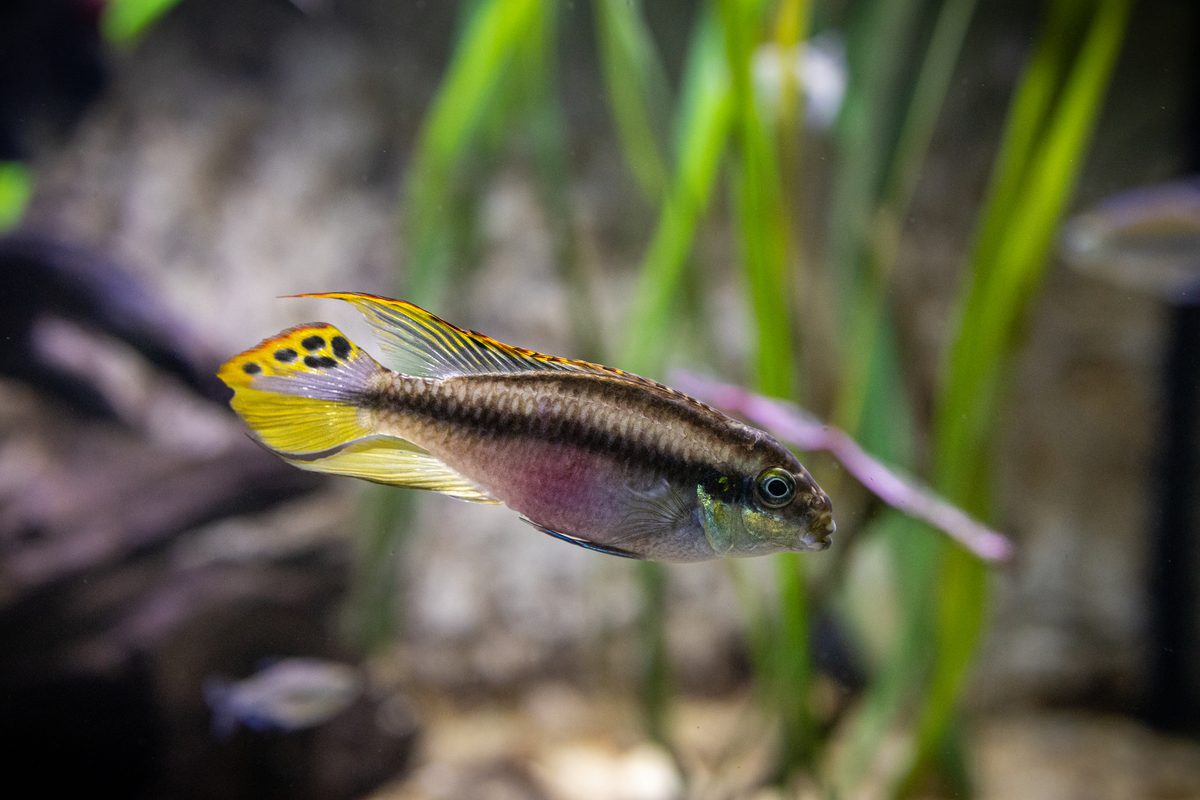
A dwarf cichlid from West Africa that most people start their first spawning with. Care is simple, but the water has to be soft.
| Temperature | 24–27 °C (75–81 °F) |
|---|---|
| pH | 5.5–7.5 |
| Hardness | 3–12 °dGH |
| Volume | from 60 l (16 gal) |
| Size | up to 10 cm (4 in) |
| Lifespan | 5–7 years |
What it is and where it comes from
Pelvicachromis pulcher comes from West Africa: south-east Nigeria, western Cameroon, eastern Benin. It lives in slow streams with dark water and dense vegetation, and enters brackish stretches near the Niger delta.
The British ichthyologist George Boulenger described it in 1901. Christian Brüning brought the fish to Germany in 1913, and from the 1950s it became common. Its bright belly and curved snout earned it the name parrot cichlid, though it is unrelated to the hybrid red parrot. Shops almost always sell farmed fish, which tolerate water better than imports.
Housing and conditions
A pair is fine in 60–80 l (16–21 gal); several pairs need 150 l (40 gal) or more with cover for each.
| Parameter | Value |
|---|---|
| Temperature | 24–27 °C (75–81 °F) |
| pH | 5.5–7.5 |
| Hardness | 3–12 °dGH |
| Volume | from 60 l (16 gal) per pair |
| Size | up to 10 cm (4 in) |
| Lifespan | 5–7 years |
Gentle flow. A sponge filter or one with a spray bar, because fry get pulled into a powerful external. Dim light: in bright light the fish pales and hides. Fine dark substrate, 3–5 cm deep, which the krib digs over. Undemanding plants will do, though it digs under their roots. Cover is essential: pots, coconut shells, tubes, stone caves. A lid is needed, the fish jumps. Change 25–30% weekly; the calculator works out the volume.
Feeding
Omnivorous: small crustaceans, worms, larvae and some detritus in the wild. Give dwarf cichlid pellets plus bloodworm, brine shrimp, daphnia and now and then spirulina. Feed 2 times a day in small portions.
Overfeeding: swollen belly, lethargy, the fish settles on the bottom and refuses food, droppings trail as a white thread. In a small tank leftovers spoil the water fast, and the krib is sensitive to nitrogen compounds. Better underfed than overfed.
Lifespan
About 5 years, with some individuals reaching 7. Metabolism slows in cool water, and in dirty water the fish lives less. A pair moved from tank to tank ages faster.
Temperament and tank mates
Peaceful, spawning aside. The rest of the time it hides near the bottom and bothers nobody. Tank mates that work: small characins, barbs, danios, rasboras, corydoras, gouramis. Large or boisterous fish are out, as the krib will be bullied or eaten. It eats shrimp, especially the young.
Do not keep it with bristlenose plecos and other loricariids: they compete for the same caves and squabble constantly. While spawning, the pair drives off everything, including larger fish.
Diseases
Ich. White spots, rapid breathing, rubbing against decor. Warmer water and an antiparasitic medication as directed help.
Fin rot. Fin edges whiten and then fall apart. The cause is in the water, so start with tests and water changes.
Hexamitiasis. White faeces, sunken belly, no appetite. A vet prescribes treatment after examining the fish.
Injuries. Bruises from decor, missing scales after clashes. Keep the water clean and the wounds heal on their own.
Only a vet can diagnose exactly, and blind antibiotics do harm.
Breeding
It spawns in a cave, often in the community tank. The pair is permanent and the female leads: she cleans the pot and shows off her crimson belly. The 100–300 eggs go on the wall of the shelter, larvae hatch in 2–3 days and the fry swim a week later. At neutral pH the brood is half and half; soft acid water gives more females, alkaline water more males. Feed the young brine shrimp and microworms.
Who it suits
A beginner, and this is one of the few cichlids of which that is true. 60 l (16 gal) is enough, the water is simple, and breeding happens by itself. Drawbacks: the fish is timid, pales in bright light, digs the substrate and jumps. Keep it as a pair rather than alone. For a first spawning, it is the honest choice. More articles in the reference.
Calculator
The calculator takes your dimensions and works out glass, weight, stand and doses.
Open the calculator