
Guppy
Guppies forgive a beginner most mistakes, but not overfeeding and not cold water. A pair in 20 litres will survive, and a group in 60 litres will live a good deal longer.
| Temperature | 22–26 °C (72–79 °F) |
|---|---|
| pH | 6.8–7.8 |
| Hardness | 8–20 °dGH |
| Volume | from 20 l (5.3 gal) |
| Size | 3–6 cm (1.2–2.4 in) |
| Lifespan | 2–4 years |
What it is and where it comes from
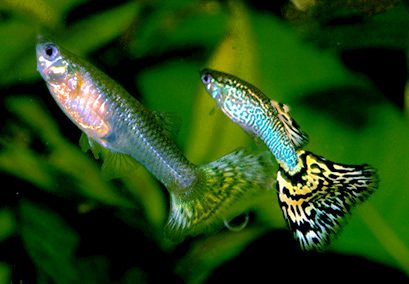
The guppy (Poecilia reticulata) comes from northern South America: Venezuela, Guyana, Trinidad, northern Brazil. It lives in streams, ponds and brackish lagoons, often in warm water with little current. Wild males are plainer than show strains; females are larger and carry eggs. Males grow to 3–4 cm (1.2–1.6 in), females to 6–7 cm (2.4–2.8 in).
The species is named after Robert Guppy, who in 1866 told the Royal Society about fish that bear live young. Guppies reached Europe in the 19th century and spread through warm waters to control mosquito larvae. Today it is among the commonest aquarium fish, with dozens of breeds: fan-tail, fork-tail, carpet, albino.
Housing and conditions
Temperature 22–26 °C, though guppies tolerate 18 and 30. In heat they live about a year and shrink. pH 6.8–7.8, hardness 8–20 °dGH: guppies like harder water than neons and take 20–25 °dGH calmly. Volume from 20 l (5.3 gal) per pair, 40–60 l for a group of 5–6; check density in the calculator.
Moderate flow, 20–25% water changes weekly, a mandatory lid. Light 8–10 hours. Fine-leaved plants: hornwort, najas, moss, since sharp stones and tough leaves injure veil fins. Substrate fine and dark. Contrary to the old advice, no salt is needed.
Feeding
Flakes or small pellets, plus daphnia, cyclops, brine shrimp and microworms. They are omnivores and need plant matter too: spirulina, blanched spinach, algae. A portion goes in one or two minutes, twice a day, and fry get more.
Overfeeding brings bloating, fat females and dirty water. Males in crowded, poor water get ragged fins. Hungry guppies look flat, with a sunken belly, but they take a day without food calmly.
Lifespan
2–4 years, up to 5 in good conditions. At 18–20 °C fish live longer but fall ill more often; at 28–30 °C the time drops to a year. Females usually outlive males, especially without a birth every six weeks. Show lines with long fins trail behind plain forms.
Temperament and tank mates
A peaceful schooling fish, but males court constantly. Keep one male to two or three females, or the female wears out. Tank mates: corydoras, neons, rasboras, small tetras, snails. Bettas and barbs nip fins, and large cichlids and goldfish do not fit either.
Guppies use every layer of the water and leave plants alone. In a community tank, almost every tank mate eats the fry.
Diseases
Five problems are most common.
- Ich. White spots on body and fins, and the fish rubs itself. Raise the temperature and use an ich remedy as instructed.
- Fin rot. Shorter fins with a white edge. Clean water and antibacterial remedies help; a severe case needs a vet.
- Tetrahymenosis. Listlessness, a bent spine, ulcers, wasting. It is contagious, so sick fish are isolated and treated as the vet directs.
- Dropsy. Scales stand out, the belly swells, the eyes bulge. The outlook is usually poor, and without a vet the fish dies.
- Worms. Thread-like droppings, thinness despite a good appetite. A vet picks the treatment; guessing does not work.
A vet makes the exact diagnosis; blind antibiotic treatment does harm.
Breeding
Livebearers. Pregnancy lasts 21–40 days, and the female gives birth to 1 to 200 fry. A separate tank with dense moss or hornwort at 24–26 °C. The female is fed and removed after the birth. Fry eat infusoria, microworms and brine shrimp nauplii from the start.
One difficulty: they breed without stopping. To avoid overstocking, the sexes are separated at 3–4 weeks and pairs chosen by breed.
Who it suits
Guppies suit a first aquarium. They need 20 l or more, but stability matters more than litres, and in 60 l with a filter and plants there is less trouble. Its short life and endless breeding are offset by cheap food, bright males and a peaceful nature.
Calculator
The calculator takes your dimensions and works out glass, weight, stand and doses.
Open the calculator