
Cherry shrimp
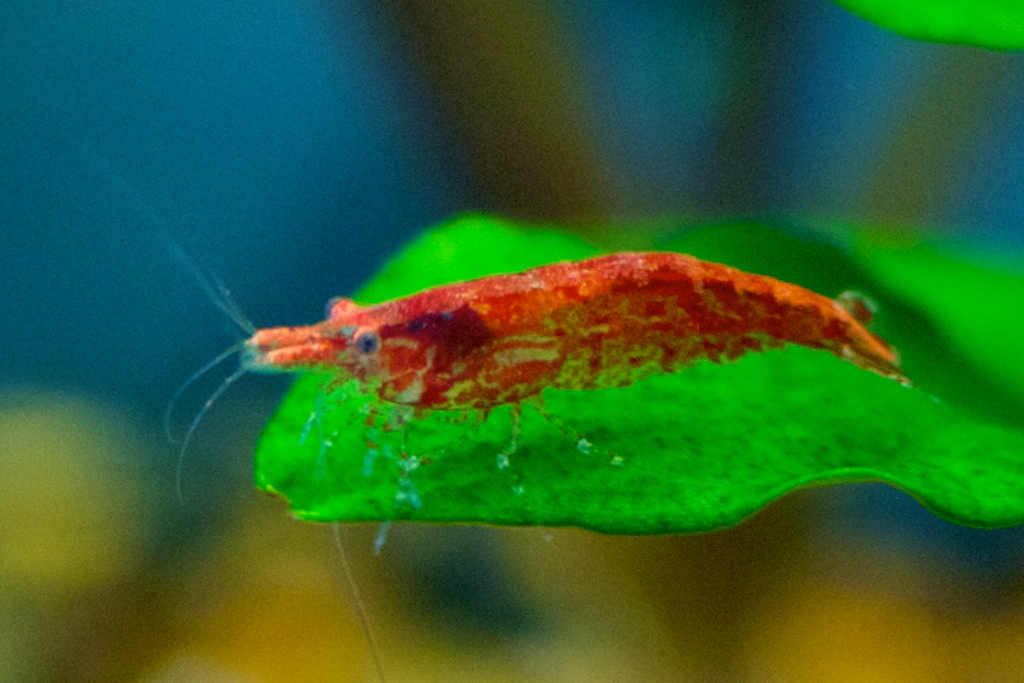
Cherry shrimp forgives tap water and breeds without effort, but it lives about eighteen months and loses colour without selection. Volume, parameters and the usual mistakes.
| Temperature | 18–26 °C (64–79 °F) |
|---|---|
| pH | 6.5–8.0 |
| Hardness | 5–12 °dGH |
| Volume | from 10 l (3 gal) |
| Size | up to 3 cm (1.2 in) |
| Lifespan | 1–2 years |
What it is and where it comes from
Neocaridina davidi comes from Taiwan, eastern China, the Korean peninsula and Vietnam. The wild shrimp is brown and dull, while the red form came out of selective breeding and became the most widespread. Cherry shrimp reached Europe in the late 1990s and Russia a little later, and today it is the most affordable aquarium shrimp.
Besides red there are yellow, orange, blue, green, black and white lines. Mix different colours and the offspring goes back to the wild brown, so the lines are kept apart.
Housing and conditions
Temperature 18–26 °C (64–79 °F), briefly up to 28 °C (82 °F). pH 6.5–8.0, hardness 5–12 °dGH, carbonate hardness 2–6 °dKH. This is one of the few shrimp that lives for years in ordinary medium-hard tap water.
From 10–15 l (3–4 gal) for a small group; 20–30 l (5–8 gal) is handier for breeding. Gentle flow, a sponge filter or an airlift. A high-output internal filter sucks up the young.
Any substrate will do, but dark reads better: the red shows up on it. Moss, duckweed, ferns, ceramic shelters. Light is not critical. A lid is needed, though cherry shrimp escapes less often than Amano.
Copper in remedies is deadly, as for other shrimp. Do not pour iodine-based products into a shrimp tank: an overdose hits moulting, and the shrimp dies at the next shed of its shell.
Feeding
Grazing, detritus, bacterial film on driftwood. Supplements: shrimp tablets, spirulina, blanched courgette, nettle leaf, dried almond leaf. Protein once a week, or the shrimp start nibbling the tender tips of plants.
Overfeeding: cloudy water, planaria on the glass. Young shrimp die from too much food more often than from hunger. A portion should be eaten within a couple of hours.
Lifespan
1–2 years, with large females sometimes reaching 3. The figure depends on temperature: at 26 °C (79 °F) the shrimp lives less but breeds faster.
Temperament and tank mates
Calm, always looking for something on the bottom. With fish it only works if they are small: guppies, tetras, danios, micro-rasboras, corydoras. Large cichlids, loaches, pufferfish and gouramis clear shrimp out completely, and within a week rather than a month.
Not with crayfish. Helena will not touch an adult cherry, but picks up fry and moulting individuals. Nerites and apple snails are safe, with competition only over food.
Problems
- Copper poisoning. Shrimp dash along the glass, fall on their side and die in batches. Only a move to clean water without copper saves them.
- Bad moult. A white ring at the base of the shell, a porcelain back, skin stuck on. The cause is low GH and a lack of minerals: raise the hardness.
- Bacterial infection. The body turns cloudy, the shrimp is listless and does not eat. Move it out, remove rotting organic matter, check nitrate.
- Escape. The shrimp leaves along a hose and dries out on the floor. The cure is a lid.
A specialist diagnoses exactly, but with invertebrates it is easier to move the animal to clean water and level the parameters than to treat blindly.
Breeding
Easier than with any other shrimp. Sexual maturity comes at about two months, the female carries 20–30 eggs under her abdomen for three weeks, and the young emerge as tiny shrimp about a millimetre long. Stable parameters, moss for the young and no predators are all it takes. Breeders select the brightest individuals, but in a small group the colour fades gradually.
Who it suits
The simplest option for a first shrimp tank: it forgives tap water and breeds without effort. 10–15 l (3–4 gal) is enough for a dozen individuals. Drawbacks: a short lifespan and loss of colour with inbreeding. One caveat from practice: in hard water with high KH moulting goes normally, but a sudden change with cold water causes a mass shedding of shells.
Calculator
The calculator takes your dimensions and works out glass, weight, stand and doses.
Open the calculator