
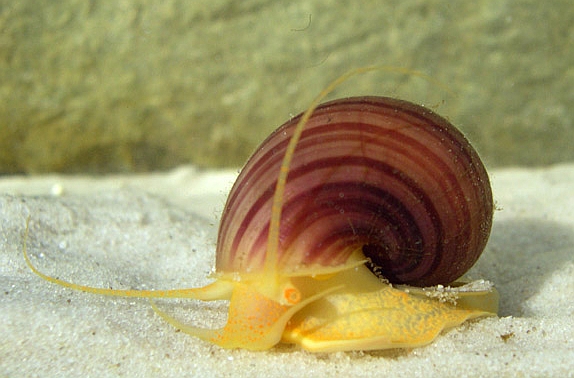
Mystery snail
A mystery snail will not cut your plants, but it fouls the water badly and likes to climb out. Here are hardness, feeding and the clutch above the water.
| Temperature | 20–28 °C (68–82 °F) |
|---|---|
| pH | 7.0–8.0 |
| Hardness | 8–18 °dGH |
| Volume | from 50 l (13 gal) |
| Size | up to 6 cm (2.4 in) |
| Lifespan | 1–2 years |
What it is and where it comes from
Pomacea bridgesii belongs to Ampullariidae and comes from the Amazon basin, Bolivia, Brazil, Paraguay and Peru. It breathes with gills and a lung, so it regularly climbs to the surface for air.
Mystery snails have been kept since the 1970s, and in the USSR before mass imports began. Close relatives and hybrids are often sold under the same name, and part of the imports are Pomacea canaliculata, which really does eat plants.
Housing and conditions
Temperature 20–28 °C (68–82 °F). Sources allow 30 °C, but in heat the snail eats less and wears out faster. pH 7.0–8.0, since the shell dissolves from the tip in acidic water. Hardness 8–18 °dGH, carbonate from 4 °dKH, and calcium in the water is essential.
Volume from 50 l (13 gal). The snail eats and fouls a lot, so a 20-litre tank goes bad quickly; the filter needs headroom and changes are 20–25 % a week.
A lid is mandatory: the snail crawls up the glass and lays above the water, and without one ends up dried on the floor. Substrate soft, no sharp edges, or the shell chips when it falls.
Plants are easier than people think: bridgesii has a soft radula and cannot cut leaves. A delicate plant may suffer, but a healthy clump is safe. If plants vanish, the culprit is probably another species that came with the snail.
Feeding
Blanched courgette, cucumber, carrot, lettuce or spinach leaf, sinking catfish tablets, spirulina. Feed in the evening, remove leftovers in the morning. Protein rarely, as a piece of fish or shrimp.
Overfeeding shows as green cloudiness and a smell. The snail eats little and fouls much, so a vegetable goes in as a small piece two or three times a week; the rest comes from algae and detritus.
Lifespan
A year or two, some individuals reach three. In warm water the snail grows fast and ages faster.
Temperament and tank mates
Peaceful and slow, it bothers no one. It suits any fish except mollusc eaters: loaches, puffers and some large cichlids, which pull it out of the shell or bite off its foot.
Not with a predatory Helena snail: she rarely takes an adult but eats juveniles and weakened individuals. With a ramshorn competition is almost nil, since the two eat different things.
Problems
- Shell erosion. The tip whitens, the shell thins and holes appear, from soft acidic water and too little calcium. Hardness is raised and calcium-rich food is given.
- Fungus on the shell. White fluff or cotton on a damaged area. The snail moves to clean hard water; the main tank is cleared of organic matter and pH is checked.
- Copper poisoning. The snail retracts, does not come out and dies within a day. Copper comes with medicines and from the tap.
- Falls and tipping over. The snail cannot always right itself, especially on smooth glass, so one on its back for over an hour is turned over by hand.
A specialist makes the exact diagnosis, but with invertebrates it is usually easier to move the animal into clean water and fix the parameters than to treat blindly.
Breeding
Snails are dioecious, but the sexes are nearly impossible to tell apart from outside. The female lays 100–300 eggs above the water in a clutch like a bunch of grapes, never wetted, since soaked eggs die. After two to four weeks, depending on humidity and temperature, the snails emerge and drop in. Juveniles get adult food, only finer.
Who it suits
A beginner, if the tank is 50 l or more and has a lid. The snail is conspicuous, alive and asks for almost no attention. Drawbacks: mess, a short life and a habit of climbing out. It also trims rotting leaves, which is more of a plus than a minus.
Calculator
The calculator takes your dimensions and works out glass, weight, stand and doses.
Open the calculator