
Jewel cichlid
A scarlet African cichlid with a hard temper. Care is simple, but tank mates are hard to pick: while spawning, the jewel attacks anything that moves.
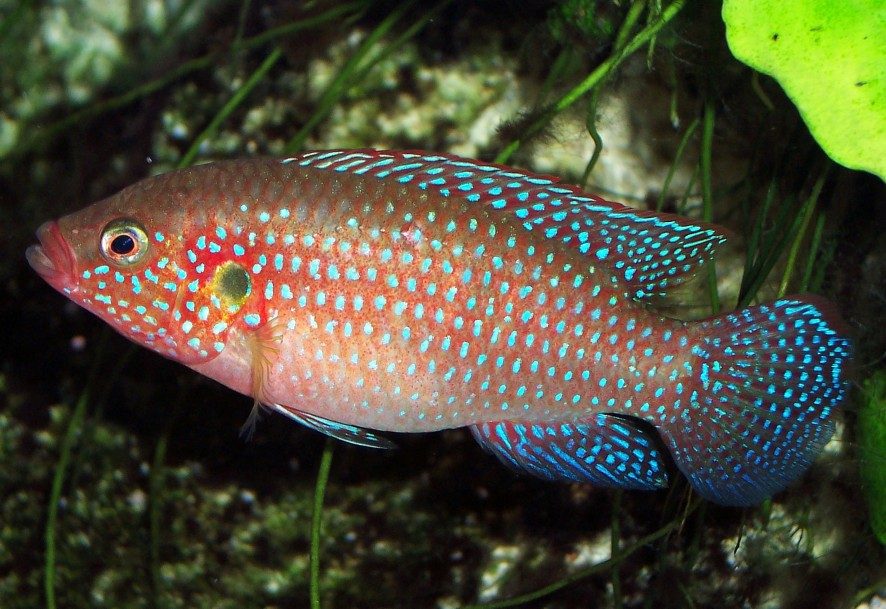
| Temperature | 23–28 °C (73–82 °F) |
|---|---|
| pH | 6.0–7.8 |
| Hardness | 4–15 °dGH |
| Volume | from 60 l (16 gal) |
| Size | up to 15 cm (6 in) |
| Lifespan | 5–7 years |
What it is and where it comes from
The jewel cichlid lives in West Africa, from southern Guinea to central Liberia. It keeps to shallow streams and channels with overhanging vegetation, hiding under driftwood and in thickets along the bank.
Theodor Gill described the species in 1862 as Hemichromis bimaculatus. In 2022 the genus was revised on molecular data, and the fish moved to Rubricatochromis bimaculatus, though shops still use the old name. In the trade it is often confused with Hemichromis lifalili. The spots tell them apart: the jewel has three, the last on the caudal peduncle, lifalili has two.
Housing and conditions
A pair is fine in 60–80 l (16–21 gal); two pairs need 120 l (32 gal) or more with driftwood dividing the bottom into territories.
| Parameter | Value |
|---|---|
| Temperature | 23–28 °C (73–82 °F) |
| pH | 6.0–7.8 |
| Hardness | 4–15 °dGH |
| Volume | from 60 l (16 gal) per pair |
| Size | up to 15 cm (6 in) |
| Lifespan | 5–7 years |
Gentle flow, dim light, coarse gravel: the jewel digs constantly and shifts stones. Cover is a must, or the weaker fish dies. It tears up soft-leaved plants, so only anubias and cryptocorynes with protected roots last. Use an external filter, the jewel breaks internal ones. Change 25–30% weekly and keep a lid on, the fish jumps. To recalculate volume and weight, use the calculator.
Feeding
A predator with an excellent appetite. Cichlid pellets plus bloodworm, tubifex, prawn, earthworm, fish pieces, and now and then spinach and spirulina. Feed once a day, a portion eaten in 1–2 minutes.
Overfeeding in the jewel looks like a swollen belly and lethargy near the bottom. The fish loses interest and droppings turn long and whitish. Obesity and liver trouble follow. Uneaten pieces rot, ammonia rises, and in such water the jewel picks up infections easily.
Lifespan
About 5 years, sometimes 7–8. Apart from water, fights decide: a fish hounded by its own kind lives shorter and falls ill more often.
Temperament and tank mates
Nobody would call it calm. Outside spawning the jewel tolerates neighbours of similar size; while spawning it attacks everything, including its owner's hand. A pair is chosen from six young fish, because a bought pair often ends with the death of the female.
It gets along with large barbs, synodontis catfish, plecos and cichlids of similar size, and not with small fish, shrimp, snails or goldfish. Keep it in a species tank or a roomy community with cover and zones.
Diseases
Fight injuries. Torn fins, missing scales, grazes on the flanks. Clean the wounds and keep the water clean, or fungus moves in.
Ich. White spots on the body, the fish rubs against stones. Raise the temperature a couple of degrees and add a parasite remedy as directed.
Fin rot. Fin edges whiten and fray. The cause is usually dirty water, so treat after water changes and tests.
Hexamitiasis. White faeces, sunken belly, no appetite. Treatment does not start without a water analysis and a vet's prescription.
Only a vet can diagnose exactly, and blind antibiotics do harm.
Breeding
Easy to breed, with one difficulty: getting a pair. Spawning is on a flat stone or in a ceramic pot. The female lays up to 600 eggs, larvae hatch in two days, and after another day or two they swim. The parents herd and guard the fry for about a month. Feed the young brine shrimp nauplii and microworms. After spawning, move the neighbours out or they will be beaten up.
Who it suits
Not a beginner, even though care is simple. The problem is temperament, not water: the fish is territorial and dangerous to everything during spawning. It needs its own 60 l (16 gal) tank or a very careful community. Drawbacks: aggression and dug-up substrate. Good points: bright colour, easy breeding, interesting to watch. More articles in the reference.
Calculator
The calculator takes your dimensions and works out glass, weight, stand and doses.
Open the calculator