
Veiltail goldfish
A goldfish whose tail is longer than its body, and which needs a roomy coldwater tank plus careful handling of those fins. What to know before buying.
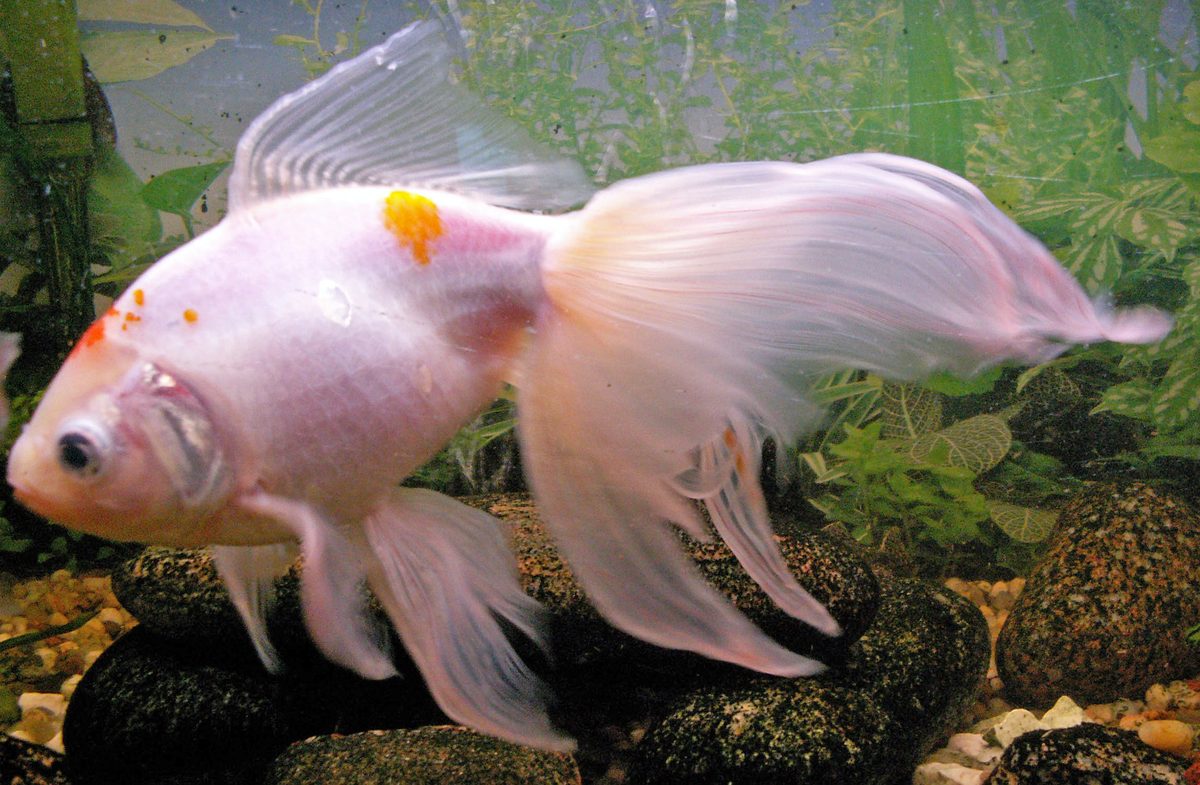
| Temperature | 14–23 °C (57–73 °F) |
|---|---|
| pH | 6.5–8.0 |
| Hardness | 6–20 °dGH |
| Volume | 50–80 l (13–21 gal) |
| Size | 20–30 cm (7.9–11.8 in) |
| Lifespan | up to 15 years |
What it is and where it comes from
The veiltail is a short-bodied goldfish with the longest tail of all the breeds. The caudal fin can be several times longer than the body; old descriptions mention a tail six body lengths long.
Russian literature names Japan, Yokohama, with the ryukin as ancestor. The English version credits the United States: in the 1890s Franklin Barrett of Philadelphia crossed a Japanese ryukin with a short-tailed telescope, giving the "Philadelphia veiltail". Both are probably right: Japanese stock supplied the base, the Americans fixed the shape.
Housing and conditions
Temperature 14–23 °C, and below 13 is out of the question. pH around 7.0 (6.5–8.0), hardness 6–20 °dGH: the sources disagree here, some giving 6–18, others up to 20.
50–80 l per fish. An external filter is mandatory, because a big veiltail eats and excretes a lot and silt lifted from the bottom clogs an internal one fast. Change 25–30% weekly, keep the current weak and the aeration strong. Volume and water weight are checked in the calculator.
Large gravel, no sharp stones or driftwood, since the tail tears on any burr. Bright light. Plants with hard leaves and protected roots, or they are dug up. It grows to 20 cm, English sources say 20–30 cm, which shows at once in a small tank.
Feeding
Omnivorous and prone to gluttony. Goldfish dry food, bloodworm, daphnia, a plant supplement. A portion eaten in two or three minutes, two or three feeds a day, one fasting day a week.
Overfeeding is more dangerous here than in the long-bodied breeds: a short body and displaced organs produce swim bladder trouble. The signs are a fish floating belly up, listing to one side or standing at the bottom for hours, plus obesity and nitrogenous waste.
Lifespan
Up to 15 years for short-bodied forms per the encyclopaedias, long-bodied fish 40. In practice the veiltail loses years to swim bladder, nipped fins and infections. Volume and a stable temperature decide much of it.
Temperament and tank mates
Peaceful and slow. The ideal is a species tank with telescopes, ryukins and orandas. The comet is a bad neighbour: faster and eating for two.
Barbs, tetras, black widows and cichlids nip the fins. Small fish become food. Tropical species are simply wrong on temperature.
Diseases
Fin rot. The fins lose their shape, the edges whiten and holes appear. Start with clean water and vacuuming, use antibacterials on a vet's instruction.
Swim bladder. The fish hangs at the surface, swims at an angle or lies on its side. Fasting and softened food do not always help, and fish with repeated attacks should not be bred.
Ich. White spots, scuffs, restless behaviour. Treat in quarantine with antiparasitics and raise the temperature gradually.
Fungus on the tail. Flakes of mould on a damaged fin, caused by injury and dirty water. Antiseptics and water changes.
Fin injuries. Ragged edges after decor or tank mates. Remove the sharp objects before the wound turns septic.
A vet makes the diagnosis; guessing with antibiotics does harm.
Breeding
Ready by a year. A male shows tubercles, a female a full belly. A tank of 40–100 l, a grid, plants, one female and two or three males; the trigger is a water change plus a rise in temperature. Up to 10,000 eggs, the larva on the second day, the fry swimming on the fifth or sixth. The difficulty is culling, because some fry come out with a single tail and are rejected.
Who it suits
Not a beginner's fish, though not an aggressive one. It needs 100 l per pair, cool water and a species tank. Minus points: the tail gets injured, the swim bladder is the weak spot, and the fish overeats and fouls the water. Plus: a calm temper and compatibility with the other short-bodied breeds. Given a weekly clean and a big tank, it lives a long time.
Calculator
The calculator takes your dimensions and works out glass, weight, stand and doses.
Open the calculator