
Siamese algae eater
It eats black brush algae, but only in a group and only while it is hungry. And it grows noticeably bigger than buyers expect.
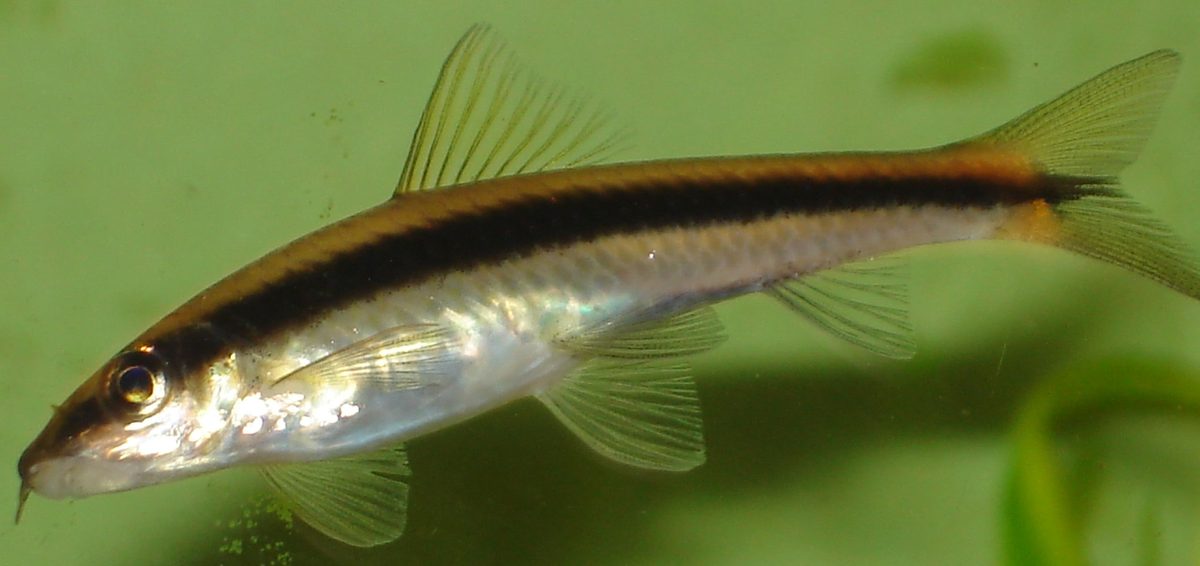
| Temperature | 20–26 °C (68–79 °F) |
|---|---|
| pH | 6.0–8.0 |
| Hardness | 5–20 °dGH |
| Volume | from 200 l (53 gal) |
| Size | up to 15 cm (5.9 in) |
| Lifespan | about 10 years |
What it is and where it comes from
The Siamese algae eater, Crossocheilus oblongus, lives in South-East Asia: the Chao Phraya and Mekong basins and the Malay Peninsula. It keeps to fast streams with a stony bottom, driftwood and submerged roots, and moves into flooded forest in the rainy season. Aquarists have known it for a long time, but its popularity arrived when people worked out that it eats black brush algae and hair algae.
That is where the confusion begins. C. langei and C. atrilimes are sold under the same name, along with false algae eaters of the genus Garra and flying foxes. On the real fish the stripe runs to the end of the caudal fin; on the impostors it stops at the tail. In the wild it reaches 15 cm, in a tank usually 7–8, but the volume still has to be ordered with a margin.
Housing and conditions
Temperature 20–26 °C, though Russian references usually give 24–26, pH 6.0–8.0, hardness 5–20 °dGH. It needs current and strong aeration, and plenty of oxygen: in warm still water it gasps.
From 200 l, otherwise the fish grows into a permanently hiding neurotic. Fine substrate, stones, driftwood, flow from a filter or a pump. Soft-leaved plants suffer once the fish is hungry. A lid is essential, since these fish jump.
It is more sensitive to organics than a barb: the first to react to acidification and high nitrate, clamping its fins and retreating to a corner. Weekly changes and vacuuming are mandatory. Strong light is not, although more algae grow under it.
Feeding
It eats algae of every kind: black brush, hair, staghorn, green film. Add spirulina tablets, blanched courgette, cucumber and spinach, and now and then bloodworm or brine shrimp. Feed once or twice a day.
Overfeeding matters because a full fish stops eating algae and starts on the plants. The belly swells and the fish hangs at the surface. One hungry day a week brings the appetite for brush algae back.
Lifespan
About ten years. In tanks usually fewer, because the fish is bought as a cleaner and kept in a small volume without current. Sources disagree: some give five to seven years, others ten. Fish from cool, flowing water are bigger and live longer.
Temperament and tank mates
Peaceful towards other fish, less so towards its own kind and similar cyprinids. Two or three will divide the territory and hound the weakest, so keep five or more. It gets on with shrimp, and may nip the fins of slow veiltailed fish. Adults are lazier than juveniles and clean the glass worse.
- good: barbs, danios, tetras, corydoras, loaches;
- avoid: bettas, veiltail forms, a handful of Siamese algae eaters;
- a group of five or more.
Diseases
Most problems come from water and from import:
- Ich. White spots and scratching. Treat in a separate tank.
- Oodinium. Golden dust, mucus, clamped fins.
- Emaciation. The fish loses weight when the tank holds no algae and no plant food.
- Injuries. Strikes against the glass after a fright, torn fins.
A vet makes the diagnosis; guessing with antibiotics does harm.
Breeding
Spawnings in hobby tanks are rare and the fry are hard to raise. Commercial fish come from farms in South-East Asia, where the species is kept in large groups in ponds. Home breeding asks for a separate tank of 100 l or more, soft water and plenty of live food.
Who it suits
A beginner, with a caveat: care is simple, but the fish needs 200 l and a group. As an algae cleaner it only works in a group and only while it is hungry. Minus points are size, jumping and a high oxygen demand. The plus is a lively fish that visibly eases the fight against brush algae. Check the stocking against the volume in the calculator.
The calculator works out water volume, weight, filter load and how many fish your tank can carry.
Open the calculator