
Amano shrimp
Amano shrimp grazes hair algae and green film, but dies from remedies with copper in them. Here are the volume, the water parameters and the moult without surprises.
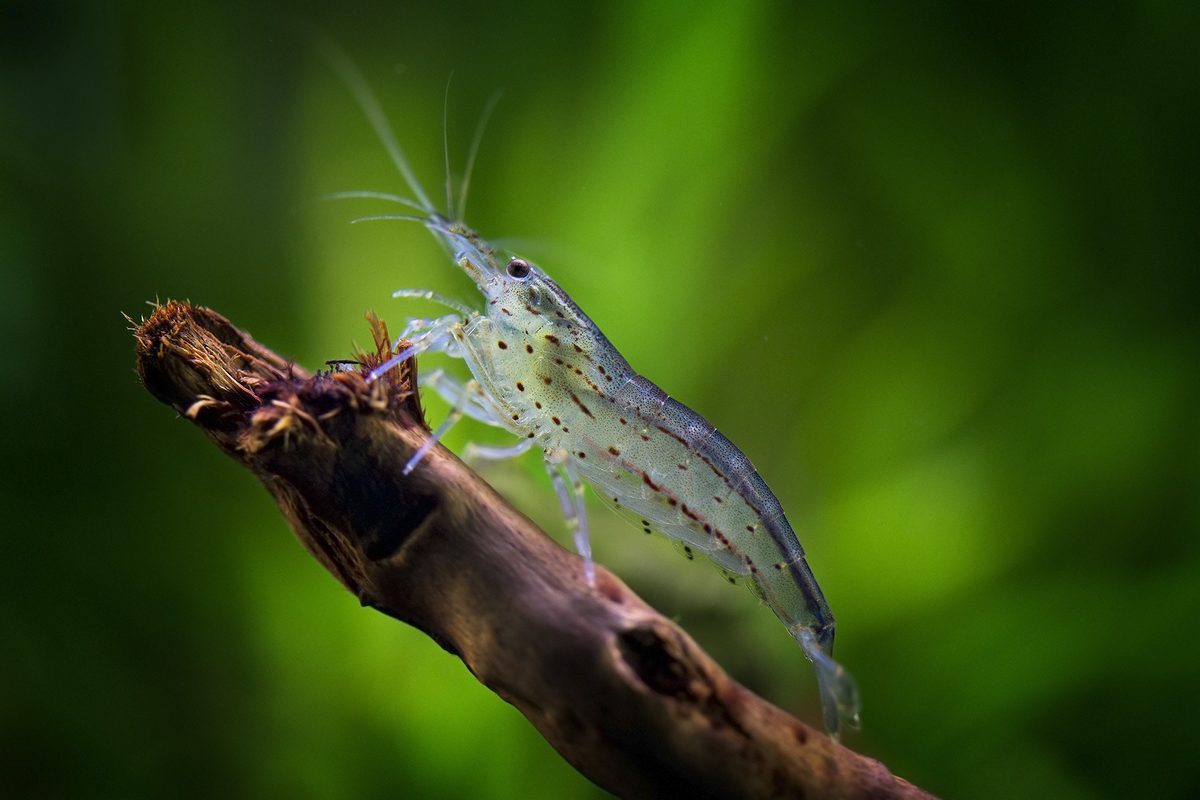
| Temperature | 20–26 °C (68–79 °F) |
|---|---|
| pH | 6.5–7.5 |
| Hardness | 4–10 °dGH |
| Volume | from 30 l (8 gal) |
| Size | up to 5 cm (2 in) |
| Lifespan | 2–3 years |
What it is and where it comes from
Caridina multidentata belongs to the family Atyidae. Its homeland is Japan and Taiwan, in fast streams where the shrimp sits on stones and overgrown driftwood. The cycle is amphidromous: the female carries eggs in fresh water, the larvae drift to the sea and return to the rivers grown.
Takashi Amano brought the shrimp into the hobby in the early 1980s, hence the common name. Until 2006 it was listed as Caridina japonica, then the taxonomy was revised. In Japanese it is called yamatonumaebi.
Housing and conditions
Temperature 20–26 °C (68–79 °F), with short rises to 28 °C (82 °F) that adults survive but live shorter for. pH 6.5–7.5, hardness 4–10 °dGH, carbonate hardness 1–4 °dKH. Soft acid water makes moulting hard, so keep GH at 4 or above.
From 30 l (8 gal) for a group, calmer at 50–60 l (13–16 gal). Flow moderate: the shrimp likes to sit in the current, but a powerful internal filter blows it away and pulls it into the rotor. Cover the intake with sponge, or use a sponge filter on an airlift. A lid is essential, as Amano shrimp climbs hoses onto the floor.
Dark, fine substrate. Moss, ferns and floating plants give cover and grazing, and any light will do as long as they grow. The main chemical limit is copper: such remedies kill shrimp within hours, and traces turn up in tap water from old pipes.
Feeding
The diet is grazing: diatoms, green algae, detritus, bacterial film. Supplement 2–3 times a week with spirulina tablets, flakes, blanched courgette, spinach or a dried almond leaf. Protein rarely, as bloodworm or brine shrimp.
Overfeeding: cloudy water, brown flakes on the bottom. Shrimp are sensitive to organic matter: in a rotting tank a bacterial bloom starts, and a whole group dies within days. Underfeeding is safer than feeding twice a day.
Lifespan
Usually 2–3 years, with some females reaching 4. At 28 °C (82 °F) the figure drops: metabolism speeds up, moults come more often, wear is faster.
Temperament and tank mates
Peaceful and timid. In a group of 6–8 it comes out into the open; a lone shrimp hides and feeds poorly. Small, non-predatory fish are acceptable: tetras, danios, guppies, corydoras, small rainbowfish.
Not with large cichlids, loaches, pufferfish, gouramis or any fish that tries everything on its teeth. Crayfish and predatory snails are poor company too: Helena will not take an adult Amano, but picks off weakened and moulting ones.
Problems
- Copper poisoning. Shrimp dash about, fall on their side and die in batches. There is no treatment; move them to clean water without copper.
- Failed moult. The shrimp gets stuck in the old skin or comes out with a white rim on the shell. The cause is low GH and KH: raise hardness and add a mineral supplement.
- Bacterial infection. The body turns cloudy, the shrimp lies on its side and does not eat. Move it out, remove rotting organic matter, check nitrate.
- Escape. They turn up on the floor behind the cabinet. The insurance is a lid and sponge in the gaps.
A specialist diagnoses exactly, but with invertebrates it is easier to move the animal to clean water and level the parameters than to treat blindly.
Breeding
It does not breed in a freshwater tank. Amano larvae need several salt-water stages; without the marine phase they do not develop. Enthusiasts raise them in brackish water, but the result is unstable. Shops almost always sell imported shrimp.
Who it suits
A beginner, provided they keep the water stable and do not pour remedies into a community tank. 30 l (8 gal) is enough, and six shrimp will also live in a larger planted tank. Drawbacks: copper sensitivity, escape attempts, no breeding. One advantage, but weighty: it really does graze hair algae and the green film on stones.
The calculator works out water volume, weight, filter load and how many fish your tank can carry.
Open the calculator