
Telescope goldfish
A short-bodied goldfish with bulging eyes that needs a cool tank of 100 l or more and careful decor. Here is what it eats and what it suffers from.
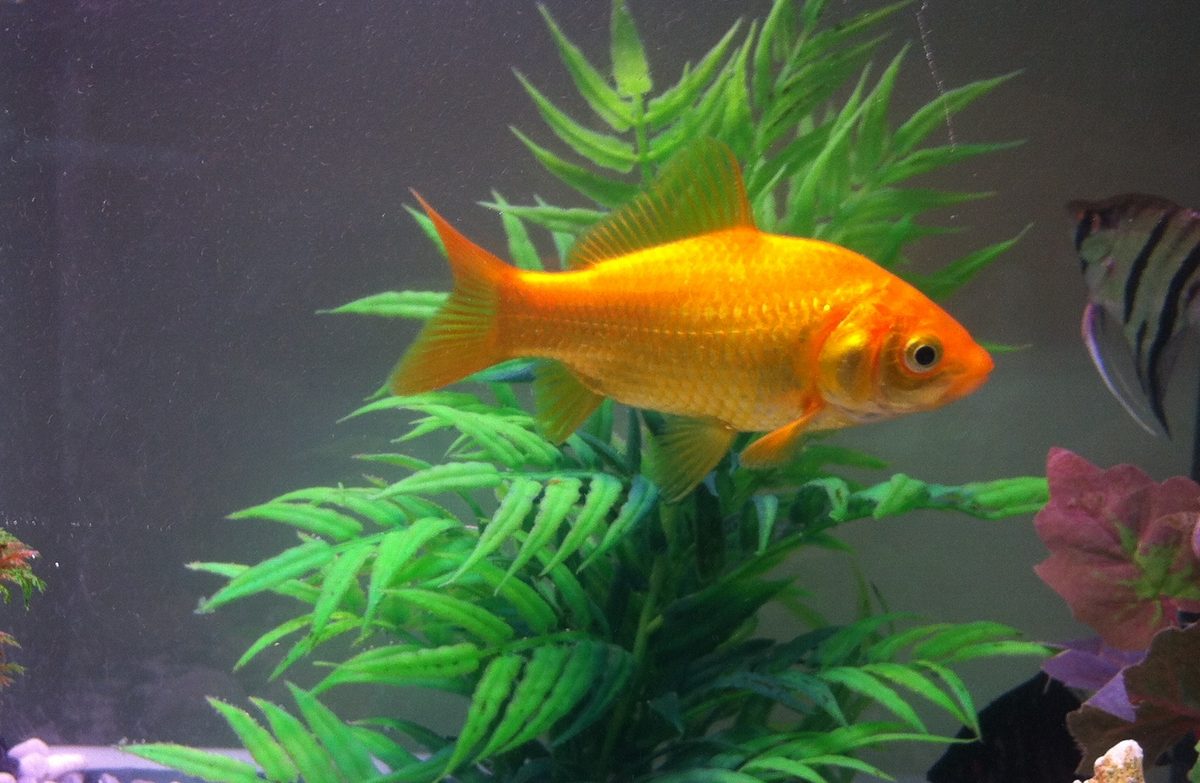
| Temperature | 12–28 °C (54–82 °F), best at 18–22 °C |
|---|---|
| pH | 6.5–8.0 |
| Hardness | up to 20 °dGH |
| Volume | from 60 l (16 gal) per pair |
| Size | up to 20 cm (7.9 in) |
| Lifespan | up to 15 years |
What it is and where it comes from
The telescope, or demekin, is a short-bodied goldfish with huge bulging eyes. No such fish exists in the wild: the form is all selection. Most short-bodied breeds come from China, which passed them to Japan and then to the world.
Pierre Carbonnier brought telescopes to Europe in 1872, and the same year two females went to Russia, to A. S. Meshchersky. By the early twentieth century Moscow aquarists had lines of their own, and the black telescope with ruby eyes, bred by Andrianov in 1941, was known abroad.
Housing and conditions
Literature gives 12–28 °C, but the comfortable corridor is 18–22. Above 26 life gets harder, since warm water holds less oxygen. pH 6.5–8.0, hardness up to 20 °dGH, though many live in soft water.
60–80 l per pair, an adult better in 100 l. A round bowl will not do: the fish needs room to turn and the filter will not fit. Weak current, strong filtration, 25–30% changed weekly; the calculator sizes a tank.
Coarse rounded substrate, as telescopes dig and swallow small pieces. No sharp edges on the decor, or eyes and fins suffer. Bright light. Live plants get torn up: use Anubias, Cryptocoryne or plastic. The eyes finish forming by six months, stalks reaching 2 cm. It grows to 20 cm, less in a tank.
Feeding
Omnivores. Base: a quality goldfish food with plant content, plus daphnia, bloodworm, cucumber or spinach. Two or three feeds a day, a portion eaten in as many minutes, one fasting day a week.
Overfeeding shows as a bloated belly and a fish hanging at the surface or lying on the bottom, then swim bladder trouble, obesity and cloudy water. Telescopes see poorly and find food slowly, so in a community they get the least.
Lifespan
Up to 15 years for short-bodied fish, 40 for long-bodied, but those figures assume ideal conditions and few pass the upper limit in a tank. Volume, temperature and water quality decide the rest.
Temperament and tank mates
Calm, slow and short-sighted. Best with other short-bodied goldfish, the veiltail, oranda and ryukin. The comet is a poor match: faster, first to the food and happy to chase.
Barbs, cichlids, tetras and black widows nip fins and damage eyes, and small fish simply disappear. Tropical neighbours are ruled out by temperature, since a telescope wants it cooler.
Diseases
Ich. White spots, the fish rubbing on decor. Quarantine and antiparasitics, temperature raised slowly, as goldfish take 30 °C badly.
Fin rot. The fin edge whitens and frays, usually from dirty water. Start with changes and vacuuming; antibacterials by prescription.
Eye injuries. Clouding and swelling after a knock or a fight. Remove sharp objects, keep the water clean, isolate at any sign of infection.
Swim bladder. The fish swims on its side or cannot rise. Fasting and softened food often help; advanced cases do not recover.
Fungus. Cottony growths on grazes. Antiseptics and clean water, medication once the infection is advanced.
A vet makes the diagnosis; guessing with antibiotics does harm.
Breeding
Maturity at about a year: the male develops tubercles on the gill covers, the female's belly rounds out. A tank from 100 l, a grid on the bottom, fine-leaved plants, one female and two males, a water change and a rise in temperature as the trigger. You get 2,000–10,000 eggs, the larva hatches in two days and the fry swim on the fifth, starting on rotifers then brine shrimp nauplii. Breeders are hard to choose, and the bulging eyes appear only by six months.
Who it suits
A first aquarium with caveats: the fish is tough but needs 100 l per pair, cool water and a species tank. Minus points: heavy waste, torn plants, vulnerable eyes, careful decor. Plus: it forgives parameter mistakes if the water is changed on time. Budget time for the weekly clean.
The calculator works out water volume, weight, filter load and how many fish your tank can carry.
Open the calculator