
Swordtail
A livebearer with a sword on its tail. Its temper depends on how many females share the tank and on whether the lid is closed.
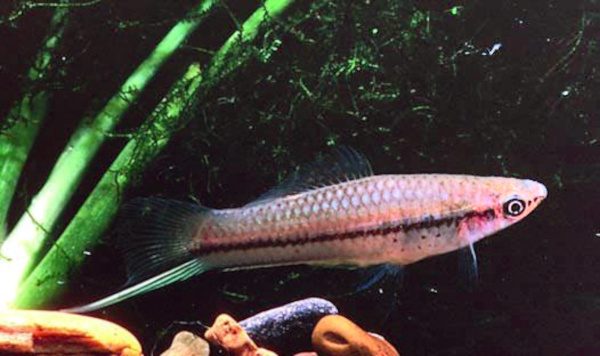
| Temperature | 20–26 °C (68–79 °F) |
|---|---|
| pH | 7.0–8.0 |
| Hardness | 8–20 °dGH |
| Volume | from 60 l (16 gal) |
| Size | up to 12 cm (4.7 in) |
| Lifespan | 3–5 years |
What it is and where it comes from
Heckel described the swordtail in 1848 and named it after Karl Heller, who brought it from Mexico to Vienna. Its range is south-eastern Mexico, Guatemala, Belize and Honduras, and it has been kept in aquariums since 1864.
The wild form is olive with a red stripe. The colours came from hybridisation with the platy, so shop fish often have no clean "sword" but carry foreign genes. Females are larger: up to 16 cm (6.3 in) in the wild, 8–10 cm in aquariums without the sword.
The swordtail went around the world with people: stable populations exist in the United States, Africa, Australia and India, where it has pushed out native fish and counts as invasive.
Housing and conditions
Temperature 20–26 °C. The swordtail takes cool water better than many livebearers: Seriously Fish gives 16–28 °C, and a short spell at 18 °C is no trouble. pH 7.0–8.0, hardness 8–20 °dGH, more important than for guppies: in soft water it holds its shape worse and falls ill more often.
Volume: from 50 l (13 gal) per harem, 80–100 l better, and adults want a 120×30 cm footprint. Moderate current, a filter with aeration, bright light, dense plants at the sides, open water, dark substrate, and a lid, as swordtails jump and end up on the floor.
Feeding
Omnivorous; in the wild it eats insects, algae and detritus. In an aquarium, flakes, granules, bloodworm, brine shrimp, and always something vegetable: spirulina, spinach. Feed once a day, and a weekly fasting day is useful.
Overfeeding shows as a heavy belly and apathy. Swordtails overeat and can go a week without food unharmed, so hunger is not the danger, obesity and constipation are. Spare food also raises nitrate.
Lifespan
Up to 5 years in good conditions, more often 3–4. Males barely grow after maturity and live less than females. Hybrid lines with veiltail fins are weaker than wild stock and go earlier.
Temperament and tank mates
Calm with other species, intolerant of its own males: in a tight tank they fight until someone is damaged. Keep one male to two or three females, or a group of three or more males so that the aggression spreads. Cover from driftwood and plants cuts injuries, as the losing male goes into the thickets instead of hitting the glass.
Tank mates: mollies, platies, zebrafish, black skirt tetras, tetras, corydoras, bristlenose plecos. Not: large cichlids, veiltail bettas and goldfish, as a slow fish with long fins gets chewed.
Diseases
The usual problems:
- Ich: white spots, the fish scratches. Treated with antiparasitic medication as directed.
- Fin rot: fin edges turn white, especially after fights and in dirty water.
- Dropsy: a swollen body, scales standing out, refusal to eat. At a late stage it is almost impossible to save.
- Pigment tumours: dark lumps on the body of hybrids, a hereditary trait. There is no treatment, and the fish is isolated.
A vet makes the diagnosis; antibiotics at random do harm.
Breeding
A livebearer. Pregnancy runs 4–6 weeks, and the female delivers 15–100 fry, usually in the morning. She can store sperm and produce another brood without a male; now and then a female turns male, especially when males are scarce. The fry are large and eat brine shrimp nauplii from birth. In a community tank they get eaten, so a female about to give birth moves to plants; the fry stay near the bottom at first, so thickets are essential. Maturity comes at 5–6 months.
Who it suits
A beginner with a tank from 60–80 l and hard water. The fish is tough and showy, but needs company and a lid. Minus: males fighting, jumping, hybrid health and a tendency to overeat. It suits neither soft water nor a nano tank. To check the load on your tank, use the calculator.
The calculator works out water volume, weight, filter load and how many fish your tank can carry.
Open the calculator