
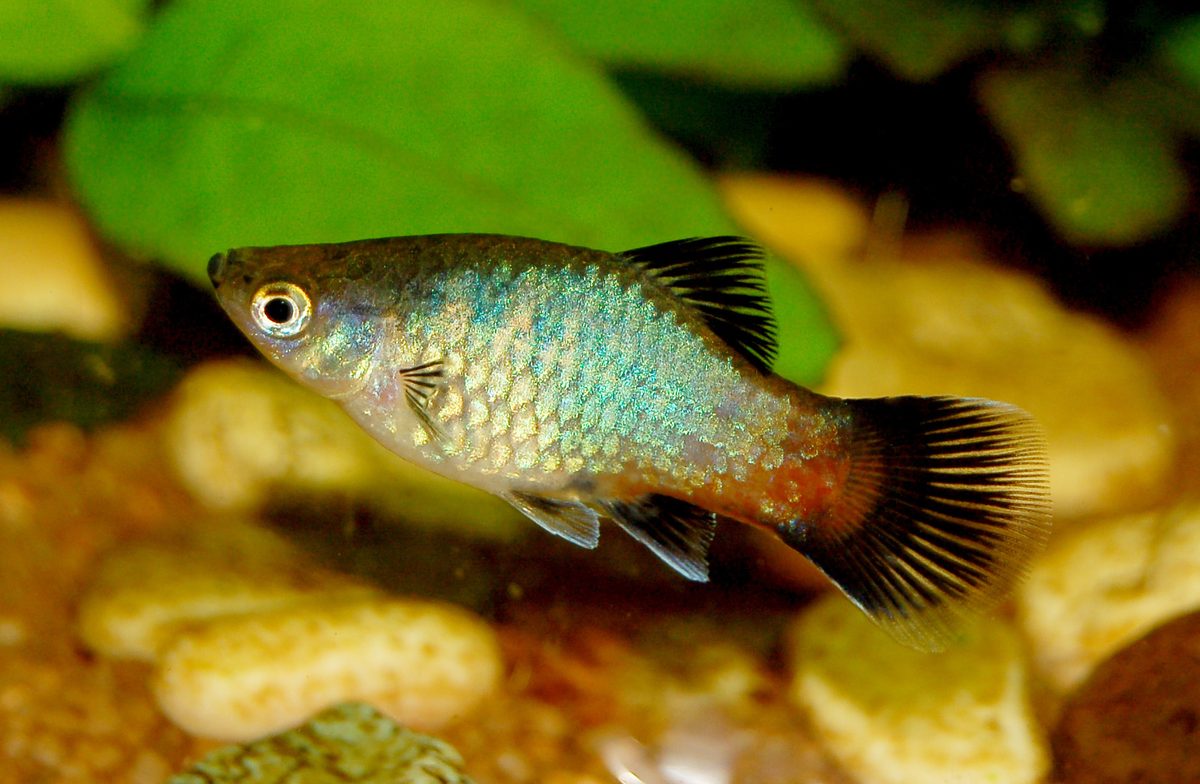
Platy
A peaceful livebearer that breeds without any help from its owner. A good first fish, provided the tap water is hard enough for it.
| Temperature | 20–26 °C (68–79 °F) |
|---|---|
| pH | 7.0–8.2 |
| Hardness | 10–25 °dGH |
| Volume | from 50 l (13 gal) |
| Size | up to 5 cm (2 in) |
| Lifespan | 2–4 years |
What it is and where it comes from
Günther described the southern platyfish in 1866. Its range is the Atlantic slope from Veracruz to northern Belize and Nicaragua, in slow streams, ditches and warm springs. No wild fish are sold: everything in the shops is hybridised with the swordtail, and some breeds also with the three-colour platy.
That is where the naming confusion starts. "Platy" in everyday use means Xiphophorus maculatus, while the scientific genus Poecilia contains guppies and mollies. There are dozens of bred forms: Mickey Mouse, wagtail, tuxedo, moon, red, blue.
The platy has three types of sex chromosome, W, X and Y, and the sex of the brood depends on their combination. So a single drop can hold both females and males, and individual fish change sex during their lives.
Housing and conditions
Temperature 20–26 °C (68–79 °F), though sources disagree: English Wikipedia gives 18–25 °C, FanFishka 24–27 °C. pH 7.0–8.2, hardness 10–25 °dGH. In soft, acidic water the platy does worse than in hard water, so hardness is better kept by testing than by eye.
A tank from 50–60 l (13–16 gal) with a 60×30 cm footprint. Weak current, a quiet filter, bright light, live plants, dark substrate. A lid is needed, because the fish is active and jumps out. Females use cover from driftwood and thickets when they tire of male attention.
Feeding
Omnivorous; in the wild it eats insects and algae. In an aquarium, flakes, granules for livebearers, daphnia, brine shrimp, vegetable supplements. Plant food is needed for the gut: without it the platy starts nibbling tender leaves. Feed once or twice a day, a portion in two minutes.
Overfeeding is a constant with platies: the fish begs for food and takes whatever it is given. The belly gets heavy, the fish settles on the bottom and females stop delivering. Uneaten food rots, nitrate climbs and the water greens quickly.
Lifespan
2–4 years. FanFishka writes about four years, while some aquarists on forums say two. The spread is explainable: temperature, feeding and line quality matter more than it seems. In cool water at 20–22 °C the fish lives longer than at 26–27 °C.
Temperament and tank mates
The most peaceful of the livebearers. Even males hardly ever clash, and several males can share a tank. It does not bother its neighbours, though it may eat small fry and shrimp; larger shrimp and snails are safe.
Tank mates: swordtails, mollies, black skirt tetras, zebrafish, corydoras. Not: large cichlids and predators. The platy crosses with the swordtail, so keep one or the other if you do not want hybrids.
Diseases
Most common:
- Ich: white spots, scratching against stones. Treated with antiparasitic medication as directed.
- Fin rot: cloudy edges on the fins and tail, usually in dirty water.
- Fungus on injuries: cottony growths, especially after fights or a move.
- Obesity: a heavy belly, little movement. Fasting days help.
A vet makes the diagnosis; antibiotics at random do harm.
Breeding
A livebearer, and breeding it is easier than holding it back. Pregnancy runs 4–6 weeks, and the female drops 20–40 fry, large females up to 80. The fry are ready to eat at once and grow fast. In a community tank part of the brood survives in the thickets with no help from the owner. If no offspring are wanted, keep males only: females from a mixed group are almost always already pregnant and deliver several more times without a male.
Who it suits
A beginner and a child: the fish is peaceful, tough and eats anything. It needs a tank from 50 l with hard water and a lid. Minus: a short life, weak genetics in shop lines and endless fry. For soft water or a planted tank with CO₂ it is a poor choice. To work out the stocking density, use the calculator.
The calculator works out water volume, weight, filter load and how many fish your tank can carry.
Open the calculator