
Endler's guppy
A tiny livebearer from Venezuela that lives in a nano tank and breeds on its own. The hard part is not buying a hybrid sold as a pure line.
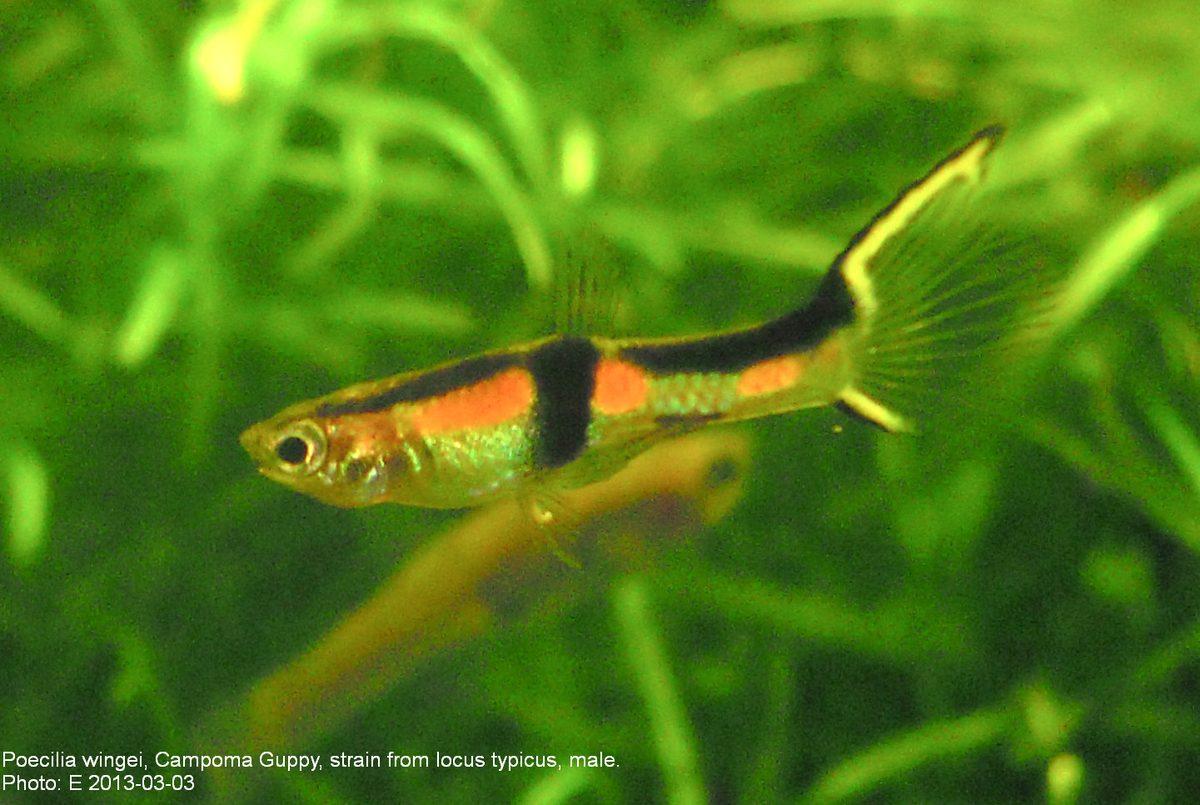
| Temperature | 24–28 °C (75–82 °F) |
|---|---|
| pH | 7.0–8.5 |
| Hardness | 10–25 °dGH |
| Volume | from 20 l (5 gal) |
| Size | up to 3 cm (1.2 in) |
| Lifespan | 1.5–2.5 years |
What it is and where it comes from
Franklin Bond first caught Endler's guppy in 1937 in the Patos lagoon in northern Venezuela. The species did not interest science at the time, and the fish was long thought extinct until John Endler found it again in 1975. The name Poecilia wingei appeared only in 2005. Besides Patos there are the Campoma and El Tigre populations, kept as separate lines without mixing.
By then the lagoon was full of rubbish, and in 2024 the species went onto the IUCN Red List. In aquariums it survives through breeders, but pure lines are few: it crosses with the common guppy and produces fertile offspring.
Housing and conditions
Temperature 24–28 °C (75–82 °F). Seriously Fish gives 24–30 °C, FanFishka 20–28 °C with an optimum of 25–26 °C. Above 28 °C the fish lives faster and goes earlier. pH 7.0–8.5, hardness 10–25 °dGH. In soft water it survives, but the colour dulls and females produce fewer fry.
A tank from 20–30 l (5–8 gal); for a colony 40 l and a 45×30 cm footprint are better. Moderate current and a weak filter, since Endler's guppies dislike strong flow. Diffuse light, dense plants, floating plants very welcome, dark substrate. A lid is mandatory, as the fish jumps.
Feeding
Omnivorous; in the wild they pick up small benthos and detritus. In an aquarium, flakes, microworm, brine shrimp nauplii, daphnia. Feed once or twice a day, and the portion should be eaten within a minute.
Overfeeding looks like a heavy female that stops delivering and a fish hanging at the surface. Spare food spoils the water in a small tank within a day, so underfeeding is safer than overfeeding.
Lifespan
1.5–2.5 years. FanFishka writes of a year to two and a half, which is close to practice: males live less than females, and high temperature shortens life. So the colony is refreshed with young fish now and then. That is the price of being small.
Temperament and tank mates
Peaceful; males dance in front of females all the time, but there are no fights. Keep one male to two or three females, or the attention is spread unevenly. Females sometimes divide territory and chase each other, so the tank needs thickets and floating plants: in open water weaker females suffer.
Tank mates: small tetras, zebrafish, corydoras, rasboras. Not: common guppies, swordtails and mollies, large fish. It crosses with the common guppy and produces hybrids, and a large fish eats it whole.
Diseases
What turns up most often:
- Ich: white spots, clamped fins. Treated with antiparasitic medication as directed.
- Fin rot: ragged tail edges, usually after an injury or dirty water.
- Wasting: the fish loses weight with a normal appetite and the back becomes sharp. Causes range from parasites to mycobacteria.
- Columnaris: a white patch at the mouth, then a quick death. Quarantine is needed.
A vet makes the diagnosis; antibiotics at random do harm.
Breeding
Livebearers, and breeding runs by itself. The female delivers every 22–24 days, from 5 to 25 fry depending on age and size. The fry are large and take nauplii and crushed flakes from day one. Males colour up by 3–5 weeks, maturity comes at 2–3 months. No separate tank is needed, thickets are enough; in a dense colony the fish regulates its own numbers. A pure line is kept apart from common guppies, because one stray male is enough for the colour to blend within two generations.
Who it suits
A beginner with a nano tank from 20–30 l. The fish is tough, needs little space and produces offspring without effort. Minus: a short life, constant hybrids sold as pure Endler's and a tendency to overcrowd. It is no fish for a community tank with large fish. To see how many fish your tank can hold, use the calculator.
The calculator works out water volume, weight, filter load and how many fish your tank can carry.
Open the calculator