
Bristlenose pleco
A bristlenose pleco cleans the glass while young and needs driftwood for life. Tank size, temperature, feeding, and why the fish pales and loses weight.
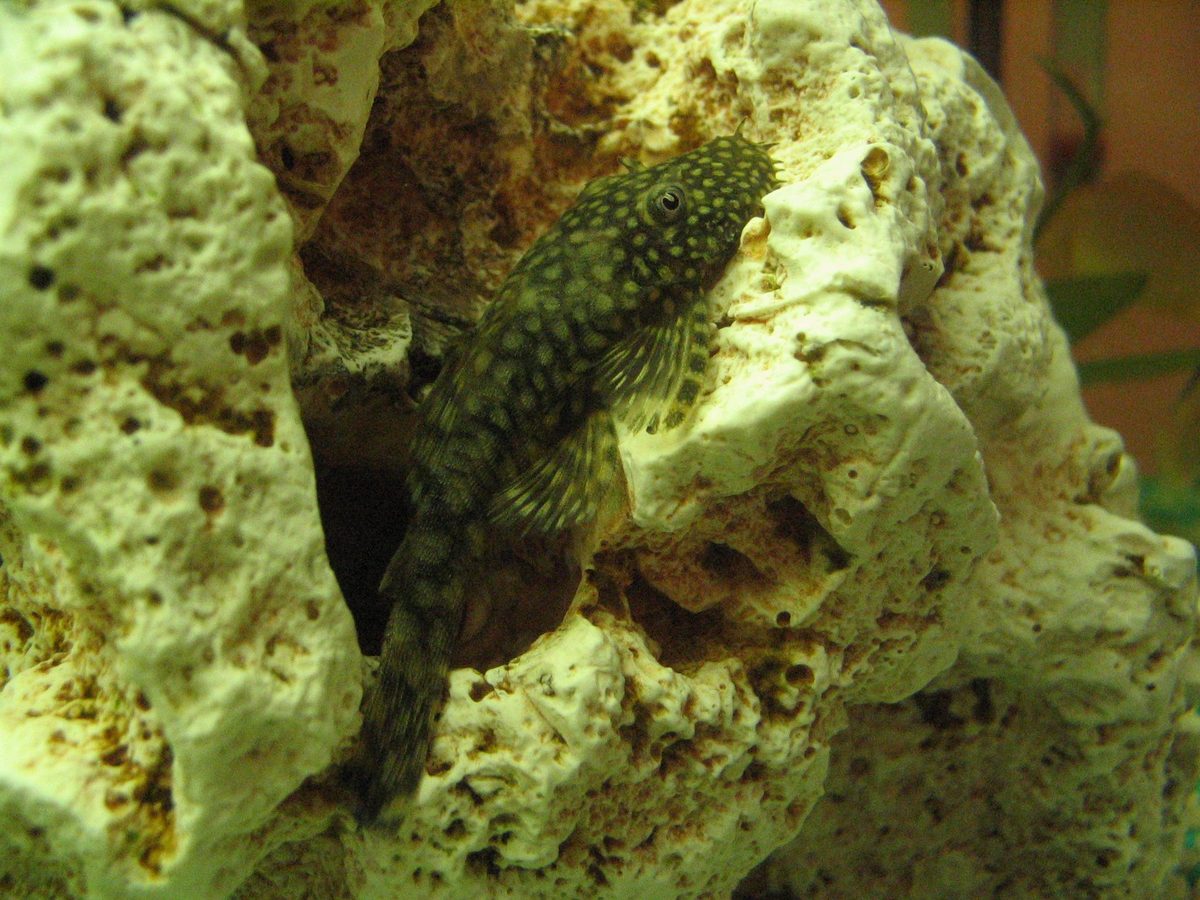
| Temperature | 23–27 °C (73–81 °F) |
|---|---|
| pH | 6.5–7.5 |
| Hardness | up to 20 °dGH |
| Volume | from 50 l (13 gal) |
| Size | up to 15 cm (6 in) |
| Lifespan | 5–8 years |
What it is and where it comes from
The bristlenose pleco is an armoured catfish from the Amazon basin. In the wild it holds in fast current on stones and driftwood, scraping growth off with a wide mouth lined with horny bumps, hence the second name, suckermouth catfish.
Kner described Ancistrus dolichopterus in 1854. It reached Russia in the 1970s and was soon common; almost everything in the shops is farm-bred. Some fish sell as Ancistrus sp., as the pure species is long mixed with selected forms: albino, longfin, starlight, red.
Housing and conditions
Temperature 23–27 °C. The upper limit matters more: at 30 °C the fish hides, stops eating and pales. Sources range from 22 to 28 °C; hot weather calls for stronger aeration.
pH 6.5–7.5, hardness up to 20 °dGH. Soft acidic water is not required, and settled tap water does for years. Change 25–30% a week: the fish is big, the waste is heavy and nitrate climbs fast.
Tank from 50 l for one, a pair from 80 l. Current is welcome, and the intake needs a sponge or mesh, since the fish gets into gaps and tubes. Fine substrate, no sharp edges, diffused light: under bright light it hides all day.
Driftwood is mandatory, not decor but digestion: the wood supplies cellulose and microorganisms. Without it, bloating and constipation start. It leaves plants alone when fed, but a hungry fish punches holes in soft leaves.
Feeding
The base is vegetable: spirulina tablets, catfish wafers, blanched courgette, cucumber, pumpkin, lettuce leaf. Feed in the evening before lights out, and remove leftovers after 8–12 hours.
Protein weekly: bloodworm, brine shrimp, tubifex. Overfeeding it leads to obesity, and the fish cannot lose weight. A swollen belly and cloudy water give it away, and in a crowded tank it triggers a nitrate spike. The load on a tank that size is easy to estimate in the calculator.
Lifespan
Usually 5–8 years, some reach 10. Warm water speeds metabolism, so the fish grows quicker and lives less. Cold and hunger do not extend life either.
Temperament and tank mates
Indifferent to tank mates; shares territory only with other armoured catfish. Two males in a small tank without caves fight at night, and a sailfin pleco may clash over driftwood.
Small tetras, guppies, barbs, angelfish and gouramis work. Discus carry a risk: the pleco attaches at night to the flat body and damages the slime coat. Large aggressive cichlids are poor company.
Diseases
- Bloating. Belly swollen, fish listless, off food: no driftwood or too much protein. Driftwood, vegetables and a two or three day fast help.
- Emaciation. Sunken belly, hip bones showing. The pleco eats slowly at night, quick tank mates get there first, so food goes near its cave after lights out.
- Ich. White grains on body and fins. Treat per the label; salt in a community tank is out, as plants and some fish tolerate it badly.
- Injuries. Torn fins, grazes on the sucker, usually from sharp substrate, decor gaps or a filter without a sponge.
A vet makes the diagnosis; blind antibiotic treatment does harm.
Breeding
One of the few catfish that breeds on its own, without hormones. A tube or coconut shell with an entrance slightly wider than the male suffices. He cleans the cave, the female lays 30–200 orange eggs and leaves; the father guards the clutch. Eggs develop in 4–7 days, then the larvae sit on the yolk for 3–4 more. Take the male out once the fry spread across the tank.
Who it suits
A beginner: it forgives mistakes in water chemistry, needs no RO water and breeds reliably. A tank from 50 l for one, a pair from 80 l. Three drawbacks: night activity, the driftwood and the habit of getting into the filter. And it does not clean glass the way the shop promises: it grazes algae, but underfed it damages plants.
The calculator works out water volume, weight, filter load and how many fish your tank can carry.
Open the calculator