
Betta
One male in a small tank lives longer and looks brighter than he does in a community aquarium, as long as you do not overfeed him or house him with fish that nip his fins.
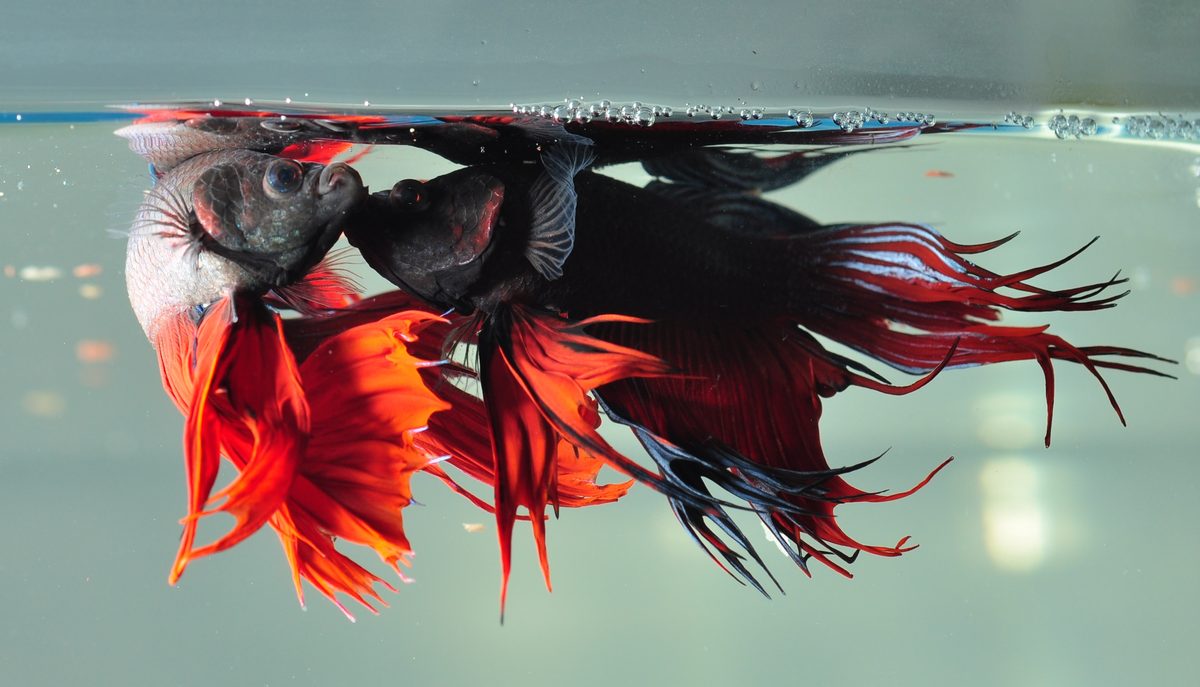
| Temperature | 24–28 °C (75–82 °F) |
|---|---|
| pH | 6.5–7.5 |
| Hardness | 5–15 °dGH |
| Volume | from 10 l (2.6 gal) |
| Size | up to 6 cm (2.4 in) |
| Lifespan | 2–4 years |
What it is and where it comes from
The betta, or Siamese fighting fish (Betta splendens), comes from Southeast Asia: Thailand, Cambodia, Vietnam. Wild fish keep to still water, rice paddies, ditches and shallow backwaters thick with plants. A labyrinth organ lets them breathe air, so low oxygen is no death sentence.
Bettas reached Europe in the late 19th century, and breeding followed fins and colour. Wild fish are olive grey with short fins. Males reach 5–6 cm (2–2.4 in), females a centimetre less. Today's veiltail, crowntail and plakat strains are breeder work, and they carry weak health.
Housing and conditions
Temperature 24–28 °C, though some sources give 22–30; steady 25–26 °C is safer. pH 6.5–7.5, hardness 5–15 °dGH. Ten litres is the minimum, but there a male lives alone and needs frequent water changes; 20–30 l with cover and plants is more reliable.
A gentle filter, a nearly invisible current: veil fins dislike flow. Aeration is optional, but the surface must stay open, and a lid is mandatory because bettas jump. Light 8–10 hours, dark substrate, broad-leaved plants and floaters. Estimate your tank's volume in the calculator.
Feeding
Base: good betta pellets, plus bloodworms, brine shrimp, daphnia and tubifex. Live food is rinsed and never taken from doubtful waters. Feed once or twice a day, a portion eaten in 2–3 minutes, with one fasting day a week.
Overfeeding shows at once: a swollen belly, the fish hanging at the surface or lying on the bottom, long pale droppings. Constipation, swim bladder trouble and dirty water follow.
Lifespan
Usually 2–4 years. Sources say "no more than three" and "up to five"; the spread is conditions and fish quality. Mass-farmed bettas live shorter, often from inbreeding and chronic digestive trouble. Below 23 °C and with rare water changes the time shrinks further.
Temperament and tank mates
A male is territorial and hounds a second male in a small tank. Females can be kept as a group apart from him. Calm companions: corydoras, rasboras, small tetras, otocinclus. Guppies and barbs are a bad idea: the first tempt him, the second nip fins. Goldfish, large cichlids and pufferfish are out.
Temperament varies even with peaceful fish. One betta ignores its neighbours, another chases the rest into stress. For the first few days, do not leave the fish unattended.
Diseases
Five problems turn up most often.
- Fin rot. Fin edges go white, tear and grow a film. Clean water and mild antibacterials first; advanced cases need a vet.
- Ich. White spots the size of semolina grains, and the fish rubs on the decor. Raise the temperature to 28–30 °C and follow the ich remedy dose.
- Velvet. Golden dust, clamped fins, rapid breathing. Copper-based products, light dimmed during treatment.
- Dropsy. Scales stand out, the belly swells, the eyes bulge. The outlook is poor, and without a vet the fish usually dies.
- Constipation and swim bladder trouble. The fish swims on its side or sinks. Fasting and softened peas help, but look for the cause in feeding and water.
A vet makes the exact diagnosis; blind antibiotic treatment does harm.
Breeding
The male builds a bubble nest and the female lays 100–300 eggs. Spawning tank 15–20 l, water 10–15 cm deep, 28 °C, soft, with cover for her. Afterwards she is removed and he guards the nest; five days later he goes too.
Fry start on infusoria, then brine shrimp nauplii. The difficulty is not spawning but raising the young without losses or defective fish.
Who it suits
A beginner does fine with one male in 10–20 l with a filter, heater and lid. For a community tank the betta is a poorer choice: tank mates need care and veil fins damage easily. It is short-lived, prone to overfeeding, and show lines fall ill. Still, no school is needed and small volumes suit it if you watch the water.
The calculator works out water volume, weight, filter load and how many fish your tank can carry.
Open the calculator