
Corydoras
A corydoras cleans the bottom but does not replace siphoning. A school of five catfish needs sand, cover and 50 litres, not a glass bowl.
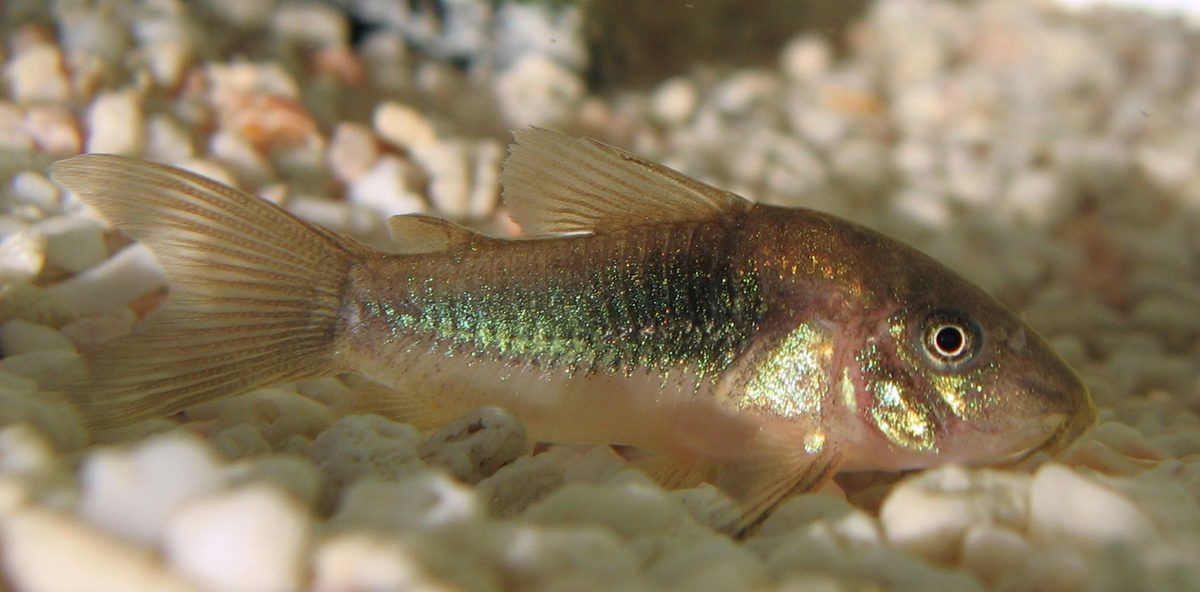
| Temperature | 22–26 °C (72–79 °F) |
|---|---|
| pH | 6.5–7.5 |
| Hardness | 2–15 °dGH |
| Volume | from 50 l (13 gal) |
| Size | 6–7 cm (2.4–2.8 in) |
| Lifespan | 6–10 years |
What it is and where it comes from
Corydoras is a genus of armoured catfish from South America, from Trinidad to La Plata. Most often kept are the peppered cory (Corydoras paleatus) and the bronze cory (C. aeneus). They live in shallow streams, oxbows and swamps with a silty bottom, often in muddy water. The peppered cory reaches 7 cm (2.8 in), the male 1–2 cm less.
The genus holds more than 160 species and new ones keep being described. The catfish reached Europe at the end of the 19th century and quickly became common in the lower layer. Bony plates and sharp spines protect them, and a prick from one hurts a human too.
Housing and conditions
Temperature 22–26 °C, pH 6.5–7.5, hardness 2–15 °dGH. Volume from 50 l (13 gal) for a group of 5–6, since corydoras school and alone they hide and feed poorly. Substrate: sand or rounded gravel, as sharp gravel injures the barbels.
A moderate filter, a calm current, dim light. Cover from driftwood, ceramic tubes and plants. Corydoras breathe air and periodically rise to the surface, which is normal. Water changes of 20–25% a week, and siphoning is mandatory. They tolerate salt badly. Work out the volume in the calculator.
Feeding
Sinking tablets and pellets for bottom fish, plus bloodworms, brine shrimp and daphnia. The corydoras takes food from the substrate, so flakes are useless. Feed in the evening or before lights out, once or twice a day.
Overfeeding is rare but leads to obesity and swim bladder trouble. Do not add food with a margin: the corydoras picks up everything that falls and easily overeats. A portion should be eaten in five minutes.
Lifespan
6–10 years, some individuals 12–15. The peppered cory lives longer at 20–22 °C than in warm water. Time depends on nitrates and substrate: in silted sand with rare siphoning the fish fall ill more often.
Temperament and tank mates
A peaceful bottom catfish that bothers no one. Tank mates: neons, guppies, rasboras, angelfish, small tetras. Not with large aggressive cichlids, which see it as food, or loaches, which compete for the bottom.
Corydoras enjoy their own company, at least 5–8 fish. They share food with other bottom fish, but fights are unusual.
Diseases
Catfish rarely fall ill in clean water, but five problems happen.
- Ich. White spots, the catfish rubs against the substrate and breathes fast. Raise the temperature to 26–28 °C and follow the remedy dose.
- Fungus on the barbels and fins. White cottony film, and the barbels get shorter. Clean water and antifungal remedies first, and look for the cause in organic matter on the bottom.
- Obesity. The belly swells, and the fish lies on the bottom after eating. A fasting day and a smaller portion help.
- Nitrate poisoning. Listlessness, refusal to feed, reddened gills. Water changes and siphoning are needed, not medication.
- Injuries from sharp substrate. Damaged barbels and belly that become infected quickly. Change the gravel to sand or rounded stones.
A vet makes the exact diagnosis; blind antibiotic treatment does harm.
Breeding
Spawning is triggered by a change of cool water and stronger aeration, imitating the rainy season. A group of 4–6 males and 2–3 females goes into a 30–50 l tank at 22–24 °C. The female lays 100–200 eggs on the glass and plants.
Parents and neighbours eat the eggs, so the clutch is moved to a separate container or the breeders are taken out. Fry eat infusoria, then microworms and brine shrimp nauplii.
Who it suits
The corydoras suits a beginner: undemanding, harmless to plants, long-lived. It needs 50 l or more, sand and a school of 5–6. It stays at the bottom, so siphoning is unavoidable, and it is sensitive to nitrogen wastes. Still, it bothers no one and gets along with almost any peaceful fish.
The calculator works out water volume, weight, filter load and how many fish your tank can carry.
Open the calculator