
Neon tetra
A neon looks its best only in a school and in soft, slightly acidic water. In a new tank it dies from pH swings more often than from disease.
| Temperature | 21–25 °C (70–77 °F) |
|---|---|
| pH | 6.0–7.2 |
| Hardness | 4–15 °dGH |
| Volume | from 60 l (16 gal) |
| Size | up to 4 cm (1.6 in) |
| Lifespan | 2–4 years |
What it is and where it comes from
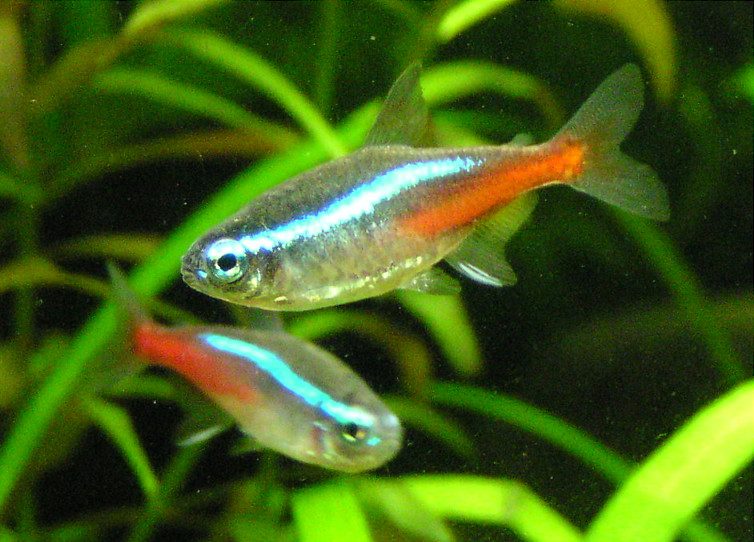
The blue, or common, neon (Paracheirodon innesi) lives in the upper Amazon, in the Putumayo and Purus on the border of Peru, Colombia and Brazil. It keeps to forest streams with acidic, soft water, under a canopy where light is scarce and the bottom lies under leaves. It grows to 4 cm (1.6 in), the female slightly larger.
The species was found in 1934 and described in 1936, named after William Innes, who passed the fish to the ichthyologist Myers. Neons reached Europe almost at once and became one of the most recognisable aquarium fish. The stripe glows thanks to cells with guanine crystals that reflect light, not to pigment in the scales.
Housing and conditions
Temperature 21–25 °C, and below 20 or above 27 the fish does poorly. pH 6.0–7.2, hardness 4–15 °dGH, though wild water is much softer and more acidic. Volume from 60 l (16 gal) for a school of 8–10, since in less neons grow skittish and hide. New fish spend two weeks in quarantine. Estimate density in the calculator.
A gentle filter, a barely visible current, subdued light. Dark substrate, plants at the sides, driftwood at the back, duckweed or pistia on the surface. A bright lamp and white gravel make it pale. Water changes of 20% a week, soft and stable.
Feeding
Base: small flakes, pellets the size of a dust speck, live daphnia, cyclops, brine shrimp, microworms. The neon feeds in midwater and at the surface and rarely goes to the bottom. Feed once or twice a day, a portion eaten in a minute.
Overfeeding is common, as the fish grabs greedily while its stomach is small. A swollen belly, listlessness and cloudy water mean the portion is too big. Uneaten flakes rot and push nitrates up.
Lifespan
Usually 2–4 years. Sources range wide: both 2–3 years and 5 are quoted, and a few fish reach 10. At 24–25 °C neons live longer, at 27–28 °C they age faster. Mass-market fish often die in the first months from weak genetics and transport.
Temperament and tank mates
A schooling, peaceful fish, but a small one: a tank mate over 8 cm (3 in) treats the neon as food. Corydoras, rasboras, guppies, small tetras and shrimp fit. Angelfish, large cichlids, goldfish and barbs do not.
In a school of 8–10 neons stay close and worry less. A lone fish hides in corners and refuses food. Scuffles with their own kind happen but end harmlessly.
Diseases
Few diseases, but neon disease kills the whole school.
- Neon disease. Whitish patches, a bent shape, listlessness. The agent is Pleistophora hyphessobryconis and there is no cure: isolate and put the fish down, then disinfect the tank.
- Ich. White spots, rapid breathing, rubbing on the decor. Raise the temperature to 26–28 °C and dose an ich remedy as instructed.
- Columnaris. White threads and ulcers on the fins that break down. A vet prescribes antibiotics, and in a community tank it spreads fast.
- Fin rot. An edge on the fins and ragged borders. Clean water and antibacterial remedies first.
- Dropsy. Scales stand out, the belly swells. The outlook is poor; treat in quarantine under a vet.
A vet makes the exact diagnosis; blind antibiotic treatment does harm.
Breeding
Spawning is hard. A separate 20–30 l tank at 0.5–3 °dGH, pH 5.5–6.0, 24–26 °C, dim light and a clump of moss. A pair lays 50–150 eggs and the fish are removed. Eggs are light-sensitive, and the fry are so small that infusoria is the first food.
Who it suits
The neon suits a beginner if the tank is cycled and the water stable. A school of at least 8 and 60 l are needed, or the fish suffers. The price of beauty: sensitivity to pH swings, a short life and incurable neon disease. Still, neons animate the middle layer and hardly damage plants.
The calculator works out water volume, weight, filter load and how many fish your tank can carry.
Open the calculator