
Tiger barb
A shoaling barb with four stripes and a reputation for nipping fins. What a shoal needs in order to live long, and which tank mates to keep away from it.
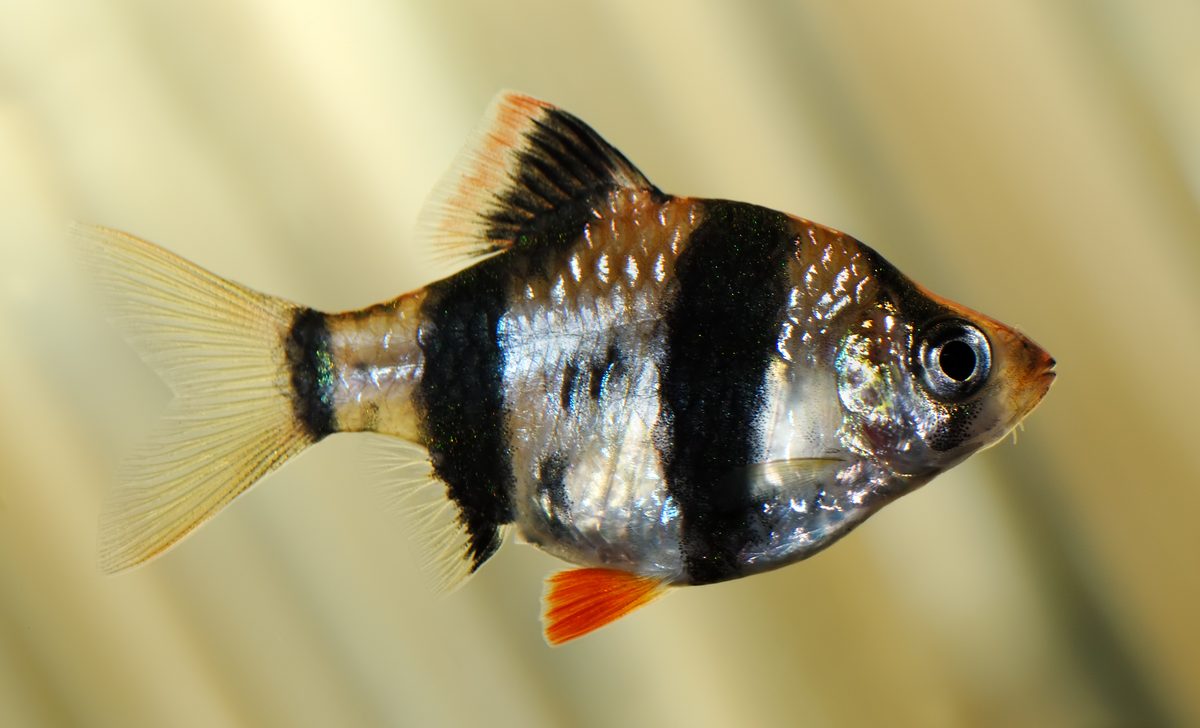
| Temperature | 22–26 °C (72–79 °F) |
|---|---|
| pH | 6.0–7.5 |
| Hardness | 5–15 °dGH |
| Volume | from 80 l (21 gal) |
| Size | up to 7 cm (2.8 in) |
| Lifespan | 4–7 years |
What it is and where it comes from
The tiger barb lives in eastern Sumatra, in the Kampar, Indragiri, Batanghari and Musi drainages. Bleeker described it in 1855, and until recently it was known as Puntius tetrazona. The genus Puntigrus was separated in 2013, taking similar Bornean species also sold as tiger barbs.
Wild fish are rarely imported: shop stock is farm-bred, inbred and weaker than wild stock, with bent spines and blurred patterns turning up. Besides the striped form there are albino, green "moss", gold and veiltail fish.
Housing and conditions
A shoal needs an 80×30 cm footprint, about 70–80 l (18–21 gal); ten fish are happier in a hundred litres. A lid is mandatory, as tiger barbs jump and easily clear the water in a fight.
Temperature: sources disagree. Seriously Fish gives 20–26 °C, Russian Wikipedia 25–27.8 °C, Aquael 24–26 °C. The working range is 22–26 °C (72–79 °F), and above 28 °C the fish wears out faster. Acidity 6.0–7.5, hardness 5–15 °dGH, though some authors allow 1–20. Moderate current, a filter turning 4–5 tank volumes an hour, diffuse light, thickets along the sides and back wall, open water in the middle, dark sand or fine gravel, and live plants left alone except for tender shoots.
Feeding
Good flakes or granules plus bloodworm, daphnia or brine shrimp two or three times a week. The vegetable part matters, or the fish nibble young leaves. Feed once or twice a day, a portion eaten in 2–3 minutes.
Overfeeding shows as a rounded belly and lethargy after the meal. Tiger barbs grab food greedily, shove each other and let the surplus rot on the bottom. Nitrate climbs, the water clouds, and obesity and swim bladder trouble follow. A weekly fasting day beats a bigger portion.
Lifespan
Usually 4–7 years. Aquael says 4–5, English Wikipedia 7, and the spread is honest: temperature and water quality decide much of it. At 27–28 °C the fish lives noticeably shorter than at 23–24 °C, and farm fish often go early from weak genetics.
Temperament and tank mates
A shoaling, quick fish that keeps sorting out its place in the group. In a shoal of 8–10 the quarrels hardly leave it; two or three barbs in a small tank become a problem, nipping the fins of anything slower.
Good tank mates: zebrafish, black skirt tetra, tetras, corydoras, bristlenose plecos, rainbowfish. Bad ones: betta, gourami, angelfish, goldfish, any veiltail form. Long fins look like an invitation to play.
Diseases
The usual problems:
- Ich ("white spot"): small white dots, rapid breathing, rubbing against stones. Treated with antiparasitic medication as directed, temperature raised and water changes more frequent.
- Columnaris: greyish white patches at the mouth and gills, frayed fins. Tiger barbs are more susceptible than many fish, so quarantine and an antibacterial are needed.
- Fin rot: fins cloudy and disintegrating at the edge, usually from dirty water and injuries after fights.
- Injuries: scrapes and torn fins after clashes; clean water and a close eye are enough.
A vet makes the diagnosis; antibiotics at random do harm.
Breeding
Egg scatterers with no parental care. Spawning tank 10–20 l (3–5 gal), a grid or fine-leaved moss on the bottom, water 2–3 degrees warmer and softer. A pair or group is added in the evening, spawning usually follows in the morning. The female lays 300 to 600 eggs, then the breeders come out. Eggs develop in 24–48 hours; the fry swim a day later and eat infusoria first.
Who it suits
A beginner with a tank from 80 l and a wish to keep a shoal. The fish is hardy, eats anything and forgives parameter mistakes. The drawbacks are real: it nips fins, jumps, needs company, and does not belong with slow species. No nano tank. To see how many fish your tank can carry, use the calculator.
The calculator works out water volume, weight, filter load and how many fish your tank can carry.
Open the calculator