
Loaches
Schooling bottom fish with a hierarchy and a habit of clicking. A clown loach outlives a dog, which is worth knowing before you buy.
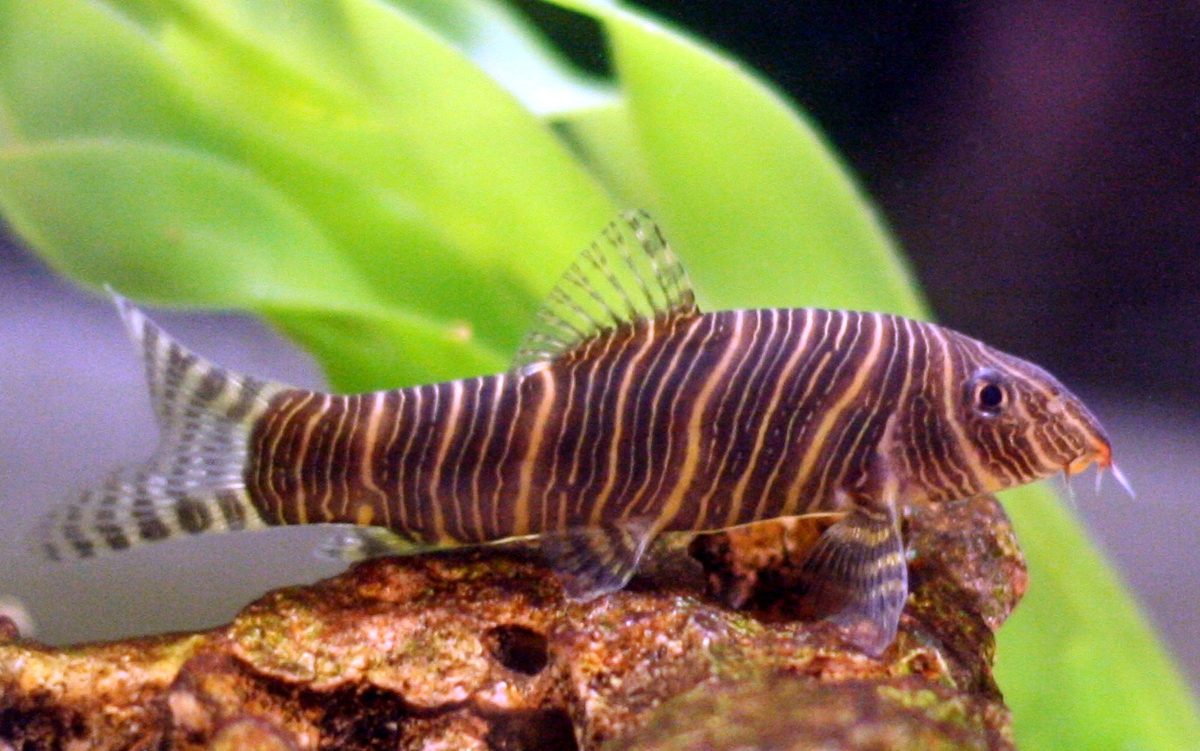
| Temperature | 24–30 °C (75–86 °F) |
|---|---|
| pH | 6.0–7.5 |
| Hardness | 1–15 °dGH |
| Volume | from 100 l (26 gal) |
| Size | up to 40 cm (16 in) |
| Lifespan | 10–20 years |
What it is and where it comes from
Loach covers the family Botiidae: the genus Botia and a few close relatives. They live in the streams and rivers of South-East Asia, close to the bottom among stones, driftwood and fallen leaves. The clown loach comes from Sumatra and Borneo, from the Kapuas, Batang Hari and Musi, and was moved into its own genus Chromobotia in 2004. Shops mostly sell clown, zebra, marbled and striped loach. A wild clown reaches 40 cm and usually half that in a tank; zebra and striped stop near 10 cm.
The seasonal migrations of clown loaches follow the river floods, so commercial fish are still caught in Sumatran basins and grown on in ponds. That explains the price, and why the fish often arrives thin.
Housing and conditions
For clowns: 24–30 °C, pH 5.0–7.0, hardness 1–12 °dGH, a base of at least 180 by 60 cm, about 650 l for a group. Small species manage in 100 l, at 24–28 °C and pH 6.5–7.5. Water must be clean and rich in oxygen, with 30–50% changed weekly and a mature filter.
Substrate fine and smooth, sand or rounded gravel. Driftwood with no sharp edges, because loaches wedge into cracks and can stick or cut themselves. Dim light; in the shade of plants they are bolder. A lid is essential, since loaches jump and can leave through gaps around pipes.
Feeding
By build they are predators with a taste for plant matter: snails, bloodworm, tubifex, brine shrimp, plus cucumber, courgette, spinach, melon. Feed in the evening after lights out, a portion that disappears in five minutes.
Overfeeding in loaches looks like a heavy, bloated belly and a fish lying unresponsive on the bottom; obesity and swim bladder trouble follow. They eat snails, but they will not stop snails breeding, which is worth knowing.
Lifespan
Clowns can pass twenty years; small species far less, usually five to ten. A group of clowns is a twenty-year project, so decide with a cool head.
Temperament and tank mates
Peaceful but schooling, with a complicated hierarchy. When they sort out rank the fish go grey, lose their pattern and shove each other with their flanks, which is normal. Keep five or six at least; a lone loach turns listless and aggressive.
- good: barbs, danios, large tetras, labeo, corydoras;
- avoid: small fish and fry, long-finned veil forms;
- a group of six or more, or stress and fights.
Diseases
Thinness causes most of the trouble:
- Skinny disease. The fish eats but loses weight and the belly sinks. Linked to the flagellate Spironucleus; treat as a vet directs.
- Ich. Spots over the body, scratching, rapid breathing.
- Oodinium. Fine golden dust on the skin, mucus, clamped fins.
- Injuries. The subocular spines tangle in a net, and sharp stone edges cut skin.
A vet makes the diagnosis; guessing with antibiotics does harm.
Breeding
Hobbyists do not breed loaches: documented cases are almost nonexistent. Farms induce spawning with hormone injections, and clowns are caught on their spawning migrations. A fry in a shop is import or farm, never a home tank.
Who it suits
An experienced keeper with a big volume. Clowns want 650 l and outlive a dog; small loaches work in 100 l, but as a group. Minus points: sensitivity to organics, jumping, a tendency to arrive emaciated. In return they are fascinating to watch, active in the evening and happy to eat snails. The calculator will size the equipment.
The calculator works out water volume, weight, filter load and how many fish your tank can carry.
Open the calculator