
Hoplo catfish
The hoplo catfish breathes air, builds a bubble nest and forgives a beginner almost any mistake with water. What it still needs.
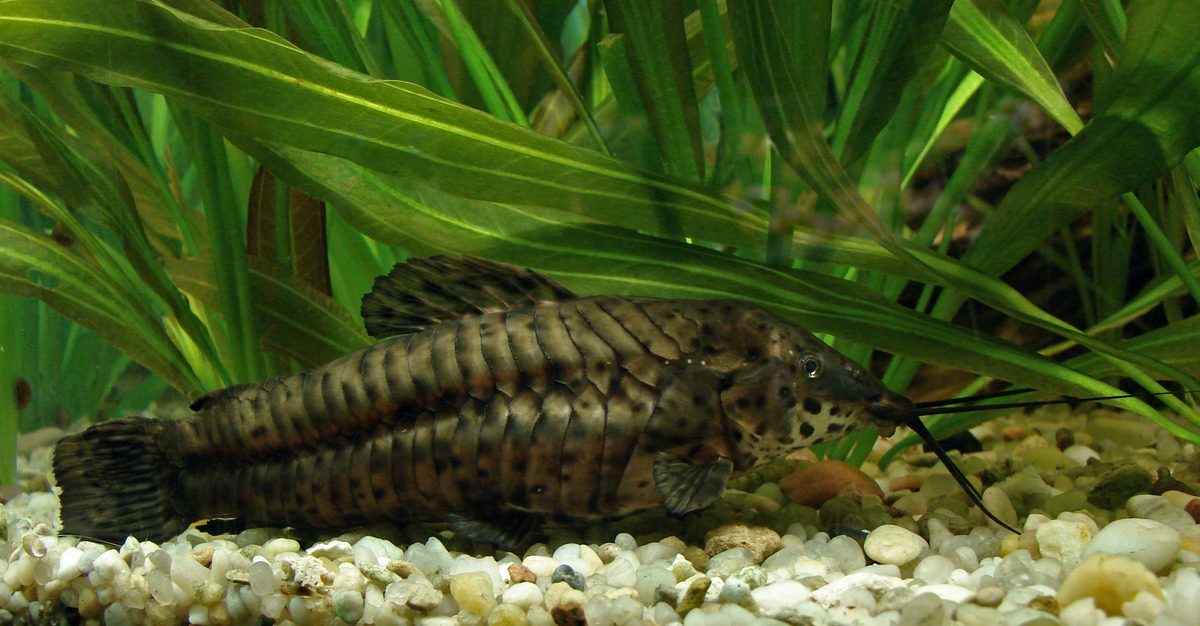
| Temperature | 20–28 °C (68–82 °F) |
|---|---|
| pH | 6.5–7.8 |
| Hardness | 5–20 °dGH |
| Volume | from 100 l (26 gal) |
| Size | up to 18 cm (7 in) |
| Lifespan | 8–10 years |
What it is and where it comes from
The hoplo catfish (Megalechis thoracata) is a callichthyid catfish from Central and South America: the Amazon, Orinoco and Rio Negro basins. It picks small streams and slow backwaters thick with plants. It survives droughts by burying itself a quarter of a metre into the mud.
Valenciennes described the species in 1840 and placed it in Hoplosternum; later it moved to Megalechis. The fish has been in the hobby for a long time and breeds without any tricks. The older spelling thoracatum still turns up, but the correct form is thoracata, from the Latin for breastplate.
Housing and conditions
Temperature 20–28 °C (68–82 °F). Wikipedia gives 19–27, Tetra 22–28, aquarium handbooks 18–28: the range is wide because the catfish is hardy and can breathe air. Keeping it at 30 °C is not a good idea.
pH 6.5–7.8, hardness up to 20 °dGH. Water changes of 20% a week. A filter and an air pump are needed, but access to the surface matters more: even in aerated water the fish rises for a gulp of air.
Volume 100–150 l (26–40 gal) per group. Tetra counts 40 l per fish and suggests 3–6, handbooks say 150 l. For three adults 150 l is the honest figure; you can check the weight and volume of the tank in the calculator.
Substrate coarse sand or rounded gravel, no sharp edges. Cover from driftwood and caves. Plants with strong roots, cryptocorynes and anubias, or they get dug up. Moderate light, and floating plants help at the surface. Cover the tank: the fish jumps.
Feeding
An omnivore that feeds off the bottom: sinking tablets, pellets, bloodworm, prawn, detritus. Feed in the evening, once a day.
Overfeeding shows in a swollen belly and a fish lying on the bottom. The danger: leftovers hide in a big tank while nitrate climbs. The catfish picks food up after other fish, but you cannot rely on scraps alone, as it loses weight fast.
Lifespan
8–10 years. The figure depends on volume and on steady temperature. A one-off five-degree swing is survivable; constant swings shorten life.
Temperament and tank mates
Peaceful, but in spawning condition the male turns dangerous to other males and can beat them up. So keep either one male or plenty of space and cover.
Tank mates: angelfish, barbs, tetras, rainbowfish, large livebearers, small cichlids. Loaches and other bottom dwellers are not a good idea, since the fight over the bottom starts at once. Large predators are bad too, as the catfish is slow and trusting.
Diseases
- Barbel and snout injuries. Grazes and a refusal to feed. Sharp substrate or stones with ragged edges are usually to blame.
- Fungus after an injury. A white coating on the damaged patch, especially in cool water.
- Obesity. From dry foods with no vegetable part, and from overfeeding.
- Jumping. The fish leaves an open tank, often hitting the floor head first.
A vet makes the diagnosis; blind antibiotic treatment does harm.
Breeding
The male builds a bubble nest, like a labyrinth fish. Put the pair in a spawning tank from 60 l, water level 15–20 cm, temperature 1–5 °C lower at first and then raised smoothly to 25–27 °C, plus changes with soft water. The nest needs support: a broad leaf or a piece of polystyrene. The female lays up to 500–1000 eggs, and incubation takes about two days. Remove the female at once and the male after the larvae appear. Sexual maturity comes at 8–14 months.
Who it suits
For a beginner it may be the best catfish for a first big tank. It forgives water mistakes, eats any sinking food and breeds at home. It needs 100–150 l and a lid without gaps, or you will find the catfish on the floor. Two drawbacks: night activity and a habit of digging up the substrate, so plants have to be anchored with stones.
The calculator works out water volume, weight, filter load and how many fish your tank can carry.
Open the calculator