
Goldfish
A round bowl kills a goldfish faster than any disease. It needs 100 litres or more, a powerful filter and cool water without sharp swings.
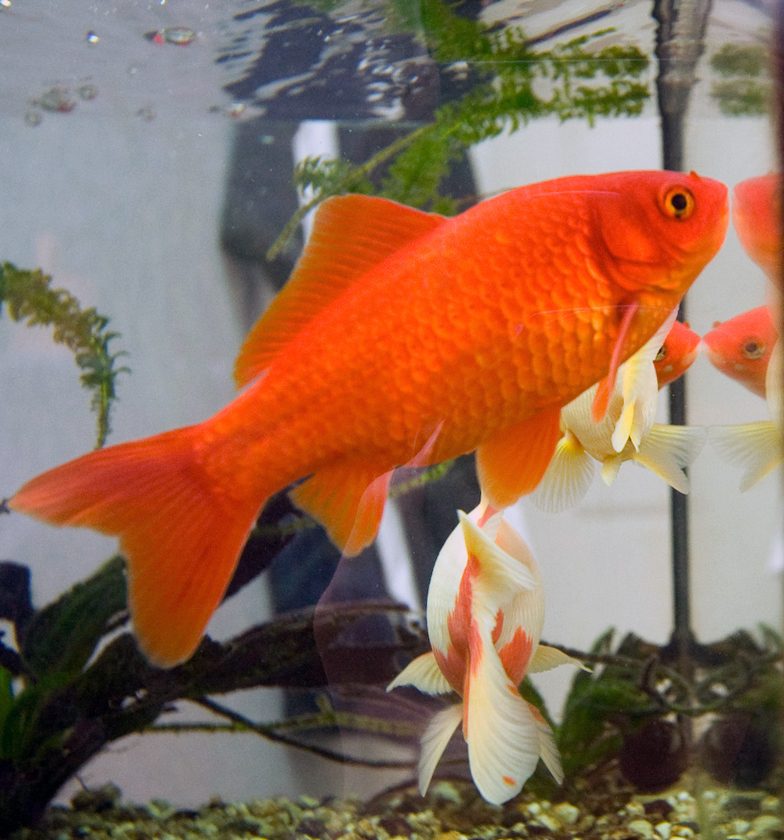
| Temperature | 18–23 °C (64–73 °F) |
|---|---|
| pH | 6.0–8.0 |
| Hardness | 5–19 °dGH |
| Volume | from 100 l (26 gal) |
| Size | up to 20 cm (8 in) |
| Lifespan | 10–15 years |
What it is and where it comes from
The goldfish (Carassius auratus) descends from the silver crucian carp, domesticated in China more than a thousand years ago. Red crucians are mentioned in the Tang dynasty, and by the 17th century the fish were bred in ponds and bowls across China and Japan. They reached Europe in the 17th century.
Centuries of breeding produced hundreds of varieties, from the plain crucian and the comet to the oranda, the telescope and the ranchu. Short bodies, bulging eyes and veil fins were developed for watching from above, hence the odd proportions.
Housing and conditions
Temperature 18–23 °C, ideally 20–22. pH 6.0–8.0, hardness 5–19 °dGH. Volume from 100 l (26 gal) for one adult, and each further fish adds 50 l; short-bodied breeds need more. In a tank the fish usually reaches 15–20 cm (6–8 in), in a pond up to 30 cm (12 in). It is not tropical and needs no heater, but sharp temperature swings are dangerous.
A powerful filter, a moderate current, constant aeration. Light 8–10 hours. Tough-leaved plants (Anubias, Vallisneria) or artificial ones, since goldfish nibble tender leaves. Coarse substrate so the fish cannot swallow it. Work out your volume in the calculator.
Feeding
Sinking pellets and flakes, plus peas, spinach, zucchini and bloodworms. Plant matter is essential, or swim bladder trouble appears. Feed once or twice a day, the portion eaten in 2–3 minutes, with a fasting day once a week.
Overfeeding happens constantly: goldfish beg and eat more than they need. The result is obesity, constipation, swimming trouble and cloudy water. Sinking food is better than floating, as the fish does not swallow air with it.
Lifespan
10–15 years, some reach 20. In a pond the fish lives longer than in a tank, thanks to volume and natural food. Time depends on tank size: 100 l gives a shorter life than 200 l. Above 28 °C and high nitrates, life shortens.
Temperament and tank mates
Peaceful but large, and it eats whatever fits in its mouth. Tank mates: other goldfish, weather loaches, large catfish. Not with neons, guppies, bettas or angelfish, because of temperature and size.
Goldfish root in the substrate and dig up plants. With tropical fish they rarely get along: one needs cool water, the other 26 °C.
Diseases
Goldfish fall ill more often than tropical fish, as volume, feeding and water quality take their toll.
- Ich. White spots, the fish scratches itself and breathes fast. Raise the temperature to 24–26 °C and follow the remedy dose.
- Fin rot. Fins become ragged and a white edge forms. Clean water and antibacterial remedies first.
- Swim bladder disorder. The fish swims on its side, hangs at the surface or sinks. Fasting, peas and clean water help, and severe cases need a vet.
- Dropsy. Scales stand out, the belly swells, the eyes bulge. The outlook is usually poor, and without a vet the fish dies.
- Gill flukes. Rapid breathing, the fish stays at the surface, the gills are pale. A vet chooses the treatment; guessing does not work.
A vet makes the exact diagnosis; blind antibiotic treatment does harm.
Breeding
Spawning at home is possible but laborious. A pond or a tank of 100 l or more, a school, 20–24 °C and plants. The female lays thousands of eggs and the parents eat them, so the eggs go into a separate container.
Fry are raised on infusoria, nauplii and microworms. The difficulty is selecting breeders by breed and getting viable offspring.
Who it suits
A round bowl or a small tank does not suit a goldfish. It needs 100 l per fish, a powerful filter and regular water changes. It is large, produces much waste and ruins plants. Still, it lives long and recognises its owner. A beginner should start with a plain form, not an oranda.
The calculator works out water volume, weight, filter load and how many fish your tank can carry.
Open the calculator