
Discus
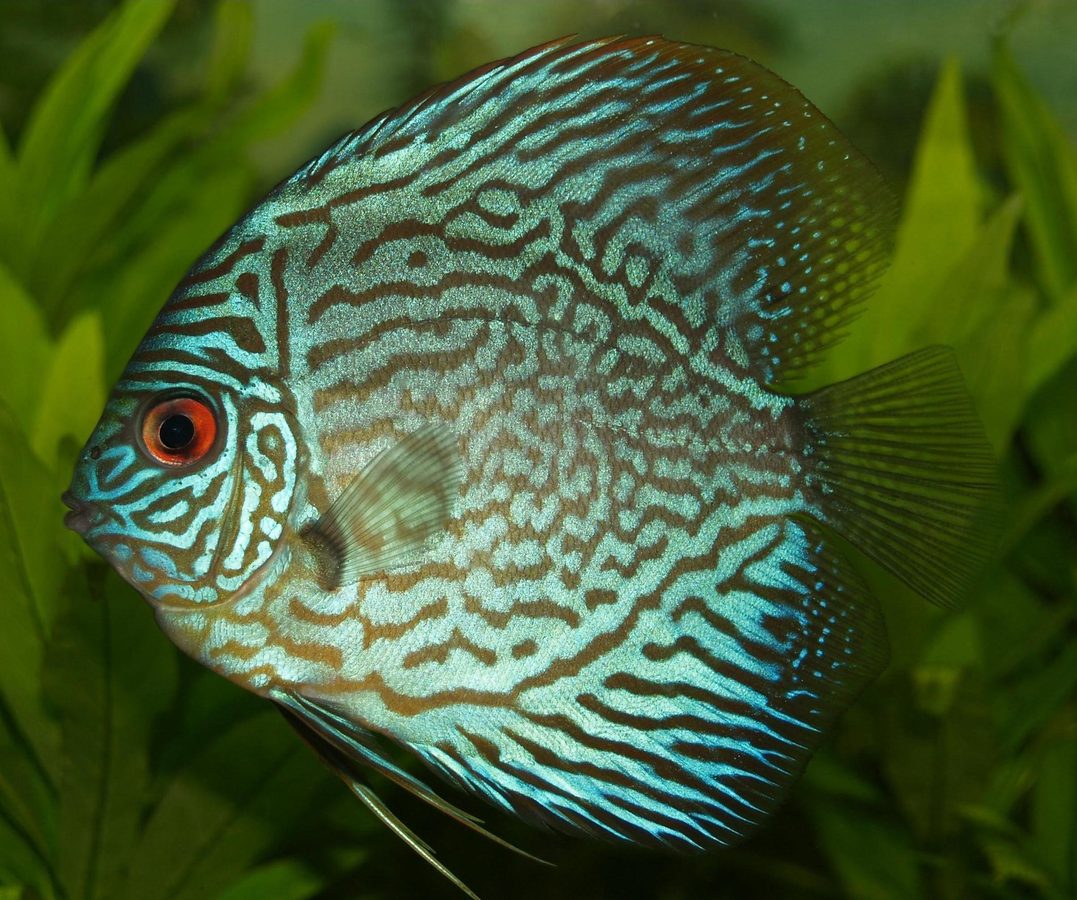
A calm Amazonian cichlid with a reputation for being difficult. It forgives little: it needs stable soft water and warmth.
| Temperature | 27–30 °C (81–86 °F) |
|---|---|
| pH | 5.5–7.0 |
| Hardness | 2–8 °dGH |
| Volume | from 200 l (53 gal) |
| Size | up to 20 cm (8 in) |
| Lifespan | 10–15 years |
What it is and where it comes from
Discus live in the Amazon basin, in Brazil, Peru and Colombia. They keep to slow tributaries and forest oxbow lakes, hiding in deep water among roots and sunken branches, moving in small shoals.
Pellegrin described Symphysodon aequifasciatus in 1904. The genus holds several species, the best known the Heckel discus, while most aquarium fish belong to this species and to lines bred from it. The fish is named for its shape: tall and flattened from the sides, it looks like a plate. Farms in Asia breed discus on an industrial scale, and from there the fish travels the world.
Housing and conditions
A pair or a group of young fish needs 200–250 l (53–66 gal); height matters as much as length, as the discus needs vertical room.
| Parameter | Value |
|---|---|
| Temperature | 27–30 °C (81–86 °F) |
| pH | 5.5–7.0 |
| Hardness | 2–8 °dGH |
| Volume | from 200 l (53 gal) |
| Size | up to 20 cm (8 in) |
| Lifespan | 10–15 years |
Sources differ: foreign references give 26–30 degrees and hardness up to 5, keepers in Russia run 28–31 and GH 5–10. The benchmark is the same: soft, stable water with no swings. Gentle flow, diffuse light, fine sand or none at all if hygiene matters. Cover from driftwood and shade-loving plants is essential: the discus is timid. Change 25–30% twice a week. The calculator will help with volume.
Feeding
Omnivorous, but a slow eater. Special discus granules or flakes plus brine shrimp, bloodworm, daphnia and glassworm. Feed 2–3 times a day in small portions.
Overfeeding in warm water is doubly dangerous: leftovers rot within a couple of hours, and the discus is sensitive to organic matter. Signs: swollen belly, no appetite, white stringy faeces, the fish hanging at the surface. Hexamitiasis comes next. Beef heart mix is best given with care: it fouls the water badly, and beginners spoil the water with it before they have fed the fish.
Lifespan
10–15 years, though the data differ: some references cautiously say 10. Much depends on water stability. A discus living with constant pH and temperature swings lasts noticeably less.
Temperament and tank mates
Peaceful, timid, and it stays in a shoal. Keeping one alone affects its behaviour badly, so buy 5–6 fish. Tank mates: small characins, corydoras that tolerate heat, dwarf cichlids.
Active barbs, large cichlids and any fish that needs cooler water do not suit it. Keep angelfish separately, as they carry diseases the discus is susceptible to.
Diseases
Hexamitiasis. White faeces, sunken belly, no appetite, pits on the head. Stress and dirty water set it off, and a vet prescribes treatment.
Ich. White spots, clamped fins, the fish rubs itself. Warmer water and a medication used as directed help.
Bacterial gill infection. The discus breathes fast, stays at the surface, and the gills look pale or darkened. Water tests and an examination are needed.
Obesity. Swollen belly, low activity. Treated with fasting, not drugs.
Only a vet can diagnose exactly; blind antibiotics do harm.
Breeding
A pair forms out of the shoal on its own. Spawning is on a vertical surface: a cone, a broad leaf, a piece of pipe. The female lays 200–400 eggs, and both parents guard the clutch and fan it with their fins. Larvae hatch in two or three days. For the first weeks the fry feed on skin secretions, and must not be separated then. Raising the fry is hard: it takes perfectly clean water and frequent changes.
Who it suits
Not a beginner. The discus forgives little: a temperature spike, a skipped water change, an infection brought in by accident. It needs 200 l (53 gal) and up, stable soft water and time for inspections. Drawbacks: mistakes are hard to fix and the fish is fussy. The pluses are shoal behaviour and a calm nature. Start with farmed fish, tougher than wild ones. More articles in the reference.
The calculator works out water volume, weight, filter load and how many fish your tank can carry.
Open the calculator