
Zebrafish
A hardy shoaling fish that swims at the surface and rarely needs a heater. What to know before you buy one, and why a shop zebrafish is not the fish it was.
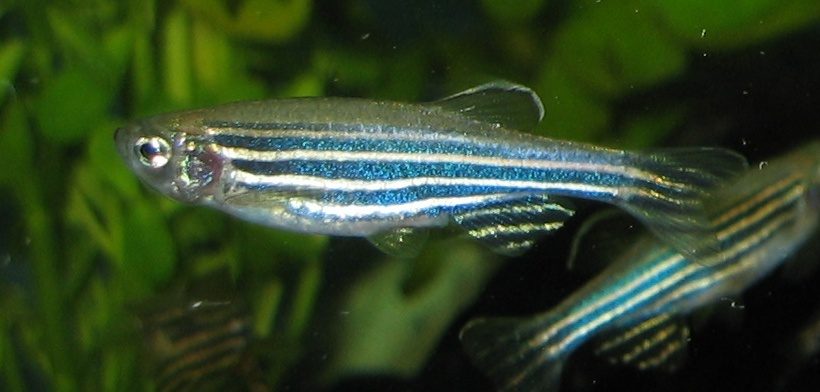
| Temperature | 18–25 °C (64–77 °F) |
|---|---|
| pH | 6.5–7.5 |
| Hardness | 5–15 °dGH |
| Volume | from 50 l (13 gal) |
| Size | up to 5 cm (2 in) |
| Lifespan | 3–4 years |
What it is and where it comes from
Hamilton described the zebrafish in 1822 from the Ganges basin. Its range is northern India, Bangladesh, Nepal and possibly Bhutan; Myanmar has had no record since 1926. It reached Europe in 1905 and became one of the trade's biggest sellers.
In the wild it holds in slow backwaters, oxbows and flooded rice fields, moving into the floods in the rainy season, which is where the surface habit comes from. It is also a classic lab animal: the embryo develops in three days, and the eggs are clear and large. In 1976 zebrafish eggs went up on Salyut 5, and the fry hatched in orbit.
Housing and conditions
Temperature 18–25 °C (64–77 °F): one of the few tropical fish that often goes without a heater, fine at 20–22 °C in a living room and taking 26–27 °C in summer. In the wild the water warms to 38 °C, but only briefly.
pH 6.5–7.5, hardness 5–15 °dGH. The tank should be 50–60 cm long, as a shoal of six is cramped in thirty litres; on paper 30 l is enough for five or six, but length must exceed height. Moderate current, no centrifuge from the filter, diffuse light, plants at the sides, open water in the middle, dark substrate, and a lid, because zebrafish jump.
Feeding
In the wild it is a micro-predator: small crustaceans, mosquito larvae, whatever falls on the surface. In an aquarium, flakes, granules, daphnia, brine shrimp, bloodworm. Feed once or twice a day, the portion gone in a minute or two, since zebrafish pick food off the surface instantly and little reaches the bottom.
Overfeeding shows as a tight belly and a fish that hangs at the surface instead of chasing its neighbours. Spare food settles, rots and raises nitrate. Obesity is commoner than people think: in a strong current the extra fat makes swimming harder and the fish lags.
Lifespan
Usually 3–4 years, five in cool water with regular changes. Farmed fish live less from inbreeding: a clean pattern and a firm body are rare in shop zebrafish now.
Temperament and tank mates
A peaceful shoal fish, almost always in motion. Keep 8–10: in a small group zebrafish grow nervous and hide in the corners, and while males compete constantly, it does not come to fights or bitten fins.
Tank mates: black skirt tetra, tetras, livebearers, corydoras, bristlenose plecos. Not large cichlids, goldfish or veiltail forms: long fins get ruined by tiger barbs, and a big fish will eat a zebrafish.
Diseases
What turns up most often:
- Neon tetra disease (the microsporidian Pleistophora hyphessobryconis): white patches in the muscle, the fish keeps to itself and breathes fast. There is no cure; affected fish are removed.
- "Wasting" (Pseudoloma neurophilia): emaciation with a normal appetite, a bent spine. It attacks the nervous system and is hard to diagnose.
- Ich: white spots, scratching. Treated with antiparasitic medication as directed.
- Fin rot: cloudy fin edges, usually after an injury and dirty water.
A vet makes the diagnosis; antibiotics at random do harm.
Breeding
Egg scatterers with no parental care. A 10–20 l spawning tank, glass marbles or moss on the bottom, water slightly softer and 2–3 degrees warmer. A pair is added in the evening; the female lays up to 400 eggs at dawn and the breeders come out. Eggs mature in 24–36 hours, and the fry swim a few days later, eating infusoria, then brine shrimp nauplii. The filter must be weak, or the fry get drawn in.
Who it suits
A beginner and a child: the fish forgives anything except dirt. It needs a tank from 50 l, a shoal of eight or more and a lid. Minus: a short life, jumping, weak shop genetics, and no nano tank. To check the load on your tank, use the calculator.
The calculator works out water volume, weight, filter load and how many fish your tank can carry.
Open the calculator