
Comet goldfish
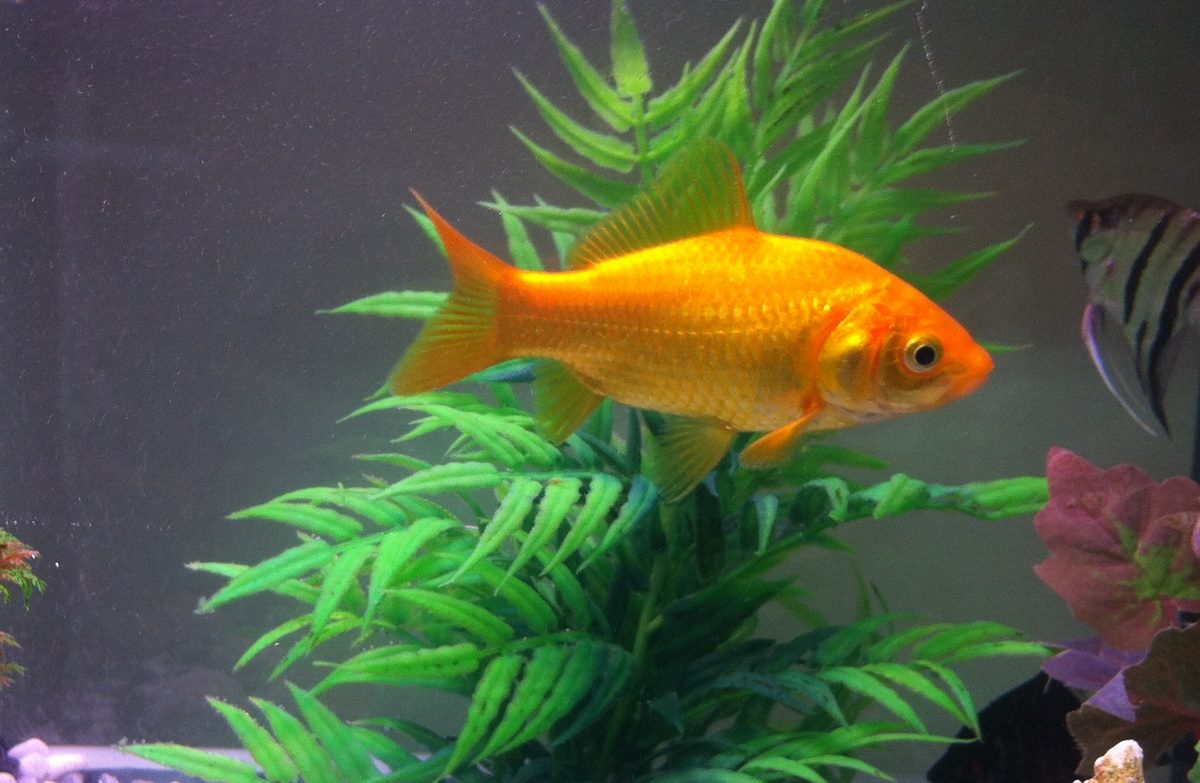
A fast long-bodied goldfish with a long tail, which needs open water and a lid over it. Here is the care, without the general talk.
| Temperature | 18–23 °C (64–73 °F) |
|---|---|
| pH | 6.0–8.0 |
| Hardness | 8–25 °dGH |
| Volume | from 40 l (10.6 gal) per fish |
| Size | up to 18 cm (7.1 in) |
| Lifespan | 5–14 years |
What it is and where it comes from
The comet is a long-bodied goldfish with a single tail and ribbon-like lobes. The tail is longer than the body, and that gave the breed its name.
It was bred in the United States in the 1880s: Hugo Mulert, working at the government fish station in Washington, selected fish with long forked tails. English Wikipedia names him as the author, while Russian sources add that the first comets may have come from Japan and that Mulert only fixed the trait. In Europe and Russia the comet appeared later and quickly became one of the most widespread pond breeds.
Housing and conditions
18–23 °C, pH 6.0–8.0, hardness 8–25 °dGH. A coldwater fish, but it dislikes sharp swings. Allow 40 l per specimen, and a school of four or five wants 150 l, preferably in a long tank.
A lid is essential, since a comet picks up speed and jumps. Strong filtration and aeration, weekly changes. A school's demand is estimated in the calculator. Bright light, large rounded gravel, hard-leaved plants with roots pressed under stones. It reaches 18 cm. The comet tolerates salting to 12–15‰ and easily handles 5–7 g of salt per litre, which is used in treatment; constant salinity is not needed.
Feeding
Unfussy: it takes dry food, animal food and plants. Two feeds a day, a portion for 5–10 minutes, one fasting day a week. Overfeeding is rarer than in the short-bodied breeds but still leads to obesity and dirty water. Hunger it handles more easily, and an adult goes up to a week without food. A plant component is obligatory, or the fish nibbles tender shoots and digests worse.
Lifespan
5–14 years in English sources, up to 14 in Russian. The spread is wide because volume decides much: in a pond or a large tank a comet lives longer, in a cramped one less. A pond with wintering and natural food gives the best figures, better than any aquarium.
Temperament and tank mates
Active, peaceful and fast. The best neighbours are the shubunkin and other long-bodied goldfish, plus large calm fish. Not the telescope or the veiltail, because the comet takes the food and keeps the slow ones stressed.
It swallows any small fish that fits in its mouth, and barbs nip its tail. Tropical species are ruled out by temperature. In a pond it gets on with koi.
Diseases
Ich. White spots, the fish scratching against stones. Treat in quarantine with antiparasitics and finish the course.
Fin rot. The fin edges whiten and tear. Clean water changes help; antibacterials on a vet's instruction.
Injuries after a jump. Grazes and lost scales. A lid and a clean tank beat any treatment.
Swim bladder. Rarer than in the short-bodied breeds and usually the result of overfeeding. A day without food and softened food.
Fungus. Cotton on grazes, especially in cool water. Antiseptics, and the water kept clean.
A vet makes the diagnosis; guessing with antibiotics does harm.
Breeding
Ready from two years, spawning in spring. A tank of 30–40 l, a net on the bottom, fine-leaved plants, one female and two or three males. The trigger is a rise to 28–30 °C and a big water change. Up to 10,000 eggs, development over 3–4 days. The difficulty is that the fry must be sorted and grown in a large volume, or the result is fish with fin defects.
Who it suits
For a beginner, given 100–150 l and cool water. In a 30 l tank a comet suffers: it swims a lot and fouls the water fast. Minus points: it jumps, tears plants, needs space and a strong filter. Plus: hardy, eats anything, gets on with other long-bodied goldfish. This is a fish for a large species tank or a pond.
The calculator works out water volume, weight, filter load and how many fish your tank can carry.
Open the calculator