
Synodontis catfish
The upside-down catfish fits in sixty litres, the featherfin squeaker needs three times that. Which species to choose and why you barely see the fish by day.
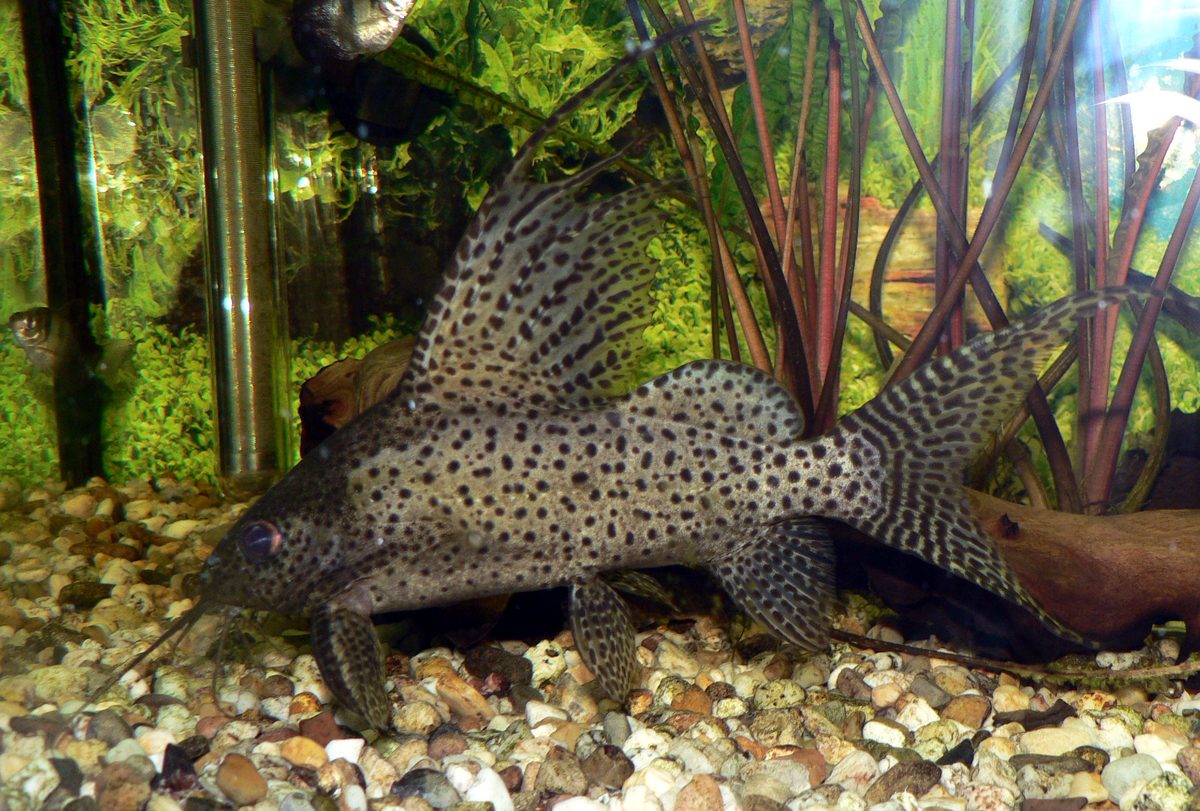
| Temperature | 22–28 °C (72–82 °F) |
|---|---|
| pH | 6.5–7.8 |
| Hardness | 5–20 °dGH |
| Volume | from 60 l (16 gal) |
| Size | up to 20 cm (8 in) |
| Lifespan | 10–15 years |
What it is and where it comes from
Synodontis belongs to the mochokid catfish family and lives in Africa. The genus holds more than 130 species, the largest in the family. They share two traits: serrated spines on the fins and the squeak the fish makes when taken out of the water. That sound gave them the name squeakers.
Three species dominate the hobby. The featherfin squeaker (Synodontis eupterus) from the Nile, Niger and Chad basins, with a tall dorsal fin. The upside-down catfish (S. nigriventris) from the middle Congo, the one that swims belly up. And the Tanganyikan S. petricola and S. multipunctatus, called cuckoo catfish for the habit of slipping eggs into cichlid nests.
Housing and conditions
Temperature 22–28 °C (72–82 °F) depending on the species: the upside-down catfish wants it warmer, the featherfin is fine at 22–27. pH 6.5–7.8, hardness 5–20 °dGH. Water changes of 20% a week, good aeration, moderate lighting.
Volume depends on the species. For the upside-down catfish and the small Tanganyikans, 60 l (16 gal) per group is enough. For the featherfin sources give 110 to 200 l, and the spread is not accidental: in the wild it reaches 30 cm, in a tank usually 15–20 cm. If you buy a juvenile, plan for 150–200 l.
Soft substrate without sharp edges: the fish probes the bottom with its barbels all the time and damages them easily. All species need cover; by day the fish sits in a cave or a pipe and drives intruders away. Plants with strong roots: echinodorus, cryptocorynes, vallisneria.
Feeding
Omnivores. The base is sinking pellets and tablets for bottom feeders, topped up with bloodworm, brine shrimp, prawn and vegetable flakes. Feed in the evening, after lights out.
Overfeeding looks alike in every catfish: swollen belly, lethargy, cloudy water. Synodontis eats greedily and fast, so it is better to underfeed than to overdo it. A hungry catfish eats small fish that fit in its mouth, and shrimp too.
Lifespan
10–15 years, closer to 15 under good conditions. The figure depends on volume and temperature: in a cramped warm tank it lives less and sickens more often.
Temperament and tank mates
Calm with other species, not its own. Each fish needs a cave, or scuffles follow at the entrance. It gets on with African cichlids better than most catfish, being used to hard water and a crowded bottom.
Good tank mates are tetras, rainbowfish, gouramis, barbs and cichlids of matching size. Very small fish and fry do not work, since they become food. Fast barbs also steal the catfish's tablet, so food goes in after lights out.
Diseases
- Barbel injuries. Barbels are broken or bleeding and the fish refuses food. Sharp substrate is the cause, and swapping it for sand helps.
- Fungus at the site of an injury. White fuzz at the base of a fin or on a barbel, more often in cold water.
- Obesity. A firm belly, the fish lies around a lot. It comes from too much protein and bloodworm.
- Ich. Grains on the body after moving or chilling.
A vet makes the diagnosis; blind antibiotic treatment does harm.
Breeding
Almost impossible at home. The mass-market species are bred with hormone injections, and spawning is triggered by imitating the rainy season. The exception is nest parasites like S. multipunctatus. They slip eggs to Tanganyikan cichlids, and the fry grow up alongside the hosts'. That trick needs a species tank with the right cichlids and plenty of room.
Who it suits
For a beginner the upside-down catfish works: 60 l, a group of 5–6, evening feeding, clean water. The featherfin squeaker is harder because of its size and the volume it needs. A shared drawback: you barely see it by day, and some species outgrow the shop's promise. Spines catch in the net, so move them in a container. Other species profiles are collected in the reference.
The calculator works out water volume, weight, filter load and how many fish your tank can carry.
Open the calculator