
Ocellaris clownfish
The marine fish made famous by Nemo, with its anemone partnership and its change of sex. What an 80 l tank has to give it, and why predators are out.
| Temperature | 22–28 °C (72–82 °F) |
|---|---|
| pH | 8.1–8.4 |
| Hardness | not specified; salinity 35‰ |
| Volume | from 80 l (21 gal) per pair |
| Size | up to 11 cm (4.3 in) |
| Lifespan | 6–10 years |
What it is and where it comes from
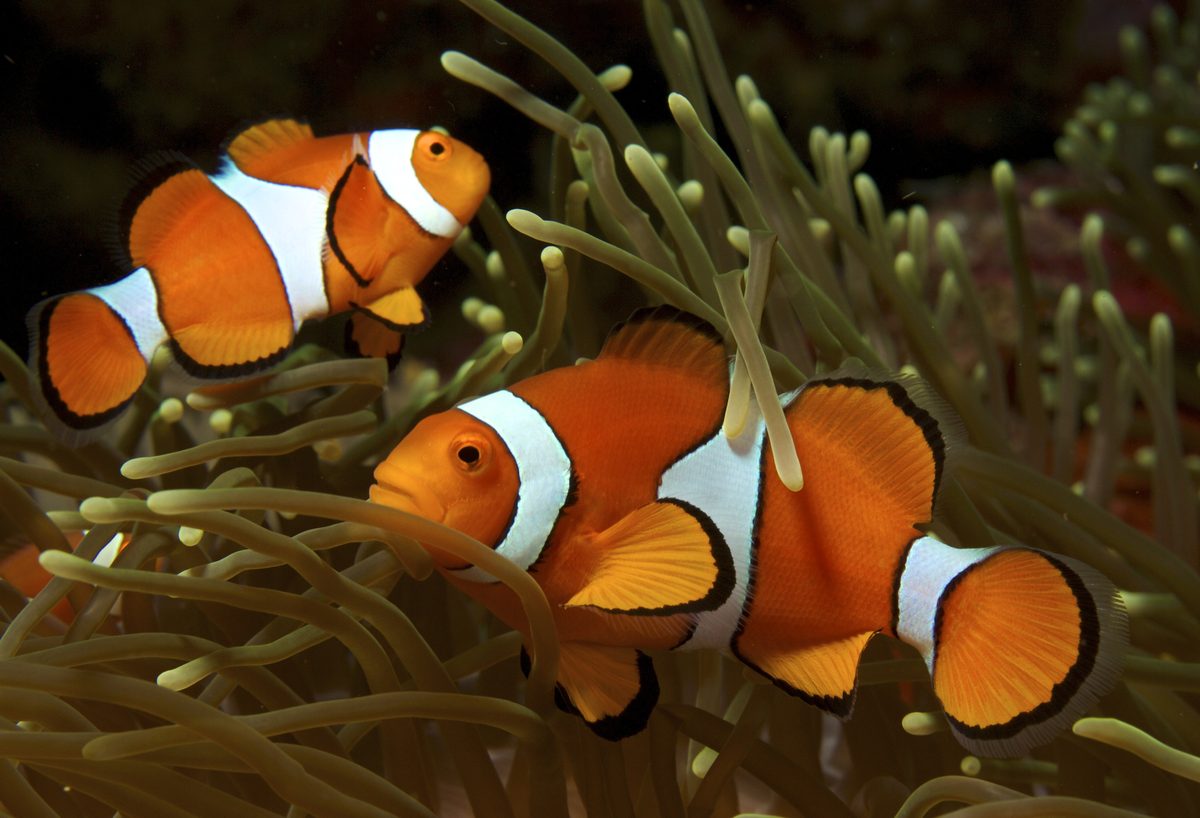
Amphiprion ocellaris, the ocellaris clownfish, is a marine fish of the damselfish family. It lives in the Indian Ocean and the western Pacific, on reefs down to 15 m, in symbiosis with the anemones Heteractis magnifica, Stichodactyla gigantea and S. mertensii. It keeps to small groups on one patch of reef and never strays far from its host. Adults reach 11 cm, females larger than males.
The deal with the anemone runs both ways: the fish ventilates the water, clears debris and lures prey, the anemone gives shelter, and the mucus on the fish stops the stinging cells from firing. Every clown is born male. The dominant male turns into a female, and when she dies the next male in rank changes sex. After "Nemo" in 2003 demand jumped and the species was bred in captivity on a large scale.
Housing and conditions
A marine tank from 80 l per pair, though shop cards mention 50. Temperature 22–28 °C, pH 8.1–8.4, salinity around 35‰. Check density with a hydrometer or refractometer and mix the salt in advance.
Live rock or ceramic media, sand, moderate flow, bright light and a skimmer. An anemone is not obligatory: the fish will accept a soft coral such as Euphyllia or Xenia, or simply hang around a rock. A lid is essential, since clowns jump. Change 10–20% weekly, because live rock works as a biofilter while the skimmer collects organics. A marine tank's volume is easiest to work out in the calculator.
Feeding
Omnivorous: zooplankton, algae, brine shrimp, mysids, dry marine flakes. Feed once a day, or twice in a small portion. Overfeeding shows as a swollen belly and cloudy water, as leftovers rot, nitrate and phosphate climb and algae move in. Offer food near the anemone or a rock, so the fish does not chase it around the tank.
Lifespan
6–10 years, in a tank usually nearer the lower bound. Stable salinity, temperature and water quality decide it. Captive-bred fish adapt more easily and bring fewer parasites than reef-caught ones.
Temperament and tank mates
Territorial, especially towards other clowns. Fights in a small tank end with nipped fins and the death of the weaker fish, so build the pair from young stock.
Good neighbours are peaceful fish of comparable size, large shrimp, snails and corals. Never large predators, morays or groupers, and no other Amphiprion in a small volume: fights come even with good decor. Very small invertebrates may be knocked about.
Diseases
Cryptocaryonosis, marine ich. White spots, rapid breathing, refusal to feed. Treat in a separate tank with marine remedies and take the invertebrates out of the display.
Amyloodiniosis, velvet. Fine golden dust, mucus, scratching. It kills fast, so quarantine is the answer.
Brooklynella. Heavy mucus, white threads, laboured breathing. Contagious, and treated in quarantine.
Bacterial ulcers. Red spots and erosions after an injury. Clean water and antibacterials as directed. Two weeks of quarantine for a new fish cuts the risk of bringing something in.
A vet makes the diagnosis; guessing with antibiotics does harm.
Breeding
The pair forms from young fish, with the female larger and dominant. Spawning happens on a flat stone by the anemone, and the male tends the clutch for 6–8 days. The larvae are planktonic at first, which is the main difficulty: a separate tank, rotifers and nauplii, and stable water. A hobby brood can be raised, but fry survival is low.
Who it suits
One of the easiest marine species, yet a marine tank is not a beginner's project in itself. It needs 80 l, salt, test kits, a skimmer and patience. Minus points: territoriality, sensitivity to salinity swings, the cost of equipment. Plus: a bright fish that feeds readily, lives for years and learns its owner.
The calculator works out water volume, weight, filter load and how many fish your tank can carry.
Open the calculator