
Dwarf gourami
A peaceful labyrinth fish for a planted tank of 50 litres or more. It often arrives from the shop already sick, so quarantine is not a formality.
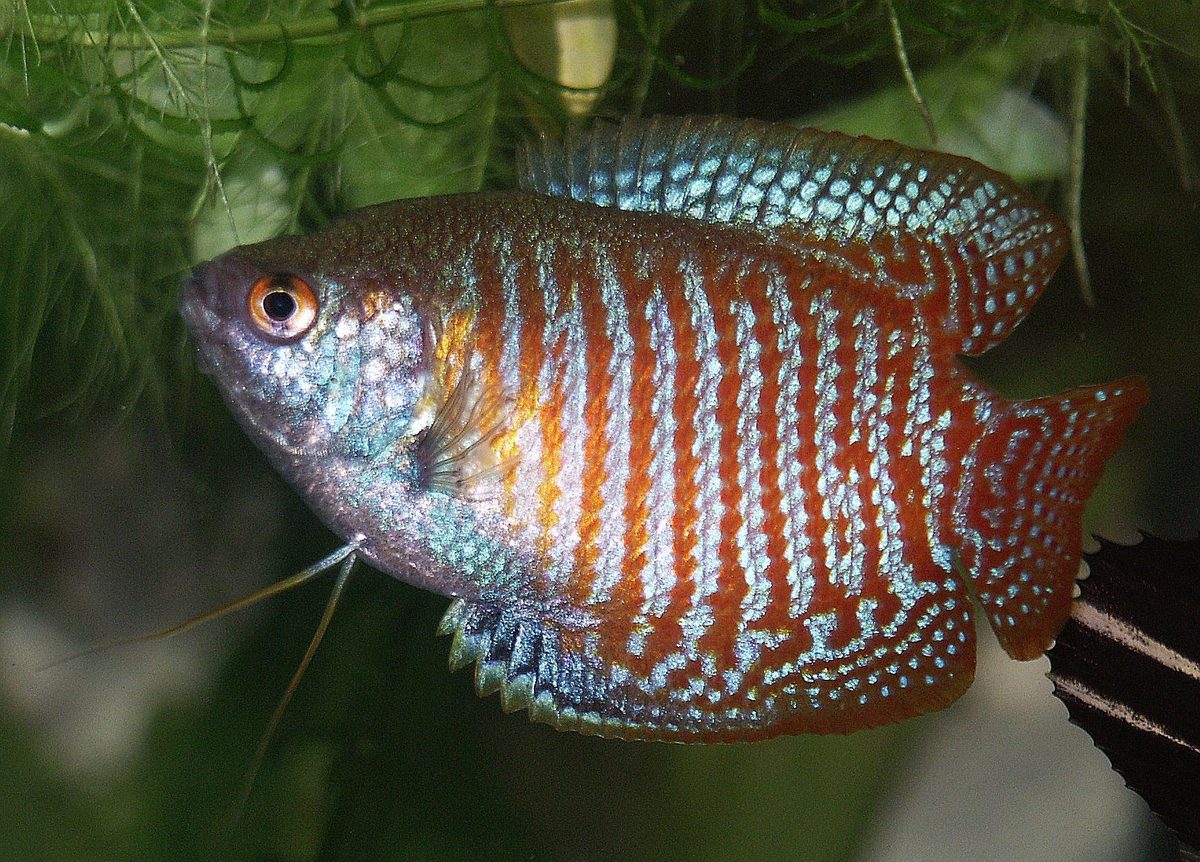
| Temperature | 22–27 °C (72–81 °F) |
|---|---|
| pH | 6.0–7.5 |
| Hardness | 2–18 °dGH |
| Volume | from 50 l (13 gal) |
| Size | up to 6 cm (2.4 in) |
| Lifespan | 4–6 years |
What it is and where it comes from
The dwarf gourami comes from South Asia: Pakistan, northern India, Bengal and Assam, Bangladesh. It lives in slow streams, ponds and canals, in rice paddies, in soft warm water and thick plants. Francis Buchanan-Hamilton described it in 1822. It appeared in Europe in 1869, a shipment reached Pierre Carbonnier in Paris in 1874, and bulk supplies from Germany began in 1903.
Today the trade almost always offers colour lines: "neon", "sunset", red, blue. The wild form with red and blue crossbars is rare, which is worth remembering when buying from a picture.
Housing and conditions
Temperature 22–27 °C, pH 6.0–7.5, hardness 2–18 °dGH. Current minimal, as the fish dislikes flow and murk. Diffused light, with floating plants and side thickets essential, because in an empty tank it hides and pales.
Volume from 50 l (13 gal) per pair, and Western references say 56 l, which is the same 50–60. Dark substrate, a gentle sponge or air-driven filter. Water changes of 20–25% a week. A tight lid, because warm humid air above the water is needed, or the labyrinth organ develops poorly in young fish.
Feeding
Omnivorous but small-mouthed: fine flakes, micro-pellets, frozen bloodworms, brine shrimp, daphnia. Plant matter is essential, or the fish nibbles tender shoots. Feed once a day, a portion gone in two minutes.
Overfeeding shows at once: a swollen belly, the fish at the surface, no reaction to food. Obesity follows, and spoiled water finishes the fish off in a couple of days.
Lifespan
Usually four to six years, longer with good care. Reference books give three to eight years, and the spread is easy to explain: much depends on the quality of imported fish, not only on the tank.
Temperament and tank mates
Timid, yet it jealously guards its corner, a rare combination. In a small tank a male chases the female to exhaustion, so cover matters more than tank mates. Keep a pair rather than a group, and add fish to an overgrown tank, not the reverse.
- small peaceful cyprinids, rasboras, corydoras and shrimp fit;
- bettas, other labyrinth fish and large barbs do not;
- two males in one volume are better not kept.
Diseases
Dwarf gouramis have a problem of their own: iridovirus (DGIV). Research suggests up to 22% of fish from Singapore arrive as carriers, the disease is incurable and passes to neighbours through the water. Symptoms: darkening, listlessness, refusal to feed, bloating. The rest is familiar:
- Ich. White spots and scratching. Malachite green products.
- Lymphocystis. Large grey growths on the fins, a virus that passes on its own.
- Fin rot. Torn fins after stress or fights, so water changes and an antiseptic are needed.
A vet makes the exact diagnosis; blind antibiotic treatment does harm.
Breeding
The male builds a bubble nest from bubbles and plant bits. Tank from 20 l, water 15 cm deep, 26–29 °C, and the female is added in the evening. Eggs number three hundred to eight hundred, larvae hatch in a day or two, and the fry swim on day four or five. The female leaves after spawning, the male once the young swim. Start: infusoria, then brine shrimp nauplii.
Who it suits
A beginner, with a reservation: care is simple, but imported fish are often already sick. A tank of 50 l or more, dense plants, a pair rather than a company. Minuses: a short life, iridovirus, timidity. A plus: a calm nature and a bright male in view. Check volume and stock in the calculator, and tank mate profiles in the reference.
The calculator works out water volume, weight, filter load and how many fish your tank can carry.
Open the calculator