
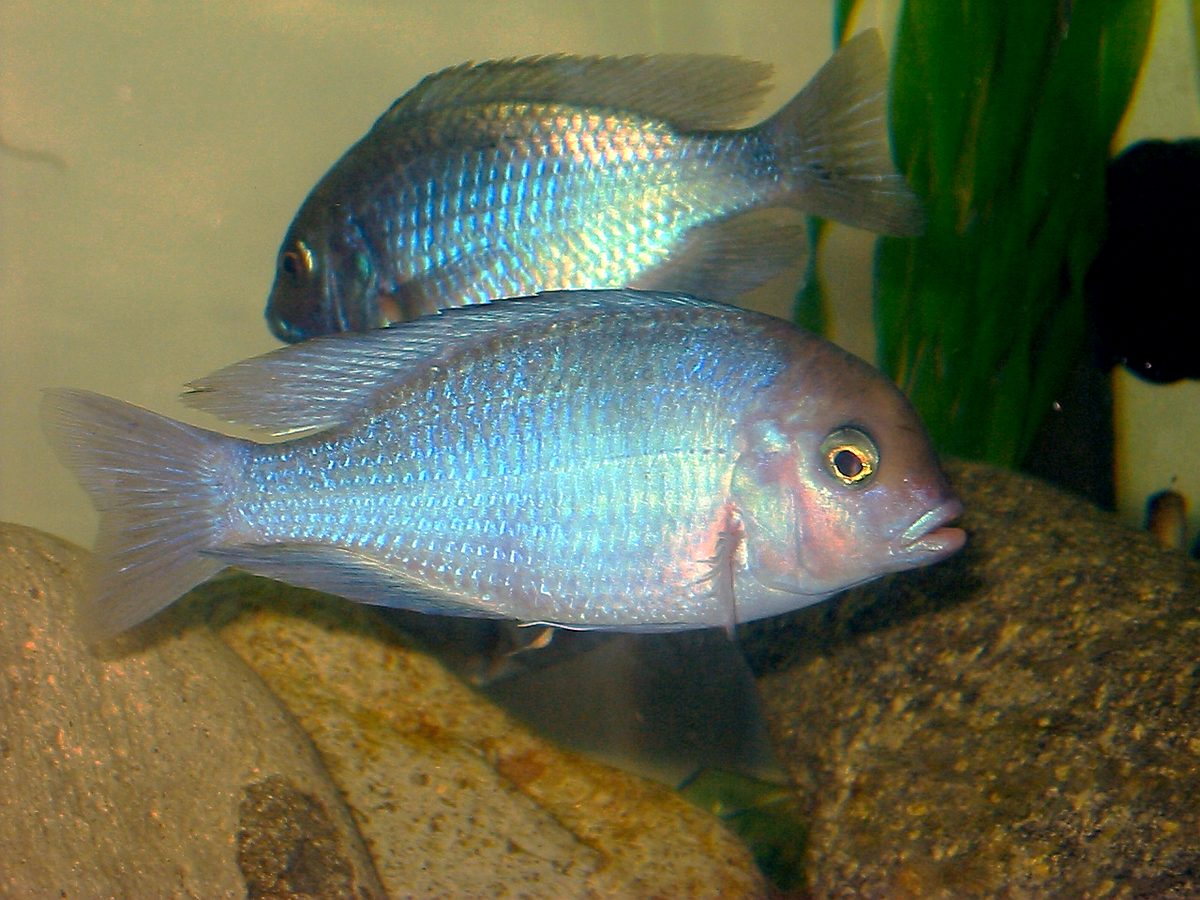
Blue dolphin cichlid
A large and surprisingly peaceful Malawi cichlid. It grows to 25 cm, so the tank has to be 300 l and up and at least 150 cm long.
| Temperature | 25–28 °C (77–82 °F) |
|---|---|
| pH | 7.5–9.0 |
| Hardness | 10–25 °dGH |
| Volume | from 300 l (79 gal) |
| Size | up to 25 cm (10 in) |
| Lifespan | 10–15 years |
What it is and where it comes from
The blue dolphin lives only in Lake Malawi, in the African Rift Valley. It stays near sandy shallows down to 15 metres, usually in small shoals.
The species was described in 1902 and reached aquariums half a century later. It used to be called Haplochromis moorii and is now placed in Cyrtocara. The dolphin name comes from the fatty pad on the forehead, which grows with age in both sexes but is bigger in males. In the wild it follows sand-sifting cichlids and picks up what they stir loose.
Housing and conditions
It needs 300 l (79 gal) or more, at least 150 cm (59 in) long. The fish is large and swims a lot; in a short tank it knocks against the glass.
| Parameter | Value |
|---|---|
| Temperature | 25–28 °C (77–82 °F) |
| pH | 7.5–9.0 |
| Hardness | 10–25 °dGH |
| Volume | from 300 l (79 gal) |
| Size | up to 25 cm (10 in) |
| Lifespan | 10–15 years |
The water is hard and alkaline, as in Malawi. Sand is essential: the dolphin sifts it through its gills, and coarse gravel injures them. Rocks go around the perimeter, open water in the middle. Plants are pointless: they get dug up, though anubias on stone sometimes survives. Filtration powerful, changes 25–30% weekly, flow moderate. A lid is needed, a startled fish jumps. Work out the volume in the calculator.
Feeding
A micro-predator: small invertebrates, larvae, crustaceans. In the tank, high-protein cichlid pellets plus bloodworm, prawn, brine shrimp and fish pieces. Feed 2–3 times a day in small portions.
Overfeeding is more dangerous in Malawi cichlids than in most fish. Swollen belly, lethargy, no appetite, white stringy faeces: that is bloat coming on. Next it lies on the bottom and dies. Beef heart and fatty meat are out, as digestion cannot cope. Better slightly hungry than full.
Lifespan
10–15 years. The dolphin grows slowly, reaching full colour and a noticeable hump by about three years, worth knowing when buying a juvenile. A cramped tank with dirty water cuts the figure.
Temperament and tank mates
Peaceful for a Malawi cichlid, sometimes timid. Pick tank mates by size and temperament: aulonocara, utaka, frontosa, synodontis catfish. Do not keep the dolphin with mbuna, whose aggression wears it down.
Keep it in a group: one male and 3–4 females. Two males only get along in a very large tank. The dolphin does not chase small fish, but the company is still a bad idea: it frightens them by size alone.
Diseases
Malawi bloat. Swollen belly, no appetite, white faeces, the fish hanging near the bottom. The cause is diet and water, and a vet prescribes treatment.
Ich. White spots, rubbing against stones, rapid breathing. Raise the temperature gradually and add a parasite remedy as directed.
Bacterial infection. Red patches, cloudy eyes, torn fins. Start with water tests and changes.
Injuries. The dolphin is timid and in a panic hits decor and glass. Decor without sharp edges and calm neighbours help.
Only a vet can diagnose exactly; blind antibiotics do harm.
Breeding
The female carries the eggs in her mouth. The male cleans a flat stone or a pit in the sand, the female lays 20–90 eggs and picks them up at once. Incubation takes about three weeks, and all that time she does not eat. The fry are large but grow slowly. Breeding is considered difficult: the sex of young fish is not visible, and stress makes the female drop the eggs early.
Who it suits
An experienced keeper with 300 l (79 gal) or more and stable alkaline water. For a beginner it is hard: the fish is large, timid and sensitive to nitrate. Drawbacks: slow growth and demanding filtration. The plus is a calm temper next to mbuna and unusual behaviour. For a Malawi tank it is a good pick. More articles in the reference.
The calculator works out water volume, weight, filter load and how many fish your tank can carry.
Open the calculator