
Severum
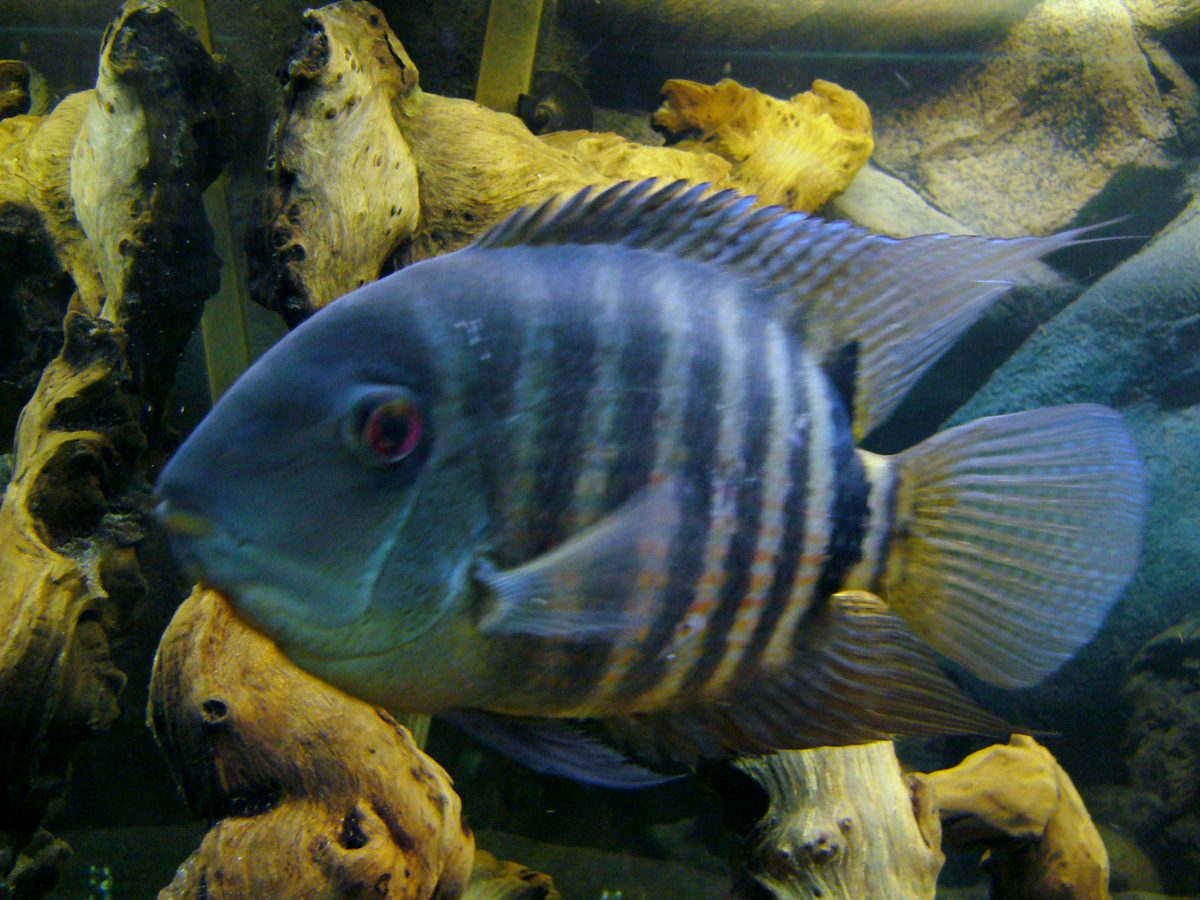
The severum looks like a discus but is far easier to keep. It grows to 20 cm and lives more than 15 years, so it needs a serious tank.
| Temperature | 22–28 °C (72–82 °F) |
|---|---|
| pH | 6.0–7.5 |
| Hardness | 4–12 °dGH |
| Volume | from 200 l (53 gal) |
| Size | up to 20 cm (8 in) |
| Lifespan | 10–15 years |
What it is and where it comes from
The severum comes from South America: the Amazon, the Solimões, the Orinoco and the Rio Negro, and rivers of Brazil, Guyana, Colombia and Venezuela. It likes still water with driftwood, shaded backwaters and oxbow lakes. The tall, flattened body earned it the nickname false discus.
Johann Natterer caught the first specimens between 1817 and 1835, and Johann Heckel described the species in 1840. The name severus refers to its northern origin: the fish was found further north than other cichlids. Heros has been revised many times since, and the trade name now covers green, gold and red-shouldered forms as well as red pearl.
Housing and conditions
An adult needs 200 l (53 gal) and 120 cm (47 in) in length. A pair lives in 150 l (40 gal), but swimming room is short and the fish falls ill more often.
| Parameter | Value |
|---|---|
| Temperature | 22–28 °C (72–82 °F) |
| pH | 6.0–7.5 |
| Hardness | 4–12 °dGH |
| Volume | from 200 l (53 gal) |
| Size | up to 20 cm (8 in) |
| Lifespan | 10–15 years |
Sources disagree on water. Foreign references want soft, acid water at pH 5.5–7.0 and hardness up to 8; keepers in Russia run 6.8–8.0 and GH up to 20. Both are right: farmed fish take a wide corridor, wild-caught ones need soft water. Flow gentle, light dim, sand substrate. The severum eats plants, so only tough-leaved species with roots held by stones survive. Change 20–25% weekly; the calculator works out volume.
Feeding
Omnivorous: algae, detritus, zooplankton, insects and fry in the wild. In the tank, cichlid pellets, bloodworm and prawn plus plant food. Once a week give blanched peas, spinach or spirulina, or the fish chews the shoots.
Feed 1–2 times a day. Overfeeding shows as a swollen belly, a fish hanging near the bottom and long whitish droppings. Constant overfeeding is common, and owners miss the weight gain. Never offer beef heart: the severum cannot digest fat.
Lifespan
10–15 years, more than 15 in good conditions. Longevity depends on volume and water stability. The severum is timid, and where it is bullied it lives noticeably shorter.
Temperament and tank mates
Peaceful as cichlids go, but size matters: anything that fits in its mouth gets eaten. It gets along with oscars, large cichlasomas, metynnis silver dollars and plecos, and not with goldfish, livebearers, tetras or neons.
Calm with neighbours, not with its own kind: a pair guards territory and chases other severums. A single fish often turns out meaner than one in a group, so advanced keepers house a pair or several together.
Diseases
Hexamitiasis. White stringy faeces, sunken belly, no appetite, later pits on the head. Water and diet first, then a vet's prescription.
Ich. White spots, the fish rubs on driftwood and stones. Raise the temperature gradually and add an antiparasitic product as directed.
Bacterial infection. Cloudy eyes, red patches, ragged fin edges. Water changes and tests first, medication after.
Obesity. Swollen belly, low activity. Fasting and more plant food help.
Only a vet can diagnose exactly, and blind antibiotics do harm.
Breeding
A pair forms out of a group of young fish, often while still juvenile. Spawning is on a flat stone or driftwood; the female lays 300 to 1000 eggs, and the parents guard and fan the clutch. They lead the fry for weeks, and in some pairs the young feed on skin secretions first. Fresh, slightly softer and more acid water triggers spawning.
Who it suits
A beginner with 200 l (53 gal) and up: the fish forgives mistakes, eats anything and does not fight without reason. The main drawback is plants, since a severum destroys live bushes. The second is timidity: without cover it pales and hangs in a corner. For a peaceful large inhabitant, it is a good choice. More articles in the reference.
The calculator works out water volume, weight, filter load and how many fish your tank can carry.
Open the calculator